Cam chain tension adjustment procedure, clarified [CB/CL/SL350, DOHC CB/CL450, DOHC CB500T]

ancientdad

Administrator
Staff member
Joined
May 22, 2020
Total Posts
35,540
Total likes
12,822
Location
Nature Coast, FL
A few instances of VHT members' accidental misinterpretation of the proper cam chain adjustment procedure for the DOHC 450 have come up recently, and it seems they have been caused by the visual of a moment from a video by those guys in Houston showing the adjustment. It's interesting that no words were spoken in the video directly describing the very moment that caused this misunderstanding, because when those guys in Houston misinform people about adjustment specs or proper procedure they usually accompany it with discussion about why they think it's "better" despite the often-significant deviation from the FSM. No, in this case they simply said "alright, that's it, you just tighten it back down again, it's an automatic cam chain adjuster" - except they didn't just tighten it back down. They only tightened the tensioner lock bolt finger-tight immediately after saying to tighten it back down, the very lock bolt they needed a wrench to loosen only a half minute prior.

I'm not posting their video, but you can view the segment in question here.

To be completely clear, this is the correct procedure:

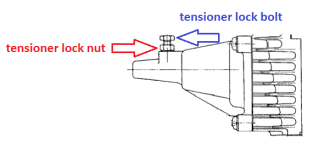
First, position the crankshaft at 90° past LT on compression stroke, then loosen the tensioner lock nut, then loosen the tensioner lock bolt. The spring-loaded adjuster will tension the chain. Then, without moving the crankshaft, first tighten the tensioner lock bolt to secure the adjustment position, then tighten the tensioner lock nut to secure the tensioner lock bolt.
1758913105070.png
 
Last edited:
A few instances of VHT members' accidental misinterpretation of the proper cam chain adjustment procedure for the DOHC 450 have come up recently, and it seems they have been caused by the visual of a moment from a those guys in Houston video showing the adjustment. It's interesting that no words were spoken in the video directly describing the very moment that caused this misunderstanding, because when those guys in Houston misinforms people about adjustment specs or proper procedure they usually accompany it with discussion about why they think it's "better" despite the often-significant deviation from the FSM. No, in this case they simply said "alright, that's it, you just tighten it back down again, it's an automatic cam chain adjuster" - except they didn't just tighten it back down. They only tightened the tensioner lock bolt finger-tight immediately after saying to tighten it back down, the very lock bolt they needed a wrench to loosen only a half minute prior.

I'm not posting their video, but you can view the segment in question here.

To be completely clear, this is the correct procedure:

First, position the crankshaft at 90° past LT on compression stroke, then loosen the tensioner lock nut, then loosen the tensioner lock bolt. The spring-loaded adjuster will tension the chain. Then, without moving the crankshaft, first tighten the tensioner lock bolt to secure the adjustment position, then tighten the tensioner lock nut to secure the tensioner lock bolt.

View attachment 50328
Just wanted to ask for my own clarification was well, that those guys in Houston video in question I believe says to go a little farther than 90 degrees past LTC, I believe they suggest this because there is a sweet spot around say 100 degrees past that all of the valve rockers are loose and all valves are completely closed. Is 90 degrees truly the appropriate rotation, or is the “sweet spot” better. Obviously the manual states 90 degrees and those guys in Houston takes some liberties with the manual, but in a way having all the rockers slacked for the chain adjustment does make sense to me. I just want to know what the exact right answer is! Thanks!
 
Just wanted to ask for my own clarification was well, that those guys in Houston video in question I believe says to go a little farther than 90 degrees past LTC, I believe they suggest this because there is a sweet spot around say 100 degrees past that all of the valve rockers are loose and all valves are completely closed. Is 90 degrees truly the appropriate rotation, or is the “sweet spot” better. Obviously the manual states 90 degrees and those guys in Houston takes some liberties with the manual, but in a way having all the rockers slacked for the chain adjustment does make sense to me. I just want to know what the exact right answer is! Thanks!
I wouldn't argue crankshaft position over 10° or so simply because you can watch the valves and check the followers for the best exact position, of course it makes sense.
 
I wouldn't argue crankshaft position over 10° or so simply because you can watch the valves and check the followers for the best exact position, of course it makes sense.
Gotcha! So the idea is to find the spot where all the rockers are free and valves are closed. And that should occur somewhere around 90 degrees give or take?
 
Gotcha! So the idea is to find the spot where all the rockers are free and valves are closed. And that should occur somewhere around 90 degrees give or take?
Yes, and remember that the goal is to remove any camshaft resistance (opening valves) from the cam chain tension so the tensioner can accomplish its job fully as designed.
 
A few instances of VHT members' accidental misinterpretation of the proper cam chain adjustment procedure for the DOHC 450 have come up recently, and it seems they have been caused by the visual of a moment from a video by those guys in Houston showing the adjustment. It's interesting that no words were spoken in the video directly describing the very moment that caused this misunderstanding, because when those guys in Houston misinform people about adjustment specs or proper procedure they usually accompany it with discussion about why they think it's "better" despite the often-significant deviation from the FSM. No, in this case they simply said "alright, that's it, you just tighten it back down again, it's an automatic cam chain adjuster" - except they didn't just tighten it back down. They only tightened the tensioner lock bolt finger-tight immediately after saying to tighten it back down, the very lock bolt they needed a wrench to loosen only a half minute prior.

I'm not posting their video, but you can view the segment in question here.

To be completely clear, this is the correct procedure:

First, position the crankshaft at 90° past LT on compression stroke, then loosen the tensioner lock nut, then loosen the tensioner lock bolt. The spring-loaded adjuster will tension the chain. Then, without moving the crankshaft, first tighten the tensioner lock bolt to secure the adjustment position, then tighten the tensioner lock nut to secure the tensioner lock bolt.

View attachment 50328
Does this procedure apply to the CB72/77 ?
 
Does this procedure apply to the CB72/77 ?
While it is similar with respect to the hardware, I'll let those more familiar with them go further. I will say the tensioner assembly and operation is essentially the same.
 
As someone who destroyed my engine following those boys from Houston's video instructions, I really appreciate you making a proper post about this. It was heartbreaking hearing that crunch inside my engine after I foolishly tried to ride it in spite of my better instincts because I could hear cam chain clatter. I bet I could have gotten at least a few thousand more miles out of that engine if not more if I had stuck to the FSM on this one.
 
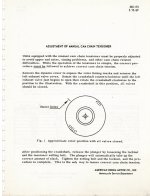
I ran across this a few years ago.
I hadn't seen the actual service bulletin until a few years ago myself, but Honda didn't strongly emphasize the setting (lock) bolt being securely tightened. Like so many things handed down by word of mouth among casual participants, the message got diluted to the point that the video from those guys in Houston was sloppy in their mentioning points of true importance.
 
Back
Top Bottom