A meticulous restoration of a CB72 '67 (and a SS50Z K3)

Try heating the outer leg about the area where it is sticking (after getting all the gas and fumes out of course) with a heat gun and see if that helps.

 
Try heating the outer leg about the area where it is sticking (after getting all the gas and fumes out of course) with a heat gun and see if that helps.
yes, but after ALL gasoline fumes are gone (flushing with cheap oil after flushing with gasoline). I have a grease gun ready for pushing the fork out if necessary.
 
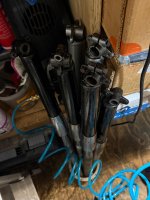
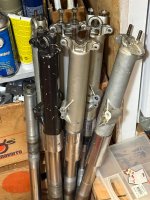
Since I'm stuck at the blue CB72'62 front forks, it was time to collect all my early front forks to find another useable one. There are two types of early front forks (both called type 1), one for the '61/'62, and one for the '63/'64 bikes, both have steel bottoms. The ones after 1964 have the later type (type II) with the aluminium bottoms. I needed a left fork for my '62, and luckily I had a few spares.

WhatsApp Image 2026-02-28 at 22.07.37 (1).jpeg

All the chrome bushes are hand-tight now, the result with perseverance, penetrating oil and a little luck now and then (and a little swearing). While I was at it, I also found a bunch of CB450 K0 front forks, so I decided to take them apart too, to see what parts are useable and what not.

WhatsApp Image 2026-02-28 at 22.07.37.jpeg

Some are in really bad shape, even cut chrome bushes and broken alumnium threads.

Now, there are front forks, springs, shrouds and other front fork parts everywhere, time to register and label them for adding to my inventory list.

WhatsApp Image 2026-02-28 at 22.07.37 (3).jpeg

WhatsApp Image 2026-02-28 at 22.07.36.jpeg

WhatsApp Image 2026-02-28 at 22.07.37 (4).jpeg

I also cleaned the carburetors of my CB450 K0, and will put them back on the bike tomorrow. The weather is getting better, so time to assemble the bomber as well (I take off a few parts from the bomber during the winter like the mufflers, odo, carburetors air filters etc).
 
Last edited:
Since I'm stuck at the blue CB72'62 front forks, it was time to collect all my early front forks to find another useable one. There are two types of early front forks (both called type 1), one for the '61/'62, and one for the '63/'64 bikes, both have steel bottoms. The ones after 1964 have the later type (type II) with the aluminium bottoms. I needed a left fork for my '62, and luckily I had a few spares.

View attachment 55545

All the chrome bushes are hand-tight now, the result with perseverance, penetrating oil and a little luck now and then (and a little swearing). While I was at it, I also found a bunch of CB450 K0 front forks, so I decided to take them apart too, to see what parts are useable and what not.

View attachment 55547

Some are in really bad shape, even cut chrome bushes and broken alumnium threads.

Now, there are front forks, springs, shrouds and other front fork parts everywhere, time to register and label them for adding to my inventory list.

View attachment 55548

View attachment 55549

View attachment 55550

I also cleaned the carburetors of my CB450 K0, and will put them back on the bike tomorrow. The weather is getting better, so time to assemble the bomber as well (I take off a few parts from the bomber during the winter like the mufflers, odo, carburetors air filters etc).
You have so many Honda spares, you should open a shop (y):)
 
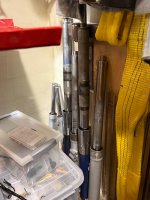
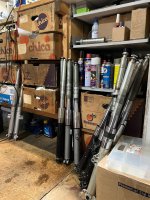
I woke up at 4.30 this morning, and couldn't catch sleep anymore (probably because went to bed too early), So I went to the shed after breakfast and a dark hour walk, were I got carried a little away with the front forks, today I took everything apart (unfortunately, 2 front fork assy's are not cooperating), cleaned them, measured them, same with the CB450 K0 forks.

It seems that I have 3 sets of type 1 '61/'62 front forks, 2 sets of type 1 '63/'64 (and a L/H NOS assy), 3 sets of CB72 late forks, and 4,5 sets of CB450 K0 front forks, and parts are in really bad shape, like this one:
WhatsApp Image 2026-03-01 at 21.56.46 (1).jpeg

WhatsApp Image 2026-03-01 at 21.56.46.jpeg

WhatsApp Image 2026-03-01 at 21.56.46 (2).jpeg

And as usual, against my better judgment, I ask myself WHY ? and HOW ?

At least the CB72 '66 has two NOS front fork legs, cleaned, and filled with oil, ready for use. At the background of this project, I'm working parralell on a blue CB72'61/61, in-between model, and it seems that I can make at least one good set out of that pile of forks. Since I have my own lathe at home, I bought some material to make new bushings / guides, for the forks.

My wife had left the building today (playing saxophone), so I finished the CB450 K0, and did ride the bike first time this season. It wasn't a long ride, since an oil leak developed (gasket of the dynamo cover), dripping oil once in a while, and I hate that. The last time I was in there, I used the old gasket again (I know, my own fault).
 
Last edited:
And as usual, against my better judgment, I ask myself WHY ? and HOW ?
It's always a question worth pondering, but also one we will never know the full answer to. Some of the damage we encounter is fairly easily explained (not justified of course, but explained because of all that we see here with others' bikes also neglected or damaged by POs), but there will always be mysteries because no matter how much anyone of us has seen previously, there will always be something more unusual and bizarre waiting out there to be discovered. And as many have said before, if only these bikes could talk.
 
Are you planning to repair these forks, I would imagine welding the drain hole will be tricky as you don't want any excess inside the fork.
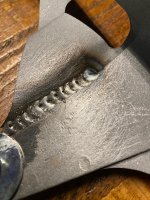
 
Are you planning to repair these forks, I would imagine welding the drain hole will be tricky as you don't want any excess inside the fork.
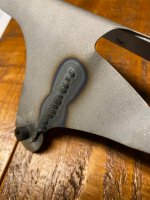
Not sure yet, but since I have plenty, it's not a today's problem. I regret throwing away damaged parts 30 years ago, and since technologies evolve and make it sometimes easy to repair that wasn't possible or very expensive. So, I will keep it, clean it, and blast it and add it to my parts inventory list under CB450 K0 / used / damaged, with a short description of the damage. At the moment this list is getting longer because I'm ready with labeling and organizing NOS parts, and busy with the used parts. For example, there are already over 100 CB450 rockers, dozens of intake and exhaust cams and many cam chain guides present.

Beyond repair should be re-defined, as beyond repair now, You never know what is possible, technically and/or financially tomorrow.
 
Last edited:
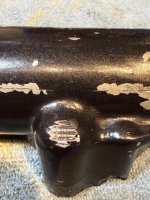
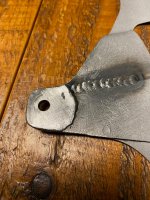
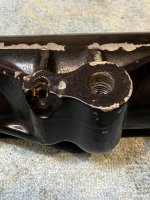
A few weeks ago I brought one of my chain covers (broken, as usual) to a welder, and he did a nice job making the chain cover stronger. I hope this will hold up in time, but not sure. It's not the quality of the cover, but a design flaw from Honda. These chain covers are prone to brake at the rear end. I have 6 out of 9 broken chain covers, this one was in good shape, just a crack.

WhatsApp Image 2026-04-13 at 11.21.59.jpeg

WhatsApp Image 2026-04-13 at 11.22.16.jpeg

WhatsApp Image 2026-04-13 at 11.22.32.jpeg

WhatsApp Image 2026-04-13 at 11.22.43.jpeg
 
Seems most models with a steel chain cover (inclusive of all models) have a problem in that area. All of my 450 guards have been welded at least once.

As to root cause, I can’t decide if it’s engine vibe, wheel imbalance, chain link (engage/disengage) ripple vibe as the root cause.
 
To put it in perspective in engineering terms, steel has a fatigue life on the order of 10E8 (10 with an exponent raised to 8) cycles in a S-N (stress - strain) flexure format. To reach that number, input in this case is considered high cycle fatigue, HCF, hertzian in nature. That is, cycles per second vibration.

Another form is low cycle fatigue, LCF, that is a high force load. But the picture evidence doesn’t show the bending signs associated with LCF.

So, unless either vibe changes or material geometry (such as thickness, heat treat condition, bracing, loose fastener, etc) the fracture will keep happening. Jensen knows this and his projected use cycle likely will stay underneath the fatigue point making his repair appropriate.

Jensen, feel free to add your own experience/expertise!
 
After the front fork's, it's back to the electrics again. Like I mentioned earlier, it's not my favorite, but without it, the bike will never be reliable.
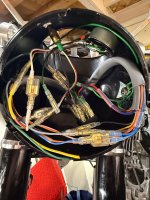
Yesterday evening I connected everything in the headlight shell, and after a few steps back and forth, I'm happy with the result:

WhatsApp Image 2026-04-22 at 13.30.56.jpeg


WhatsApp Image 2026-04-22 at 13.30.57 (1).jpeg

This pictures contains over 12 hours of work. This time is used mainly to:

- Grouping / bundling of wires that connecting to the cable
- Routing of the cables in a way that there is freedom of operation
- Determine ideal length of individual wires in a way that over-length is avoided
- Making connectors to the cables

And as usual, making a few mistakes, or "no, this won't work, it has to be different" moments, takes an hour of 2 -3 to.

But, luckily our brains are programmed in a way that (after a few weeks) the recollection is that it was worth the trouble.

Everything works (lights, winkers, break switches, break light, parking light, starter relays, speedometer back lights, tail light etc) all relays are switching, ground is solid, and it fits in the head light shell. I have to attach the cables for the front brake, rev counter and speedometer, but looking at the space I got, it won't be an issue.

There are two spare wires, (yellow and green), the pink wire is for the front brake switch (cable operated).
 
The cylindrical component with the white, green, black/white, brown/white wires is a relay?

It looks like you are repurposing an existing hole in the shell for that component? Am I seeing that correctly in the parts fiche?
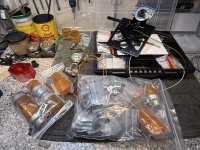
 
The cylindrical component with the white, green, black/white, brown/white wires is a relay?

It looks like you are repurposing an existing hole in the shell for that component? Am I seeing that correctly in the parts fiche?
No, it's the 5-wire headlight switch, standard on the CB72/77 in Europe. the US has the 4 wire switch (difference is the parking light).

The relays (3 of them) are visible in the center of the image, a black block with lot's of wires attached to it. One relay for switching on the power to the headlight, and the other two for switching Hi/Low. I could use two relays for the logic, but then I need another type, and I don't want that. this way i only need 1 spare relay in my toolbox, so one size fit's all ;)
 
Last edited:
Teh front is ready, everything works like it should, including the headlight (the headlight fitted easily), so this weekend I wanted to finish the tail light section, and rear winkers.

IMG_0548 groot.jpeg

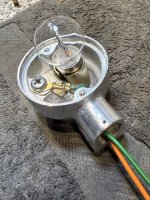
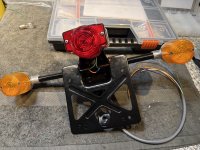
I started with the taillight and soldered 2 new wires to the bulb holder. I also made a ground for the taillight (green wire), that will be connected to the ground in the harness.

IMG_0551 groot.jpeg

I used the back plate of the taillight for the main ground, the other two green wires are from the winkers, I gave them their own ground and connected it to the taillight backplate too.

IMG_0549 groot.jpeg

It was't easy to fit the extra wire, but I managed to push the two wires through the rubber grommet that keeps water out.

IMG_0550 groot.jpeg

And after a few hours of work, it's finished.

IMG_0552 groot.jpeg

I added a led bulb for the taillight, the same type as on my CB450 K0. It is proven reliability, since the tail light is still working on my CB450 K0.
 
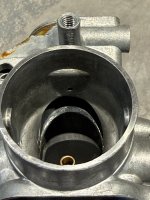
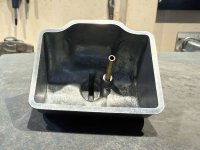
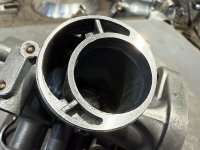
Starting with the engine, to be more precise, the carburetors. The ones that came with the bike are the original ones, with the power-jets. After looking at the carburetors (cleaned with ultrasonic bath a few years ago), I was hoping that these had straight surfaces, but as usual, nothing is flat and straight anymore, so time to get the sandpaper out and straighten all important surfaces.

Starting with the hardest one, the flat side with the holes for the bolts. It was hollow, to be precise, more then 0,4 mm, which is way too much. But before I could put the carburetor on the lathe, I needed to straighten the other surface first. I was very, very careful with the lathe, because the aluminum is very brittle.

WhatsApp Image 2026-05-17 at 13.52.59 (1).jpg

WhatsApp Image 2026-05-17 at 13.52.59.jpeg

Not perfect jet, but acceptable. I also opened up the holes for the treads, these were also damaged due to way to much force from the nuts that pushed the aluminum inwards. Since the actual sealing is with an O-ring, I call this one Ok-isch

WhatsApp Image 2026-05-17 at 13.52.58.jpg

Since I don't like leaking float chambers, I straightened these too, now perfectly flat.

WhatsApp Image 2026-05-17 at 13.52.58 (1).jpg

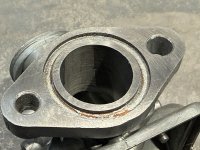
I also flattened this part, important due to air leakage. I don't want to go further, but not the whole surface is at the same level, but this will be good enough.

I went from 280 to 400, to 800, to 1200 sandpaper, now the CB72 carbs are ready to install, as is the C77 carburetor.
 
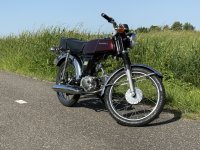
The weather is very nice here in the Netherlands the past days, so time to neglect the garage, and ride ! Yesterday I took the SS50Z K3 to my work, since it's 60 km oneway, it was a long, long day, but the bike performed pleasantly smooth, combined with a good mileage (46 km/l / 108 MPG). Since it's a small bike, I had to take a break somewhere in the middle, so time for a decent picture.

IMG_0697 groot.jpeg

The moped did well, but I adjusted the needle just one groove higher, for smoother running. I think it needs a larger main jet as well, just to be sure. Although spark plug looked fine, it's better for these small bikes to run a little richer, especially with this weather, since the cooling is minimal.

The front fork is way too soft, and bottoms out sometimes, so I need to increase the fluid hight, and maybe change the swings itself, but first try the simple things.

The tires are Michelin Anakee road, (a "little" over the top for these little bikes) , but with these small versions they are relative cheap, so a good quality/price balans, and a perfect cornering guarenteed.
 
Last edited:
Back
Top Bottom