'66 Black Bomber Engine Overhaul

baananaz

Member
Joined
Jun 1, 2020
Total Posts
27
Total likes
0
Location
Brussels
Hello everyone,

I thought given the state of the engine right now it might be best to make a log thread, since i always have a few questions and I think it's better than to inundate the other sections.

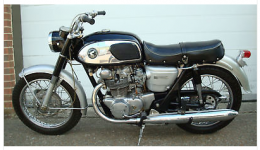
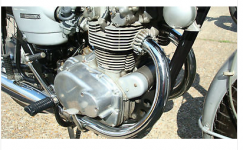
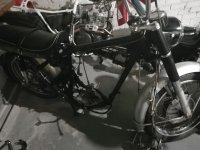
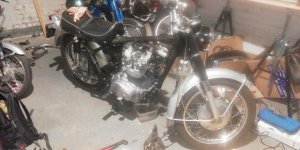
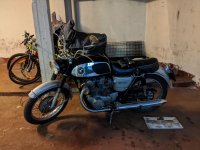
So first of all, a little history and a few pictures! I got this bike in the summer of 2018 from the UK. Here are a couple pics from the ad at the time:
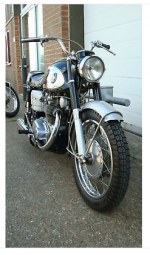
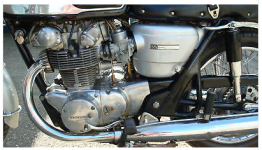
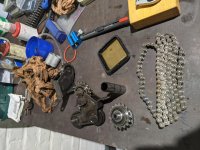
36241058_10155394478891790_7033943188486225920_n.png36276979_10155394478901790_5189111480515035136_n.png36294282_10155394478886790_5077288652594216960_n.png36354287_10155394478906790_323652822572728320_n.png

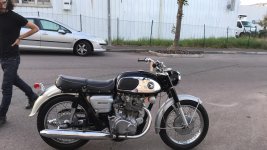
And here it is once it got to me:

37683845_10156684833415820_4549289837357694976_n.jpg

Unfortunately due to my work circumstances and moving countries I wasn't able to actually use it until a year later - last summer where I found a very good mechanic here in Brussels that took a thorough first look at it and fixed a few things (news tires, clutch plates, fork bearings, repaired tach and a general normal tune-up - cleaned carbs, oil change, etc.) which allowed me to take it out during the summer.
He did tell me right away he thought the noise the engine was making wasn't quite like his other bombers (of which he has two) and that I should keep it in mind, if it ever changed to let him know and that we might have to open her up to see what's up.

After about 700km ridden (at a very relaxed pace) I returned it to him for another quick check-up - I am very new to bikes in general and trust him much more than I do myself. He took it for a ride and let me know that he really thought the engine should be opened. Not only because of the noise, but also because we didn't particularly know how the bike was treated by the PO and if I planned on having a reliable bike for the future it seemed like the right thing to do.

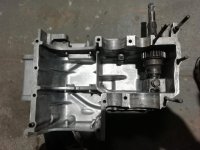
What we first found out was that the engine case was full of metallic sludge (which we still don't know where it came from as no parts were so ruined that they would cause so much sludge):

IMG-20200126-WA0006.jpg

And a few parts he recommended I change:
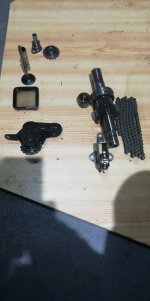
IMG-20200130-WA0000.jpg

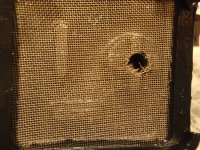
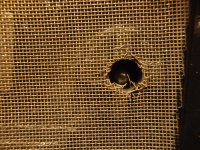
So the oil pump filter had a pretty sizeable hole in it; the cam chain tensioners had a lot of play in them. The transmission shaft and bush bearing were almost ruined (the exhaust hole from the bearing was clogged with loctite and nothing was getting out... completely ruined the shaft). Pistons pins were extremely used and one of the inlet valves also. But everything else seemed alright at the time.

Of course more problems crept up after opening the crankshaft and realizing it was also probably ruined! And the bearings were completely shot.The picture isn't very sharp but you can see the condition of the end here:
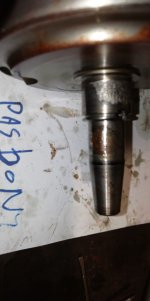
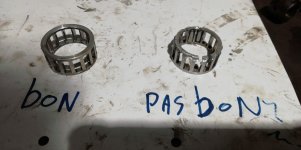
IMG-20200211-WA0001.jpg IMG-20200211-WA0000.jpg

Luckily, the very next day another one was found in the US for another very reasonable price, and as per Chris' recommendation I decided to also get that one for the future. Better safe than sorry! We ended up speaking quite a bit with Chris and as you all know his knowledge is invaluable on bombers.

He recommended a nice fix for the oil pump filter, which apparently is a common problem due to the very localized way the oil pumps out of it and damages the screen. He also recommended I change the rectifier for a more recent one as the olds ones are pretty much useless at this age and it was flatting my battery.

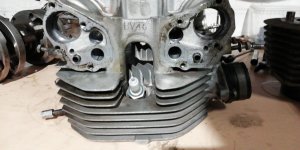
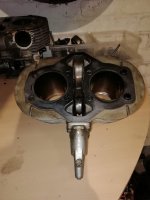
It turns out also that the pistons on the engine are from later models, and apparently were damaging the cylinder head (?) which seems surprising to me as I didn't think an engine could be running very long in those conditions. My mechanic was proposing to machine the head to make more clearance and avoid the problem (he is confident he can do it properly) but I am personally a bit more skeptical as I understand pistons should be interchangeable and I'd rather know exactly why the pistons were damaging the head before machining it. I will try to post more pictures the next time I go there but we can clearly see on the cylinder head a ring where the pistons were touching it. If anyone has an idea of what could be causing that I'd be very interested in hearing different theories.

So what was supposed to be a verification check-up turned out to be a pretty major overhaul - and I trust my mechanic was right about the noise the engine was making and in the end I'm glad we opened it as I suspect it could have seriously ended much worse than it did so far.
And even though I bought it a while ago, I am also a little bit angry at the seller of the bike (a professional shop at that!) that assured me the bike was mechanically very sound when clearly it wasn't the case. If my mechanic spotted there was an issue from the sound right away they should have a well. But well, nothing much to do know except naming them (Unit 1 motorcycles in the UK).

So right now most of the replacement parts are here or on the way, I will update this post with any questions I might have and progress pics!
 
Last edited:
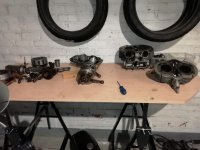
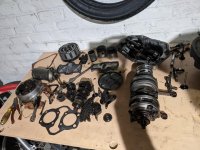
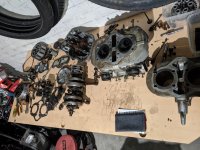
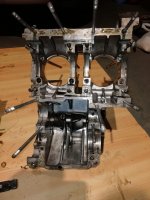
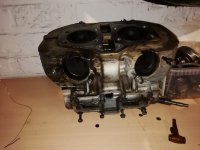
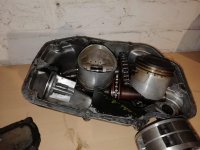
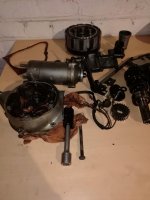
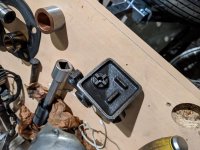
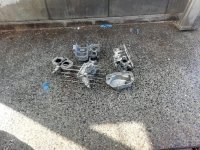
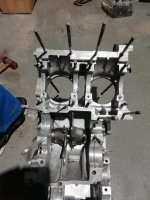
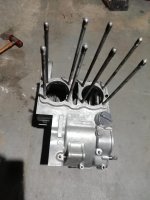
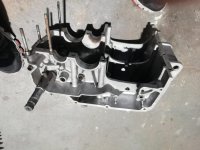
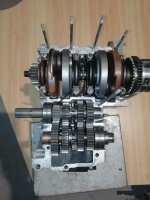
A few other pictures of the state of things right now and different parts from the engine:

IMG-20200126-WA0000.jpgIMG_20200131_172301.jpgIMG_20200131_172256.jpgIMG_20200131_164720.jpgIMG-20200207-WA0001.jpgIMG-20200126-WA0001.jpgIMG-20200126-WA0003.jpgIMG-20200126-WA0004.jpgIMG-20200126-WA0005.jpgIMG-20200126-WA0007.jpg
 
Brought everything to the garage today and should start putting it all together in the next week or so.
I still have to check the cam chain rollers side play tolerances against some measures ancientdad did from his to see if a replacement is warranted or not.

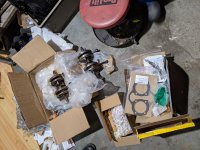
here's a picture of both crankshafts - the replacement one still in the box and the broken one outside as well as the box full of replacement parts.

IMG_20200311_202248.jpg

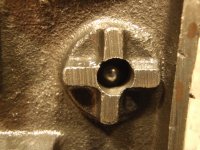
I will also rectify the oil pump as per Chris' recommendation. It consists of filing the exhaust side of it to spread out the pumped oil more evenly on the filter and avoid rupture (the angles of the crossed-shaped exhaust).

IMG_20200311_202240.jpg
 
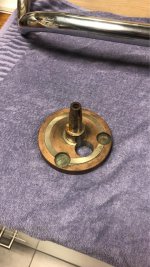
I found the damaged part of my old crankshaft for sale NOS (I attached a picture).

I would like if possible to refurbish my old crankshaft to keep as a spare, or it might end up helping someone in need.

I suppose the old crankshaft would have to be depressed and pressed back together, has anyone done it in the past? Would a good machinist be able to get it done?

91831166_2293897147379510_3890677179704410112_o.jpg

Any help or tips would be wonderful,

Many thanks!
 
A small update as this has been quite a slow project so far.

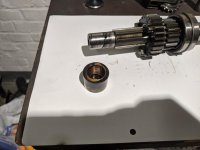
It turns out the bronze transmission bush bearing replacement that I got was from a later model, and was coated steel and not bronze. Not only is this not optimal due to the amount of wear the previous one had (if the same problem happened on a steel bearing the whole transmission would have been ruined as well as the crankcase) but also it turned out the OD was very slightly bigger. We measure 30.04 OD as opposed to the original bronze 29.94 (as provided by Jensen). So when we would put everything together and close the crankcase the transmission would simply lock up in place and not spin at all.

SO not only did the bearing have to be machined, but also the crankcase.

Apparently, this bike suffered quite a severe accident previously, perhaps the crankshaft, which completely ruined the crankcase. The bottom half was replaced, but not the top half - and these should always be pairs. The PO didn't pay attention that the two must match exactly. So my original crankcase also had to be slightly machined in order to accommodate the original OD bearing.

I am also now making sure that the crankshaft has the proper bronze washer that fit it specifically. After a very detailed conversation with Jensen it turns out there are slight differences in the three bomber crankshaft versions. After a thorough inspection and clean this will all go back together.

I will post pictures when I can and hopefully soon.
 
I will also rectify the oil pump as per Chris' recommendation. It consists of filing the exhaust side of it to spread out the pumped oil more evenly on the filter and avoid rupture (the angles of the crossed-shaped exhaust).

View attachment 744
would you mind expanding a bit on this modification (or show a picture of what the oil pumps looks like after the work has been done?). I am just curious :)
 
That oil pump base modification is a recall from Honda.

CB450 4-speed - 15-1.jpg
 
I found the damaged part of my old crankshaft for sale NOS (I attached a picture).

I would like if possible to refurbish my old crankshaft to keep as a spare, or it might end up helping someone in need.

I suppose the old crankshaft would have to be depressed and pressed back together, has anyone done it in the past? Would a good machinist be able to get it done?

Any help or tips would be wonderful,

Many thanks!

I'm not sure of the figure, but I believe it takes a 20 ton press to accomplish the crankshaft repairs - and the proper knowledge to do it as well. I have personally never known anyone who repaired a pressed together crankshaft, or had it done by anyone
 
That oil pump base modification is a recall from Honda.

View attachment 752


That is correct. And here is mine with the modification:

IMG_20200604_195601.jpg

Compared to before:

IMG_20200311_202240.jpg


The cases being cleaned (this was done a while ago but I just now got the pictures), as you can see, very professional job :)

IMG-20200604-WA0007.jpg

And the clean cases:

IMG-20200604-WA0006.jpg

IMG-20200604-WA0009.jpg

IMG-20200604-WA0011.jpg

So after machining the case, as well as the steel bush bearing to spec, everything was spinning smoothly. You can see the machined case (kind of) here:

IMG-20200604-WA0010.jpg


Everything in place with the steel bearing:

IMG-20200604-WA0003.jpg

So it was just a matter of getting the proper bronze bearing and not take any chances - as said before, had the same happened with a steel bearing there would have been much much more damage to the transmission, cases, and crank as the bronze absorbed much of the damage.

Meanwhile some minor repairs were done:

IMG-20200604-WA0002.jpg

You can can the engine fully assembled in the background just to be sure everything else was in place and fit properly.
And the poor thing waiting to have its engine back ;)

IMG-20200604-WA0015.jpg

For the crank, my mechanic confirms to my that at his shop he could press it back together, and I do trust him to have the know-how to do so, but it appears I got the wrong piece (283-050) but in the parts list, if the crank if from the original engine (s/n 5192) then I would need a 040, as there was three iterations of the bomber crank and they are all very slightly different. Although they should fit in any bomber, Jensen recommended not to start interchanging pieces between them, so for now it will stay as is, and if the time comes that I find the proper replacement part, I will see what to do.
 
Hi,

Progress!, You'll ride before the summer will set in....

This is what happens if you don't do the upgrade, I believe yours looked like that ....

P7050047.JPG

Unmodified pump

P7050048.JPG

As good as no filter at all

P7050049.JPG

or even worse, because the steel wire will be sucked in and find a place in the crank, waiting for a chance to leave it via the main bearing or big-end bearing.....
I think I found 2 or 3 engines like this. That's why my advice is to always go through the engine before riding it after buying, you never know it's history.

I don't bother to do the upgrade on the pump itself, and standard push a K1 pump in the engine.

Jensen
 
Let's hope the ride begins soon enough!

Mine didn't look quite as bad, but pretty much useless nevertheless:


IMG_20200131_164405.jpg
 
I can only assume that's the old cam chain, but removed with the master link intact and staked. Hmmm...
 
Yes the old camchain was in good condition except for a good 3/8" distension from its original length - so its been replaced since the engine was open anyways.
 
It runs!
Engine runs well, some hesitation at idle, the carbs probably need a quick readjustment given the extent of the work done on it.
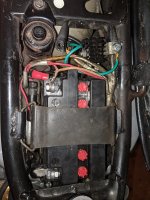
We did run into another problem - the battery doesn't seem to charge. All the different components are working properly so it is most likely a bad connection somewhere along the system. Everything is being checked and hopefully this will be fixed soon.

Here she is with the engine back on her, picture is crap but you all know the joy of such a sight after so many idle months :)

IMG-20200607-WA0000.jpg

Hopefully this weekend she will be out !
 
Small update on the bomber:

So far the engine is running smoothly, but still taking it slow and trying not to rev it too much until we readjust the carbs.
I do still have a charging issue.
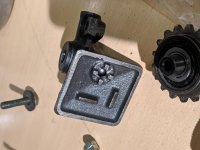
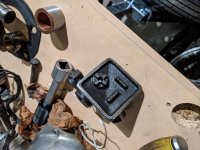
It turns out the rectifier was shot (both the original one that seemed to be working at first, as well as the replacement one I got from 4into1).
I don't know if I simply got unlucky and got a defective unit or if something on the bomber is blowing them up.

I got a couple of cheap replacements from an electronics store to help and troubleshoot the issue - I will keep the thread updated even if doesn't really pertain to the engine anymore.

Until then, a couple of pics - at least got her back in her spot, and on the first outing outside of Brussels :)

105541143_601486510784232_3041086797853656643_n.jpg

104047626_255209869090208_5878317747426098589_n.jpg

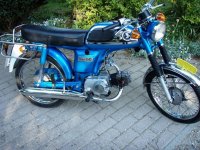
PS. Jensen, that's a 1968 SS50 ;)
 
Apparently everything is fine, except when it isn't :lol:

We are a bit at a loss on what to do for the electricals on the bomber.
Everything seems to be fine when measured separately, and there is a good output to the battery, but once all is connected (with a new rectifier, which is working) it seems the battery isn't getting charged...
Has anyone got an idea on what could be wrong at this point? We are thinking it might be the stator after all - but we are not sure, more testing needs to be done.
Very annoying issue to be getting now that the engine is rebuilt :cry:
 
Did you check the alternator output with the plug disconnected? And are you using a modern rectifier/regulator combo? If not, you should... the old rectifiers degrade with age and even a new rectifier isn't up to the capability of a modern combo unit
 
Hi,

Does the generator / rectifier not charge at all, or does it not charge enough ?

Time to measure and quantify your system

I assume you have a multimeter with the ability to measure currents up to 10 A or so, if so, you could do the following:

(Sorry, I'm a R&D physics engineer, thinking that everyone has a multimeter and can work with it)


Disconnect the + cable from your battery

You could connect a multimeter in throughput between the red power cable (connected to the battery +) and the + of the battery and measure the current (value and direction), it should be zero.

The plus of the meter onto the red cable, and the minus of the meter onto the + of the battery. Please be careful and tape-off the connections so they cannot short circuit with any other part !
If the current goes from the battery to the bike, the current is positive, if the current goes from the bike to the battery it should be negative. Now switch the multimeter so that it can measure a max of 1 A or so and write the value you measure down (with no key in your ignition switch).

Now setup the multimeter so that it can measure 10A.

Switch the ignition on, and again write down the total current and direction (engine not running, no lights on).
Switch the lights on and repeat the measurement (value and direction).

Switch the light off and start the engine with your kick starter (not with the electric starter !!!)

When the engine is running (idle), do the measurement again and write down the value and direction.
Run the engine at 4000 rpm, and do the measurement again, and write down the value and direction.

Repeat the two measurements above, but now with lights on, and write down the value and the direction.

Please share your measurements here.

I'm not really interested in the voltage value's, the current is what I'm interested in for now.

Jensen
 
Ancientdad: I am using a simple rectifier (100V and 25A from an electronics store, not a regulator/rectifier) but it is modern and working, still worth the switch?
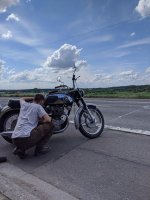
Jensen, thanks for your step-by-step, I do have a multimeter and will take these measurements asap and report back. Thanks!
 
So I set out to measure the current as per Jensen's post, but it appeared there was an extra cable arriving at the battery positive?
As per the wiring diagram it seems either this comes from the rectifier or the ignition? Could anyone confirm?

So in any case, I first tried to simply connect the multimeter between the positive cable and the battery positive while leaving that cable out, and nothing happened.
I suppose the circuit wasn't closed and therefore no current.

I then kept that cable (yellow-ish? hard to tell with the age) on the battery positive and connected the multimeter, motorcycle started and everything was normal except all the readings were at 0.00A.

I then connected the yellow cable to the battery positive cable (red) and connected the multimeter in between, and that finally worked.
Can you tell that I know nothing about electricity yet?;) But on the off chance someone out there is looking to do something similar, best to detail everything.

The readings are as follow (these are all averages as the value keeps shifting slightly):
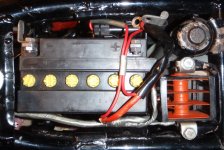
Everything off: +0.00A
Ignition on, lights off: -2.26A
Ignition on, lights on: -5.02A

Engine on, idle, lights off: -1.25A
Engine on, idle, lights on: -2.70A

Engine on, 4000rpm, lights off: +0.45A
Engine on, 4000 rpm, lights on: -0.47A

My take is that it's not charging nearly enough? Idling alone it's decharging 5 times faster than at 4000rpm? Or I am reading something incorrectly?

Looking for any input on these numbers and their meaning! Thanks
 
Hi,

Thanks for the readings. I tried to call you, but as you stated, you were in your garage :)
I'm curios where the yellow wire goes, or where it comes from. On my bomber there is no yellow wire.

There are supposed to be two red wires, or one small red wire with a black tube around it and a small red tube at the end, and a thick black wire also with a red tube on it at the end.
The small wire goes to your ignition switch via the fuse, the thick wire goes direct to your starter relay.

This is how it is supposed to be (disconnected the battery + in the picture):

battery area overview.jpg

It seems to be that your yellow wire is the thick wire, being the starter relays wire. That should always read 0 A (except when you hit the starter button), and cannot be measured with your multimeter because the current is way to high (when hitting the starter button).

rectifier closeup.jpg

The only yellow wire used in the bomber is connected to the rectifier.

I suppose you connected the generator colour to colour to the main harness ? (if the colours are faded or you're not sure if connected the right way, please reed Steve's classroom about generators)

Now the readings:

Everything off: +0.00A

That's good, no current leaking away when the ignition switch is off.

Ignition on, lights off: -2.26A
Ignition on, lights on: -5.02A


Both a little higher then expected, but probably because one of the points is closed, one of the coils is surging (that's why you should always switch your ignition off when the engine is not running)

Engine on, idle, lights off: -1.25A
Engine on, idle, lights on: -2.70A


Now the generator kicks in, and delivers a little power, but not enough, readings should be close to 0 (a little positive or negative, depending on the overall health of your system))

Engine on, 4000rpm, lights off: +0.45A
Engine on, 4000 rpm, lights on: -0.47A


The only way the generator gives enough power to "recharge" your battery is when the lights are off.
As soon as you switch your lights on, the system cannot recharge the battery, and your battery will discharge over time.

Next step is to check your output like described in Steve's classroom. If the readings are less then what Steve's classroom tell's you, your generator doesn't generate enough power.
Just chancing the rectifier for a more modern one like Ancientdad mentioned above adds another 0,5 to 0,7 A and could just do the trick, but still very weak. Chancing the tail light with an LED will help too.

For comparison, the system on my bike (100 % original) does deliver 0,75A@4000 rpm, lights on. That's significantly more and enough to keep the battery in good condition.

Jensen
 
Some news! And hopefully the last ones for a while;)

So I set to measure the AC coming out of the alternator to make sure everything was fine following 66Sprint's classroom.

First checked no continuity between all wires and engine case : good.
Checked continuity between each of them : good.

Then the AC readings:
Highest at 18.7 (should be between 17-20AC)
Middle at 14.4 (should be between 14-18AC)
Lowest at 5.5 (should be between 3-6AC)

So all were right on the mark. Alternator seems good.

At this point I didn't really know what to do, but we did meet up with a fellow black bomber owner and checked his readings and connections to see we could cross reference them. Well it turns out on his bomber the highest AC output was connected to the daytime circuit, and the lowest one (not ground) was on nighttime... The opposite of mine. For some reason it seemed logical to have the highest output cable connected to the nighttime circuit since it would consume more?

Well, we switched the two cables and everything is charging perfectly fine.

New readings are
+ 0.10A at idle.
and around + 0.75A with lights on at 3500-4000 RPM.

I don't recall exactly the other numbers but we were at around + 2.50A without lights and with some RPM.

IMG_20200710_202354.jpg

The little diagnostic setup that I'll be running with this weekend just to make sure everything is charging properly, although so far it seems like it.
On a small city ride I was averaging around +2A the whole way so hopefully the battery is now charging well.

That's it for now ! I can finally let go of some of the stress and enjoy this summer riding :lol:
 
Hi,

Good to hear, and your measurements are in line with my readings, so a healthy system !
Are the wires connected colour to colour ? Which colour is connected to the pink wire in the harness ?

With 2,5 A, lights out, and some RPM is nice to have, but a bit on the high side, depending if your battery is empty / full. I advice you to ride with lights mostly on.
If you ride the bike @7000 rpm or higher, with lights out, the battery can be overcharged, especially if you go for a long, fast ride.

Check the fluid levels of your battery on a regular base the first months.

The bomber doesn't have a voltage regulator, it's a balanced system, the generator output has to be in balance with the battery impedance (load), rectifier
Use only old fashioned acid/lead battery's on the K0, gel battery's or LIion battery's will disturb the balance of the system, and therefore destroy expensive battery. Next to that, modern battery's are very sensitive for over voltage.

All later CB450's have a voltage regulator, so no problem with more modern battery's or rectifiers there.

The generator, and old style rectifier are very capable to hold the battery in good condition. I seldom see charging issue's on the K0's, the generator is bullet-proof, so is the selenium rectifier. As long as your wiring is in good condition, it works flawless.
As soon as you start chancing some electrical parts for more modern stuff, you will run into trouble.

I know a few people who upgraded the system, and they have good experience........riding no more then 1000 km / year, and the battery always on the trickle charger when garaged......

It's not that I don't like modern electrics, on the contrary, I like them, my K2 is fully upgraded with EI, modern battery, modern voltage regulator, LED bulbs etc, and works.

Enjoy the summer (when the weather gets better....)

Jensen
 
Well, as for the colors of the wires... I will take a picture for you to see, you will understand :lol:

So would in this case a rectifier/regulator avoid overcharging the battery? Since the original isn't in there anymore anyway...

After a few longer rides, I am noticing some smoke coming from either the carburetor or air filter when the bike is running and I am stopped.. But only after longer rides. If I take it out for 20/30 minutes, no issue, but if the ride is more than one hour or so, there is smoke.

Any idea what it could be? It's worrying me a little bit. It's a light, white smoke, and only appears when I'm stopped, impossible to know if it's also there when the bike is in movement, but there's enough smoke for it to be really noticeable. Any guidance would really be appreciated I really don't want to do any damage to the bike so for now it's on another (hopefully small) rest until this issue is resolved. :biggrin:
 
I'm guessing it's actually coming from the crankcase breather tube below the carburetors and drifting up to the area
 
Mh I have been having an oily deposit on top of the crankcase just under the carbs as well, i suppose that would be consistent with a missing breather tube? I will go check it out asap and see if I find the breather hole
 
CB450 K0 = breather tubes, two of them, next to each other. The CB450 K0 has a different valve cover then the later versions. The parts manual is wrong. Only the very early CB450'K0's had one tube, yours is a later one.
 
I was just giving him a point of reference for where to look (valve cover area), but you are right about the 2 breather tubes
 
It appears you are right ancientdad!

IMG_20200717_153513.jpg

No breather tube. But there is only one of them? So it appears I have a later cover? On CMSNL it appears the 12311283020 should have one breather tube and from s/n 8530, the 12311283303 should have two. Is this then not correct information?

Also, this is the condition of my wires right now :

IMG_20200717_153424.jpg

I can make out maybe two color? of which several shades of yellow :lol: I suppose time did its job.
The system does appear to be working well now, so I'm hoping all is where it should.

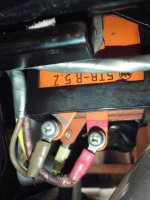
And the battery with the yellow wire I mentioned before

IMG_20200717_153336.jpg
 
I'd assume under general riding conditions you'll be fine with the single breather hose on that spigot, though it is smaller diameter than the later versions on the 5 speed. As for the yellow wire, it seems to be added into the system - and that relay-looking plug below the solenoid are behind the battery is not original, nor the later-style rectifier. If the charging system is functioning adequately, I don't suppose there's any reason to change anything but a modern rectifier/regulator combo is never a bad thing
 
Crank can be pressed apart and bearings/rods replaced.

Not “hard” to do. It’s simply using a press to push it apart. It’s also not “easy”. You need proper set up and support (braces under the webs so it doesn’t flex)

Also need to true it up once Back together. Requires a crank stand or lathe, some dial indicators and a brass hammer.

If you’ve never done it and don’t really plan to do it again, just send it out.

I don’t know that it’s ever been done on a 450/500t but on XS650 rephrasing is a big thing.


Also, are you keeping the stock air box or running a pod? 1 vent is fine.

If venting to a pod run a break check valve at the end of the tube and have it vent on the pod. This lets air out but not in.

This will keep better/more consistent oil pressure in the case, something needed on these bikes.
 
Getting back on it for a small-ish (maybe not quite?) update.

After the engine rebuild, the odometer was clocking 5440 miles. It is now at 6075.

After the charging problem was resolved, the bike has been used fairly regularly without any issues whatsoever.
The covers still needed to be properly tightened after a small break-in period - which we did a couple of weeks ago and that's when the issues started back again :lol:
I will say that until that point I was only outing the bike for small trips to and from work, and some meetings around the city and rarely took her out for longer trips.

The very next day after tightening the cases properly, I arrived at work with a huge oil leak on the transmission cover. And I mean really big, I was leaving oil puddles at every stop and by the time I arrived at work oil was not even dripping out, there was literally a stream of oil coming out. Shot gasket. It seems the new bush bearing is producing too much oil pressure from the inside and that shot the gasket from within ? I don't know if it's a realistic answer but the only one I can come up with.

The gasket was redone and properly sealed with some sort of ultra strong glue (what they used to do on old racing prepped engines as per my mechanic) and no more oil issues for far.

BUT, and here is the big one. After all these issues were solved, and the biked was "broken in" so to speak, I had the go to take it out on longer trips without fear of any major break down happening.

This week-end I took it on a longer trip to a lake with a friend of mine on his CB400F. After about an hour of riding at a slightly higher pace (we had been going around 100/110 for the last 15/20 minutes or so when this happened), and suddenly complete loss of power, engine was still running but no response whatsoever from the throttle - I tell my friend I have an issue and after looking in his mirrors he confirms to me that I do indeed have an issue. The bike was leaving a huge trail of white smoke coming straight from the cylinder head.

Pulled the clutch, turned the engine off and coasted to the side of the road. There was still a bit of smoke coming out from the cylinder head for a few minutes until it finally stopped. At first I assumed a blown gasket, since I had that issue last week, it wouldn't be out of the impossible the other ones were giving out as well.

The bike was towed back to the garage where we quickly checked to see if it was a blown gasket, and when we removed the park plugs we saw that there was.. a hole in the piston :sorry: It seems the carburation was running lean and melted a hole on the top of the piston. And the other surprise was when we removed the head cover to assess the damage done, the engine wasn't still being properly lubricated, which was what caused the first crankshaft to blow out.

So new pistons are on the way, and meanwhile we will inspect the oil pump to see if it needs to be replaced or what is going on with the oil distribution... It seems the engine still needs to be worked on quite a bit after all.
 
Actually, it isn't uncommon for the 450 engine to use a little oil at continuous high speed and when prolonged, lose enough oil that it can gall a piston or burn a hole in one. It could have been contributed to by a lean condition but we've seen it happen on a completely stock bike with proper air cleaners and factory carbs/jets as well. When you mentioned the "transmission cover" I'm assuming you meant the right crankcase cover over the clutch and shift mechanism, which doesn't usually leak in large quantities from the gasket surface. The clutch rod seal is fairly notorious for blowing out of the crankcase under the front sprocket cover and it will cause a major loss of oil, so much that it would be very dangerous to attempt to ride it that way. As for lubrication, did you upgrade to the later oil pump from the 5 speed? I believe the pump piston is 2mm larger and it delivers more oil flow.
 
Well I did check the oil levels when the leak happened and they weren't critical (around 2/3 of the dip stick levels) so I assumed it was enough to get it back to the garage. Oil was also filled back to top before I took it out on the outing where the piston blew up, so there was oil in there and as far as i can tell it wasn't leaking anymore at that time. I did not check the clutch rod seal though, any specific way to tell if it's not seated properly or will it be painfully obvious when i take the sprocket cover off? As for the oil pump it still has the original 4-speed one, but if it needs to be changed i might as well go for the 500T (better and also cheaper on the market)!
 
I can only assume the 500T pump is the same as the 450, I have not worked on one nor have I checked the part numbers to be sure. The later pump helps of course, but many Bombers with the original pump survive to this day. The clutch rod seal would lose a catastrophic amount of oil, you'd know immediately. It would be coming out of the front sprocket cover area in mass quantities.
 
Hi,

Did you clean the cranck from the inside like we discussed ? If the big-end oil hole is clogged, the piston won't be cooled from the bottom. Timing is all right ? Did you check the engine on the dyno and measure the air-fuel ratio ?

Jensen
 
Hi,

Well, kinda? I did try, the only thing I had handy to try and clean it was one of those plastic flexible go-between cleaner.
Finding the oil passage was more difficult than I thought, and from what I tried to clean, the small brush came back clean so I assumed it was clean. But to be honest I think I could have done a more thorough job, so I can't say for sure the passage was properly cleaned.
We did run oil through it and it was flowing nicely, without any debris so I assumed it was clean?

Timing and carburation were done at the very first overall check-up and I assume they were well done, but carburation will be redone now, and we will check the air-fuel ratio to be sure.
 
Hi,

In your post you mention that it seems that there are some signs of lubrication problems other then the holed piston, what are these signs, if I may ask ?

I don't understand, I run a complete stock bike (the only change is the oil filter set-up), using the stock carbs with stock jetting, and I regularly ride long distances on highways, with average speeds of 100 - 130 km an hour.
Yes, with the summer heat, the engine gets really hot, and I mean really hot, but I never had a holed piston. Do you run patrol filters ? is your routing of the fuel lines ok ? If static timing is ok, what about dynamic timing ?

As soon as the issue with the lubrication is solved, I would suggest to take your bike to a well known, preferably older person, working with a dynojet. For example Ruud Frederiks Dynojet B.V, located in Goes, Zeeland province, Netherlands. I don't know him in person, but I hear very good things about him, from my dyno goeroe.

(and if in doubt, you're always welcome to use the guy I trust with my bike, but that's a little further away for you..)

I take my bike every year to him, (at the beginning of the season), just one run, maybe two when necessary, and never sets me back more then 100 euro's,

Jensen

Jensen
[h=2][/h]is in your neighbourhood
 
Yes unfortunately also I don't understand what is going on ;)

The signs that we saw were the camshafts that appeared more used up than they were when we closed the engine, so clearly something is going on - which is also difficult to understand, as when the engine was first closed up, we left the top covers off and ran it and oil was all over the place, which we took as a sign of good lubrication.

We just yesterday got the new pistons from Japan, and the low case still needs to be opened for us to check the condition of the oil pump, although I believe it should be fine and I don't think the problem comes from there.

Regarding the timing, everything will be rechecked properly but again, I believe this was done correctly the first time around.

Will keep this thread updated as more information comes along !
 
Some news on the black bomber:

When we removed the tank to inspect the camshafts - it appears the petcock isn't feeding the carbs properly.
I am not sure if it is just a bit clogged or defective I will check it out this week, but the fuel isn't running properly.

I am left to suppose this might cause the engine to run very lean, and therefore very hot, perhaps this is the cause of the melted piston as an extreme?

Everything else seems to be fine, so this is really hard to pin point.
We will put it back together and run it to check the ratio later on and see if the carburation is set properly or not.

Until then !
 
Back
Top Bottom