1982 Honda CD200T carburetor situation

Alan G

Member
Joined
Aug 13, 2023
Total Posts
38
Total likes
8
Location
Norfolk, UK
Bought this bike last November from a dealer but too cold to ride it apart from round my yard. Went for a ride on it last Wednesday but after 18 miles it stopped running. Would re-start on button but cut out as soon as I tried to pull away. After 20 mins it re-started and I managed to get 500 yards to a friends workshop. Took spark plugs out to find the electrodes were "white". Discovered that the mixture screw was fully screwed in. Unscrewed it one and a half turns as per instruction book only to discover that petrol was pouring out of the carburettor overflow pipe. Screwed mixture adjuster back to tight and after a few minutes petrol stopped coming out of carb overflow pipe. Unscrewed mixture screw and petrol began to pour out of pipe again. Turned petrol off & called the AA. Arrived after 45 mins and although very helpful neither he nor my friend could cure it so AA took me & bike home. Obviously the carburettor has to come off but any ideas as to why this happened appreciated. The dealer must have known about this problem as mixture adjustment screw screwed in tight when I bought and I never checked it as it started and rode round my yard ok.. Lucky I didn't hole a piston with it running so weak.

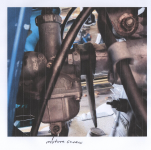
Re earlier thread attached pic of mixture adjustment screw.
1775824798472.png
 
Last edited by a moderator:
The carbs should have a float, float needle, and seat to control the flow of gas into the carb. Slow and or pilot jets should limit fuel flow through the idle circuit. It almost sounds as if yours is missing the jets in the idle circuit, so fuel goes through the circuit too much, to the point of flooding the motor unless the screw is all in. I would be pulling the carb(s) for a look see.
 
Many thanks for replies. It's a definite carb strip to find out exactly what's wrong. In due course I'll let you know the result.
 
To be clear, the drain screw that @ancientdad pointed out is intended to allow fuel to drain from the bowl, so that is functioning as expected. If the bike is running, the carb may be fine. Snug that screw back in.

Do you have the factory service manual? I would suggest reading up on the carburetor and studying the diagram to locate the mixture screw.
 
I have locate the mixture screw but impossible to get at to adjust without taking the carb off. If the mixture screw is ok then there must be another reason the bike packed up then started again but would not drive until engine had cooled down. I fitted Iridium spark plugs do you think they may be the problem?
 
The only caveat when changing the plug would be to keep the same heat range and the same gap at the electrode. Be careful not to damage the iridium electrode, which is likely more fragile than a standard plug.

Using a hotter plug could have a negative effect.
 
Ok I've looked up Iridium spark plugs & air cooled engines on the internet & they can definitely fail if they get too hot. So after engine cooled down and bike worked ok it is probably the Iridium plugs that failed. In any event I have learned a lot about my carburettor in this process. I would NOT recommend Iridium spark plugs for ANY air cooled engine. I sought professional advice on the specific Iridium plug for the CD200 but obviously they were not suitable. An expensive lesson learned. Many thanks to all who helped me.
 
Yes the plugs were NGK CR7HIX (7544). Last Wednesday was a very hot day, 23 degrees.l Perhaps I wouldn't have had the problem if it has been cooler and I hadn't spent 10 of the 18 miles in traffic round Norwich. Although it would have happened at some time during the Summer.
 
Back to you original symptoms, they sound very much like a plugged vent in the fuel filler cap. Ride until it stops, open the cap, see if that fixes it for a while. Common problem.
 
Inside of fuel cap spotlessly clean. Also I rode 18 miles before it stopped, a lot of it through heavy traffic, as well as 55 mph before & after traffic, so I think blocked vent in filler cap unlikely. Please refer to my earlier thread re the Iridium spark plugs I had put in. When I took them out after bike stopped the bent electrodes were white, obviously from over heating. When bike cooled down after 20 mins it started ok. Iridium spark plugs are evidently NOT suitable foe air cooled engines as they run cooler than standard plugs. There is some info on the internet on this subject which on hindsight I wish I'd read before fitting the Iridium plugs. I plan to do a VMCC run tomorrow of about 90 miles and am pretty confident that the problem has been resolved.
 
Seeing the spark plugs offered for the '81 CD200 at CMSNL dot com, there's :
NGK CR6HS, CR7HS, and CR8HS
or
Denso U20FSR-U, U22FSR-U, and U24FSR-U

Three "HEAT RANGES" for three different applications - NGK's 6,7,8 and Denso's 20,22,24

Honda Owner's Manual for my '82 bikes also lists 3 choices, stating to use
"as standard" the middle heat range number (for your CD200 = 7 or 22)
or
"for cold temps below 5*C ", use the lower no. (6 or 20)
or,
"for extended high-speed driving", use the higher no. (8 or 24)
 
"Inside of fuel cap spotlessly clean. Also I rode 18 miles before it stopped, a lot of it through heavy traffic, as well as 55 mph before & after traffic, so I think blocked vent in filler cap unlikely"

Actually the experience you describe is exactly what a clogged fuel vent would do.
 
"Inside of fuel cap spotlessly clean. Also I rode 18 miles before it stopped, a lot of it through heavy traffic, as well as 55 mph before & after traffic, so I think blocked vent in filler cap unlikely"

Actually the experience you describe is exactly what a clogged fuel vent would do.
I concur. A new-to-me '92 BMW R100GS saw me angling to the side of a very busy Interstate 5 at least three times on a 15 mile drive. The gas cap itself looked very clean on that one as well! Opening the cap yields results, but then again just stopping for a while will equalize the pressure enough for the bike to start again, upon which one is motivated to just get out of Dodge as compared to puzzling over "why".

In my case I just carefully drilled out the tiny vent hole in the cap, it must have been occluded with something.
 
I wouldn't go as far as to rule it, out but 18 miles would seem pretty far for a blocked gas cap vent. I experienced the phenomenon once with my CB360G after installing a new to me tank that had been sealed (including the gas cap). It would only make a couple of miles before stalling out.

I do agree with the idea that it would produce a lean condition and could cause overheating along the way.
 
I'm not convinced about the iridium plugs either. If they are the correct grade and equivalence to usual plugs, I really can't see how they could cause this problem, regardless of air or water cooling.
 
  • Like
Reactions: J-T
At last this learning curve (saga) has come to an end, Thank goodness & I thank all who have contributed.
Did 100 miles today, VMCC run, and it didn't miss a beat. A lot of country lanes in the morning then a fast ride home of nearly 50 miles, a lot at 50 mph and several miles at 60 mph ( I have fitted a 16 tooth gearbox sprocket).
Examined plugs when I got home, central electrode a medium to slightly darker brown colour. Plugs I used were NGK "R" CR7HS. Plenty of fuel left in tank. So it appears that the whole saga was self inflicted by "upgrading" to Iridium spark plugs.
I had fitted a set in my 1953 Riley RMF 2.5 litre car but have taken them out only having run them in the engine for about 20 mins and reverted to standard NGK plugs. These Iridium spark plugs may be perfectly ok in cars & bikes from say 1990's but I would never use them again in any Classic/vintage vehicle.
 
Interesting. I found this on line:

Older engines
Using a platinum or iridium spark plug in an older engine may lead to the fouling of the plug rather rapidly because the plug is too cold to burn off any excess fuel and oil that get into the combustion chambers of the engine. Burning off extra fuel and oil is what the hotter copper core spark plugs did very well.

I've got Iridium NGK plugs in my '98 CBR engined Hornet, fitted them back in 2014. I have a brand new set of conventional NGK plugs sitting on the shelf, was going to fit these at the last service but bike is running so well I haven't bothered.
 
  • Like
Reactions: J-T
Recently my 1982 Honda CD200 has developed an uneven tick over. Adjusting the single carb tick over speed screw only speeds up or slows down the tick over and makes no difference to lumpy tick over. I would suspect ignition system but the bike has CDI ignition so no points to adjust. Any advice/help appreciated.
 
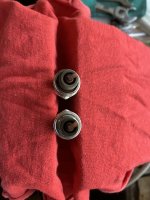
Re my previous post I have changed the spark plus with no improvement. Looking at the plugs I took out it seems the nearside plug is running a little weaker, or the right hand plug is running a bit richer. Hopefully photo attached. I did 140 miles on it yesterday and no trouble at all either at low speed or cruising at 55 to 60 mph.

IMG_0440.JPG
 
Last edited by a moderator:
The top plug has no black deposit whereas the bottom plug has a moderate black deposit. I have used the kick starter and both cylinders appear to have very similar good compression. I'll have to see if I can get an adaptor for my compression tester to see if there is any difference before making any decisions.
 
Have tested compression, Right hand cylinder 122 psi, left hand cylinder 120 psi. Not as good as spec of 125 psi but it is 44 years old! Found that the two small nuts that hold carburettor to the two port manifold were a little loose so have tightened them. No change in plug colours after last Sunday's run of 120 miles. I noticed that in heavy traffic after a non stop run of 45 miles the tick over speed increased a lot. However when starting from cold and warming up at home tick over is normal. Maybe the slightly loose carburettor to manifold nuts were sucking in air when the bike got very hot giving a weaker mixture and increasing tick over speed a lot.. It was a very hot day last Sunday. If I ever get to the bottom of this anomaly I'll post the results. Now that it is cooler I intend to remove both clutch & alternator casings, the previous owner stuck them back on with some sort of instant gasket, and use proper gaskets with high melting point grease. I used to own a CB200 which the owner used instant gasket and worms on the inside detached and got stuck in the oil pump filter resulting in catastrophic cam failures due to no oil supply. I'll replace the cross headed screws with Allen bolts.
 
Found that the two small nuts that hold carburettor to the two port manifold were a little loose so have tightened them.
Be cautious tightening those nuts, because overtightening them can cause the carb body to distort and make the slide movement sticky.
 
My single carb CL175 (CD 175 head and carb) starts well from cold, and soon settles down to a 1200 rpm idle. Once fully hot, the idle speed increases to almost 2000 rpm. This doesn't cause me any issues, and I'd rather have a fast tick over than worry about stalling it at the lights.

Some will say that these are classic symptoms of a blocked idle circuit, but I'm pretty happy that my carb is fully clean, just old and possibly worn, running on fuel that didn't exist back in 1970.

Reminded me to have a look at my plug colours, job for tomorrow perhaps :geek:
 
Back
Top Bottom