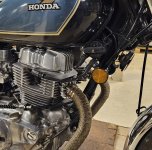
1981 CM400C refresh (with handmade wood side covers)

tmeric7

Member
Joined
Sep 5, 2023
Total Posts
13
Total likes
36
Location
York County, PA
This is my first motorcycle, and I got it about 9 years ago. I'm generally a fan of the stock look, but my other vintage bikes are earlier (72 - 78) and the stock CM400C has cruiser accents that I personally don't care for, especially the stepped seat, shape of the side covers, and design of the front emblem. It's still fun to ride, but had became less reliable starting. So this fall was time for a thorough "refresh" to (1) thoroughly clean a dirty, oily barn bike, (2) make it more cosmetically appealing, to me, and (3) give it a real good tune up.

Here's the list of everything I can remember that I did...

Mechanical: clean air filter, tighten head bolts to spec, adjust valve clearance, replace spark plugs and wires, GM coil mod, thoroughly clean and sync carbs, adjust pilot screws, lube cables and swingarm, replace rear tire, adjust cam chain, set fork pressure, adjust clutch, replace many parts/gaskets/seals, re-jetted for new mufflers

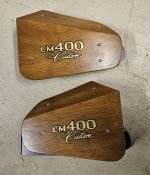
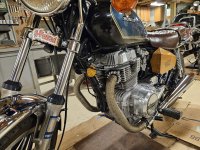
Cosmetic: New mufflers (kinda mechanical, but cosmetic to me), new seat, THOROUGH cleaning (by way of partial disassembly), new handmade wood side covers, new front emblem to match (wood), rear "Honda flame" wood accents, exhaust wrap, refit tachometer display screw

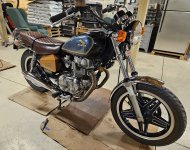
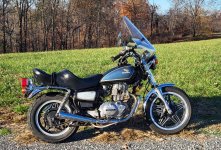
I'll post with more detail on some of these (and by request), but here are some pictures of the final product. It starts/idles great. One test ride was successful.
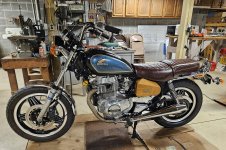
20231230_165240.jpg
20231230_165032.jpg
20231230_165123.jpg
 
Thanks for sharing! I did want to see what you did with side covers. I've got the same 81 CM400C. I think if the tank had brown wood look it would blend together more. Like the old station wagons from the 70's. My exhaust on 400 are in pretty good shape, a few small rust holes. My 82 CM450 has slightly bigger rust holes. Yet I don't notice it being overly loud, so I have no desire to replace them. If they were loud, that would be a problem. I'm assuming these are aftermarket exhaust? You happy with them? Also, why do people wrap the exhausts pipes? I assume it is some insulating fiber cloth typically, yours looks rather distinct, gold colored. Probably won't stay gold, those pipes get hot.

I've got one missing side cover on 450, since it is the same shape as the 400, I have thought about using that as a rough mold to fashion something up. I don't think I want to put to much effort into it, but you know how these things go.
 
I did the best I could to match the wood stain to the gold accents on the tank. Then with the brown seat, exhaust wrap, and other wood accents I tried to make it as cohesive as possible with what I had. I guess I could have gone with an ebony stain to match the tank, but I do like the golden brown color.

The exhaust is aftermarket from Randakks. I like the look and they were affordable, as far as it goes. It only takes a brief inspection to see that they are much more "open". Accordingly, they are notably louder. It's fine for me, but some probably wouldn't like it. I wrapped the pipes for the appearance. They were not very attractive anymore. Many clam performance improvements with exhaust wrap because it keeps the heat in the pipes and helps with exhaust scavenging. I doubt for this motorcycle that there is a notable difference.

I knew the covers would take some time to make, and they surly did!
 
You could make a short project log on those side covers. Attach points must have been fin. The color does look good with the tank accents. Really nice work.
 
The exhaust mufflers are aftermarket from Randakks. I like the look and they were affordable. It only takes a brief inspection to see that they are much more "open". Accordingly, they are notably louder. It's fine for me, but some probably wouldn't like it. I wrapped the pipes for the appearance. They were not very attractive anymore.
I'm considering these new aftermarket single-walled exhaust headpipes (headers, downpipes) for the future when the look of my original ones bother me enough:

or


You, me, and "MC_Collector" have the same color original "Cosmo Black Metallic" gas tanks !
Until today, I've wondered why Honda named this dual-"candied"-blue "Cosmo Black", and now I've concluded it was because the tanks in this dual-color look like a spectacular, clear night sky, and (if chipped at all) the chips look like stars in (cosmonautical) space - FANTASTIC !

This is MC_Collector's bike: (photos of mine still to come!)


1704061378121.jpeg
 
original "Cosmo Black Metallic" gas tanks
Excellent! I never knew the color name, and I like it better just knowing it uses the word "metallic".
You could make a short project log on those side covers.
I don't have several photos of key steps that I now wish I had. I was probably afraid of documenting failure. Here is a rundown of key points.

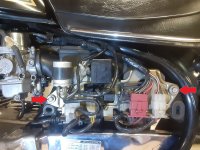
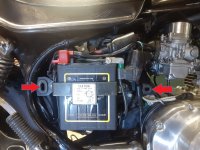
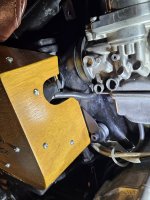
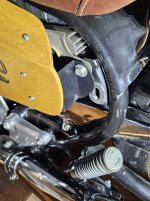
1. I knew mounting would be really important, so I based the design off that. I decided two secure points would be sufficient. For the LH side, I decided to use the 2 bolts that hold the electrical panel in place. I would just piggyback the cover onto them. For the RH side, no existing hardware was available. I used the two grommet holes for the original side covers. (See arrows in pics.) On the right I would use 6mm SHCS and make a custom "nut" to slide in behind the two grommets.
20230930_121922.jpg
20230930_121956.jpg
20231231_212323.jpg
20231231_212450.jpg
20231231_212408.jpg

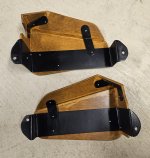
2. You can see from the last two pics above that I used sheet steel for the mounting frame and to provide strength. I found something that was at least 1/16in think. It may have been more like 0.075. It came out of the scrap bin, but was the perfect thickness because I could still cut and form it easily but is rigid and thick enough that I could tap holes for all the #6 mounting screws I use to hold the wood to the frame. I wish I had good picks of just those frames on the bike, because I thought that was a really important step I got right, even if you don't really see it in the end.

3. I attached the frames to each side of the bike and mocked up the wood panels with paperboard and tape. This was another important step for which I don't have a photo! Each side would have four pieces of wood, and the mock-up showed me how it would look, and I could trim and shape the paper sections to proper fit. Then use them as templates to cut the wood pieces.

4. I bought a piece of wood at Home Depot of the color and thickness I wanted. It turned out to be really soft, too. That made it easy to fashion and fit, but I hope it does not cause me problems with durability. Later I addressed this with support in the frame and extra finishing. I used the templates to form and fit the wood panels. I screwed the font and side pieces directly to the frame, and taped on the other two. Then, removed the wood shell and glued from the inside. At the time, I wasn't sure how strong it would be just glued, so I provided support from the frame for each piece. In the end, the glued joints were strong and I probably have more mounting screws than necessary.
20231109_110232.jpg

5. I provided support from the frame from behind for each panel. All the holes in the frame are tapped, so I don't need nuts from behind. The wood is soft enough that it compresses a bit, and I feel confident that they won't vibrate out.
20231226_072125.jpg

6. For the most durable finish possible, I tried a marine varnish on the inside. This product proved hard to work with, and I wasn't happy with the appearance I was able to get. So for the front, I used a wipe-on polyurethane (after applying decals I bought online). I applied a lot of layers to aid durability, so some dust got trapped in the finish, but you need to be right on it to see. In the end, I'm really happy with them, and it's nice to see a concept in your head work out! (With a lot of planning and time...)
20231226_072038.jpg

Happy New Year!
Tristan
 
Yes, looks great, looks cleaned up really nice, now it's customized with a unique look. So you've had it for 9 years, just giving it some TLC it needed? Mine got in that state where it was fussy and hard to start, cleaning carbs was the key. How did the carb cleaning go for you? Do you think that was a significant issue with getting it running better, or were there other items that you replaced like coils, plugs that you think made a big difference.
 
How did the carb cleaning go for you?
Carb cleaning went fine. This is the third motorcycle I've done carbs on, but I had the carbs out on the KZ1000 more times than I'd like to admit. :rolleyes:

I did the carb work on this CM400 before I found the excellent write-up on VHT by LDR. I was just using a Clymer manual at the time, which does not advise splitting the carbs. (LDR does explain how to do this.) So I didn't get into the air cutoff valve for the RH carb because it's blocked when you don't split them. I cleaned and reused all the jets, and replaced rubber parts with a cheap kit. It needed cleaned by my standards, but wasn't like some photos you see...

Do you think that was a significant issue with getting it running better, or were there other items that you replaced like coils, plugs that you think made a big difference.
Of course when your problem solving the conventional wisdom is to change one thing at a time. But in practice, when you take to a project, you want to get to everything you can think of! I did replace the coil (with the GM coil mod), spark plugs, and plug wires. I'm a huge fan of getting a good hot spark, because that's been "the problem" for me more than once in the past. So I can't say which factors played the most influential role, but leaving these mysteries with an old motorcycle seems somehow appropriate.
 
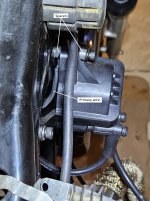
This is a post covering my GM coil modification. Here is a link to the full thread on this topic. I'll try to focus on what I did that is maybe a little different, and I'll post a shorter version on that dedicated topic thread.

1. I don't recall seeing much on specifics for replacement spark plug wires. I used Taylor P/N 45409, and was really happy with it. I bought two of these kits, but only used one. There is enough wire and it comes with two connectors (used on coil side). If reusing the spark plug caps, the mod requires only one of these kits.
20240102_162342.jpg

2. There are several vendors for the coils. I bought a Duralast P/N C849, and I'm sure I got that info on these forums. I paid $42 at Auto Zone. I know you can get other brands for half that online, but I like to be able to take it back to a store if needed. (And I tell myself that the quality *may* be better than a brand I've never heard of.)

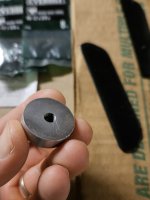
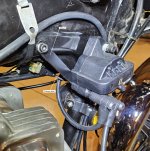
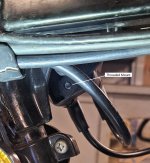
3. I read about how some people drill out the electrical connector area and bring the wires out the front to mount the coil flush with the frame. I was going to do that, but instead I ran the primary wires out the back and used a spacer made of plastic tube the same width of my mounting bracket (approx. 1/4 inch) and ran the primary wires directly over to the connector. The spacers compress a bit so I didn't bother with a lock washer. The primary wire is just two short lengths of 16 gauge with spade connectors soldered to each end. (The coil side requires a smaller spade so I just ground down the "standard" size I had.)
20240102_161618.jpg
20240102_161805.jpg
20240102_161338(1).jpg

Overall, I feel like it was a pretty clean way to mount up, and it looks like it belongs to me.
20240102_162736.jpg
 
I took this motorcycle to a local car show and entered it into the cruiser bike class. Sure, it's not what they're expecting in that category, but for a motorcycle in 1981...

We took 2nd place in that category. When I say "we" I mean that my 8yo son was along and the coolest part was just seeing how excited he was. It was a "Creatures of the Night" show so the award lights up. He's been using it as his night light!

Ezra_2nd_Place.jpg
 
Very cool, a chip off the old block. Always great to see a smile from those kids and get them involved with your hobbies.
 
Back
Top Bottom