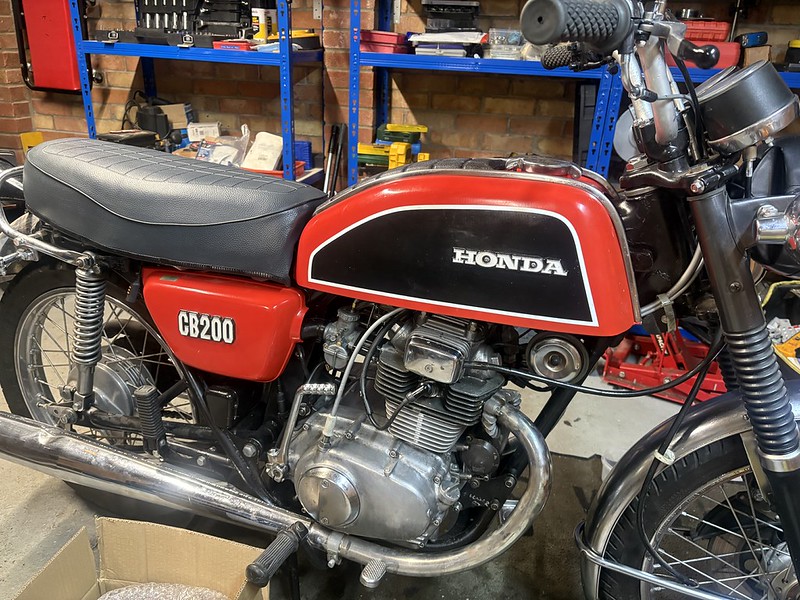
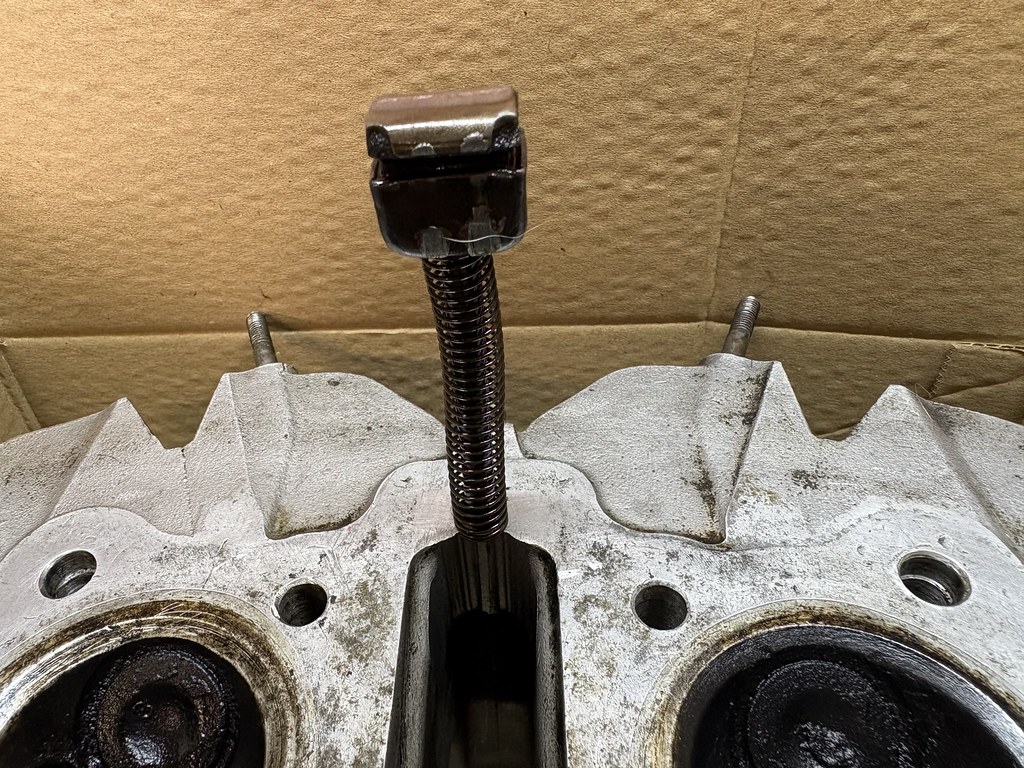
1977 CB200

I didn't follow this thread in detail initially because I have never worked on a CB200, but I got curious after following your CB360 thread and tried to digest everything over the last two days. I hope you won't mind a few questions as I get fully up to speed.
  • The motor came to you with a cracked/broken sprocket flange on the cam. I think you mentioned a "box of nails" sound at one point. Was that in reference to turning the motor over by hand or was it actually running in that condition??
  • The cylinders had been substantially overbored in the past, to the point that the cylinder walls were quite thin. Combining this with the cam failure, is it possible that the crank has been damaged, for example, the main bearings?
  • I somehow missed seeing and hearing the video in which the motor noise is present after you installed the standard cylinders and pistons. Can you tell me which post that was in? Or, would you mind sharing a recording of the motor in its current state? Does the frequency of the noise follow the rpm of the motor?
  • What is the theory connecting the head to the noise? Does that mean the noise is expected to be due to the action of the valves?
  • Did you already inspect the tach drive or check to see if there is any wobble visible on the end of the cam?
Engine noises can be nerve wracking for sure. Hope you can get it sorted.
I’m sitting here eating my breakfast after walking Bob on the beach, and wondering about your point in the above post regarding there being something wrong in the bottom end. I haven’t done anything inside the crank case, apart from test the big ends for play at the con rods and have a shufti down the cam chain cavity with an endoscope... only because I’d been addressing the two issues I knew about (big bore and cam chain) when I took it apart the previous two times.

As I’ve decided to remove the motor to swap the head (once I have the replacement prepared) in a few weeks time anyway, I’m wondering whether I’d be wise to turn the motor over and pull the bottom of the engine off at that time? It is horizontally split, so that isn’t a particularly onerous job. It might be sensible at this point to make sure there aren’t any creepy crawlies lurking around inside - and check out the main bearings?

Whilst the noise doesn’t seem to be coming from the bottom end, it is hard to tell with such a small engine - and I’d feel a bit of a prune if I had to take it apart yet again if changing the head doesn’t help matters. What do you think?

Alan :)
 
Last edited:
Since you'll have the motor out anyways, it does seem a good opportunity to have a look at the bottom end. Hopefully you will find it to be solid and smooth, so it can be removed from the list of suspects. Have you already replaced the seals in the lower cases?
 
Since you'll have the motor out anyways, it does seem a good opportunity to have a look at the bottom end. Hopefully you will find it to be solid and smooth, so it can be removed from the list of suspects. Have you already replaced the seals in the lower cases?
Thank you for that.
Seals in the lower cases? What are we talking about there? I haven’t replaced anything below the gasket at the bottom of the barrels.
Alan :)
 
Many thanks - I don’t have any oil leaks.

Alan :)
Which is great - but if you did decide to flip the engine and pull the outer crankcase covers, you'd at least want to replace the clutch rod and countershaft seals because they span the seam of the crankcase halves. The shift shaft and kickstart shaft seals can be left undisturbed.
 
Which is great - but if you did decide to flip the engine and pull the outer crankcase covers, you'd at least want to replace the clutch rod and countershaft seals because they span the seam of the crankcase halves. The shift shaft and kickstart shaft seals can be left undisturbed.
Ah, I see. Yes, of course, it would make sense to do that. I’d been trying to imagine where there might be a pressure seal on the crankcase - like with a 2 stroke!

I‘ve just listened to those 4 previous videos of the motor running that I’d conflated together into a post a few days ago - whilst the motor runs much better now, it has certainly been suffering from the same mechanical noise since I first fitted the standard barrels and pistons. I don’t think I made a recording prior to that.

It is confusing that the motor starts on the button; I don’t know whether the compression test (90psi both sides) is a red herring or not, but that is largely what led me to suspect a fault with the cylinder head.

This latest idea of mine to have a look at the bottom end is somewhat clutching at straws - because I can’t think of anything else - and it would make sense to do it whilst the motor is out of the frame.

:rolleyes:
 
This latest idea of mine to have a look at the bottom end is somewhat clutching at straws - because I can’t think of anything else - and it would make sense to do it whilst the motor is out of the frame.
Thinking about your noise with respect to the bottom end, the only location-related thing I'd expect it to be is a loose wristpin (gudgeon pin) but that can't be inspected from the bottom end only on these all ball and roller bearing crankshafts. The only other thing I can think of might be primary gear noise, but it's a straight-cut single gear-to-gear arrangement like most of the twins and is rarely an issue.
 
Iirc all the correct size seals were available new, think I got mine from https://avxseals.com/ so avoid old stock for those if you can.
Yes indeed - I find that with nitrile seals it is best (and by far cheapest) to identify the right size and then purchase new stock from a machine parts factor - there is nothing special about seals that come in a Honda bag (except the price in my experience).

:)
 
Thinking about your noise with respect to the bottom end, the only location-related thing I'd expect it to be is a loose wristpin (gudgeon pin) but that can't be inspected from the bottom end only on these all ball and roller bearing crankshafts. The only other thing I can think of might be primary gear noise, but it's a straight-cut single gear-to-gear arrangement like most of the twins and is rarely an issue.
By a gudgeon pin bearing I think we would call that a little end bearing here? They were new when I fitted the barrels and pistons and the motor has only run an hour or so since then,

If the issue was with with the primary gear drive I’d expect the note to change when the clutch was engaged and disengaged, but it doesn’t.

It doesn’t sound like a big end (crank pin) bearing - and I couldn’t discern any play from the con rods when the barrels were off (although that was a rather cursory check because I wasn’t looking for issues there).

That probably leaves the main bearings (unless the cylinder head hypothesis does indeed prove to be correct). Does that noise sound like the rumble of failed main bearings? I’m not sure about that, but this is just a process of eliminating the impossible (paraphrasing Sherlock Holmes). I note from the manual that it is a pressed up crank, so probably beyond my capability to change the inner main bearings - so perhaps I’ll start casting around for a crank just in case?

I don’t think there is any more diagnosis I can do from the outside. I’ll see if I can get the replacement head I have checked for flatness and hydro blasted this coming week, then perhaps take the motor out for another shufti.

I‘ll get to the bottom of this little Honda’s issues - one day!

Alan :)

Stop Press: whilst thinking about the possibility of this being a bottom end problem and reading the manual over my breakfast porridge this morning, I’d found a replacement used CB200 crank. The seller is a reputable breaker and says the main and big end bearings are good. Anyway, I offered £43 for the crank assembly, which the seller accepted just a few seconds ago. I think that is a good insurance against the CB200’s main bearings being the problem; I’ll certainly pull the bottom of the motor off for a look now.
 
Last edited:
Another thought crossed my mind reading your last post. I don't know offhand if this is an interference engine, but the harsh sound and low compression make me wonder if the cam timing might be off slightly. Perhaps the harsh sound is a light contact between piston and valve.
 
Another thought crossed my mind reading your last post. I don't know offhand if this is an interference engine, but the harsh sound and low compression make me wonder if the cam timing might be off slightly. Perhaps the harsh sound is a light contact between piston and valve.
All Hondas of that era are interference engines, none escape bent valves if the cam timing is off or the cam chain breaks.
 
All Hondas of that era are interference engines, none escape bent valves if the cam timing is off or the cam chain breaks.
Is it so close that a one tooth error on the cam sprocket will cause interference?

I guess it's also possible that there are bent valves from that cracked cam sprocket flange at the start of this project.
 
Is it so close that a one tooth error on the cam sprocket will cause interference?
Some will run a tooth off, but in my experience not all will.
I guess it's also possible that there are bent valves from that cracked cam sprocket flange at the start of this project.
But typically, any valve even slightly bent causes enough leakage to lower compression to the point that the cylinder won't run.
 
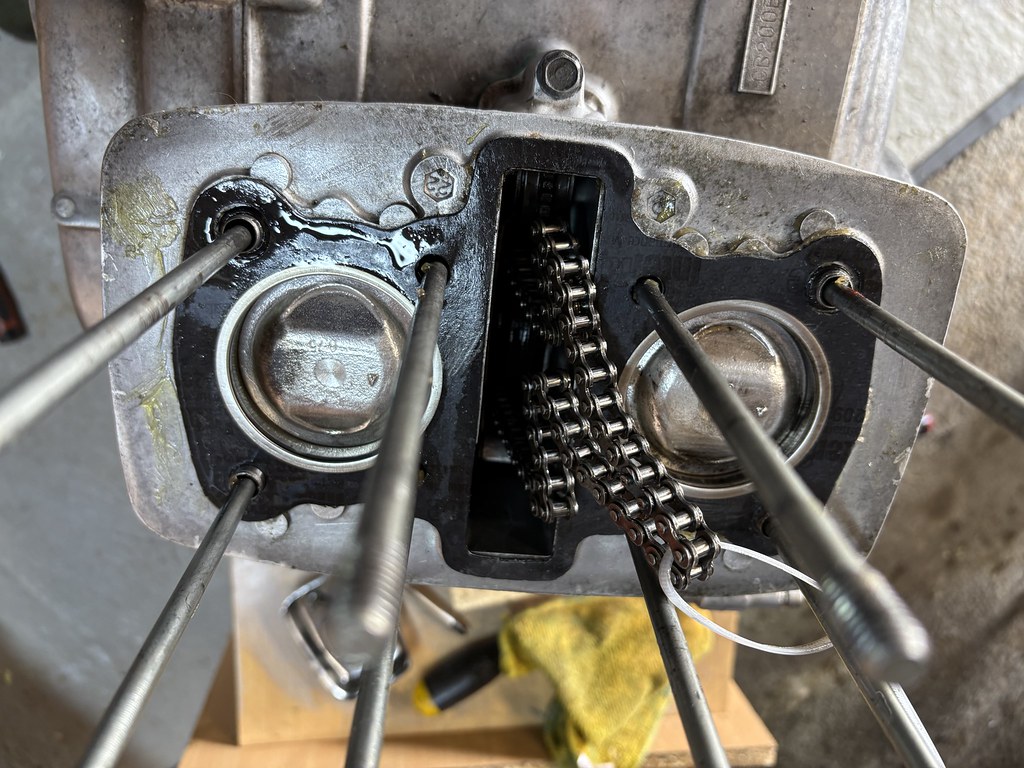
Thank you for the comments and ideas chaps. First the valve contact idea: Here is a photo showing the (almost new) pistons when I took the motor apart to change the cam chain:

IMG_6342 by Alan Othen, on Flickr

There are no marks on the piston crown that I think we would have noticed - and the noise was before and after changing the cam chain.

Moving on: is it possible that the motor already had two bent valves (both chamber pressures being 90psi) from the time the motor was bored to 240cc - and before I changed back to standard barrels and pistons? Of course it is, but that would have resulted in two bent valves now. The only test I did on the valves was with petrol in the exhaust valves (which both sealed as they should). Eliminating what isn't feasible: is it possible that the two inlet valves were both damaged whilst the larger pistons were fitted? Yes, of course it is... and that might explain the compression pressures, but would it result in that noisy engine? I just don't know.

I've just been out in the garage to have a look at the replacement head. I don't have a valve compressor anywhere near small enough to remove the valves from it, so I'll have to acquire or borrow one this week. I did run the straight edge of a steel rule over it though, and it seems to be flat and true.

So, what do I have (the things that haven't been eliminated yet):

1. The old head may be distorted (from the time the 240cc barrels were fitted) such that the gasket doesn't make an effective seal (accounting for the compression results) and perhaps if the camshaft bearing surfaces are out of line the noise as well?

2. Both inlet valves may have been damaged from the time it ran at 240cc, which would also account for the low compression - but I'm not sure about the noise?

3. The main bearings may be worn or damaged - from the time the big bore block was fitted - and perhaps something to do with that camshaft chain carrier failure?

With the current evidence I can't think of anything else. Now, the remedy for the first two will be to fit the replacement head I have, once I get it prepared (as good as I can make it). If the main bearings are at fault than the replacement crank I have on its way should solve that.

Fortunately the parts I've just bought were pretty inexpensive (I think £45 for the head, £43 for the crank), I already have another complete casket set and a couple of nitrile seals will only be a tenner or so, hence this latest episode isn't going to cost much (maybe a couple of days of my time, but that comes free). I think I was previously up to about £2,200 total costs, so I'm still aiming to bring this in under £2,500 (which would be fine).

Have I missed anything chaps?

Alan :unsure:

This is the only photo I can find of the inside or the head that is fitted now (from the most recent work - changing the cam chain): unfortunately it doesn't cover the inlet valves:

IMG_6341 by Alan Othen, on Flickr

... there is no obvious sign of damage though?
 
I would want to have a look at all four valves. It's conceivable (maybe unlikely) that they could be only slightly bent and still seal when closed. Probably worth looking at the valves on the replacement head also. The bent valve theory feels more likely to me than anything else at this point.

Did you ever photograph the crowns of the overbored pistons? Edit: One piston is visible in post #50 and I don't see any marks on it.

I took apart a CB350 motor a few years ago and didn't even notice that the exhaust valves were bent until @jensen was kind enough to point it out.
 
Last edited:
I would want to have a look at all four valves. It's conceivable (maybe unlikely) that they could be only slightly bent and still seal when closed. Probably worth looking at the valves on the replacement head also. The bent valve theory feels more likely to me than anything else at this point.

Did you ever photograph the crowns of the overbored pistons? Edit: One piston is visible in post #50 and I don't see any marks on it.

I took apart a CB350 motor a few years ago and didn't even notice that the exhaust valves were bent until @jensen was kind enough to point it out.
Thank you for that.

I have a valve spring compressor arriving (via that nice Mr Bezos) that should be able to remove the valves on the replacement head. We can have a good look at them later on this week.

Well done in spotting post #50 and the photo of the big bore pistons. That was some time ago now and I’d forgotten.

I‘m not sure what is wrong with little Honda; I keep hoping for a Eurika! moment - but I’ve been like that all the time I’ve owned it.

:)
 
I’m pleased to report the small valve spring compressor that nice Mr Bezos sent me worked perfectly and quickly removed the valves from the replacement head I have:

IMG_6758 by Alan Othen, on Flickr

… that all looks okay.

A question if I may: are the valve stem oil seals the same for both inlet and exhaust? I found some listed on eBay that claim to be for the exhaust - but the only ones look exactly the same to me.

Valve stem seals

:)
 
CMSNL shows the same part number for the intake and exhaust valve stem seals: 12209-354-003.

Good that the replacement valve stems appear to be straight. Probably wouldn't hurt to clean some of the carbon off the exhaust valves.
 
Last edited:
Back
Top Bottom