

Seriously though, I did try to listen to the engine but your speaking during it did make hearing any noises a bit difficult.Ha, ha, ha…

Seriously though, I did try to listen to the engine but your speaking during it did make hearing any noises a bit difficult.Ha, ha, ha…

I’ll do another recording (without talking over it) tomorrow and post it. Many thanks.Seriously though, I did try to listen to the engine but your speaking during it did make hearing any noises a bit difficult.
I'm not the best carb guy to ask, but I can tell you that slight imbalances in both idle speed adjustment between carbs as well as slight differences in mixture screw adjustments can often allow a change from cold to warm.One thing I did notice is that the tickover rises a bit (from 1,500 to 2,500RPM) after a couple of minutes, and I also noticed a little bit of fuel (drops) overflowing from the left hand float bowl. Here is my thesis: the left hand float or valve is allowing the bowl to flood very slightly at tickover - so after a few minutes it fills up, richens the mixture on that side and so increases the engine speed. Does that sound plausible?
Minus the jets, and possibly the float needles if they aren't exact matches in every way, because kit parts accuracy is always suspect.so I might as well fit the reconditioning kits I have.
Noted - I saw your note previously.I'm not the best carb guy to ask, but I can tell you that slight imbalances in both idle speed adjustment between carbs as well as slight differences in mixture screw adjustments can often allow a change from cold to warm.
Minus the jets, and possibly the float needles if they aren't exact matches in every way, because kit parts accuracy is always suspect.
Sorry, I mention it so often that I tend to forget if I've mentioned it... CRS you knowNoted - I saw your note previously.

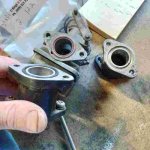
Did you replace the old o rings on the intake manifolds?tickover rises a bit (from 1,500 to 2,500RPM) after a couple of minutes
My apologies for using such and Englishism, normally I remember to include the American version as well (silencer/muffler and so on), but I’d forgotten that ‘shooftie’ might not cross the Atlantic easily.Did you replace the old o rings on the intake manifolds?
If they are old flat and hardened instability can arise as the engine warms.
Also had to break out the English to English dictionary for "shooftie".
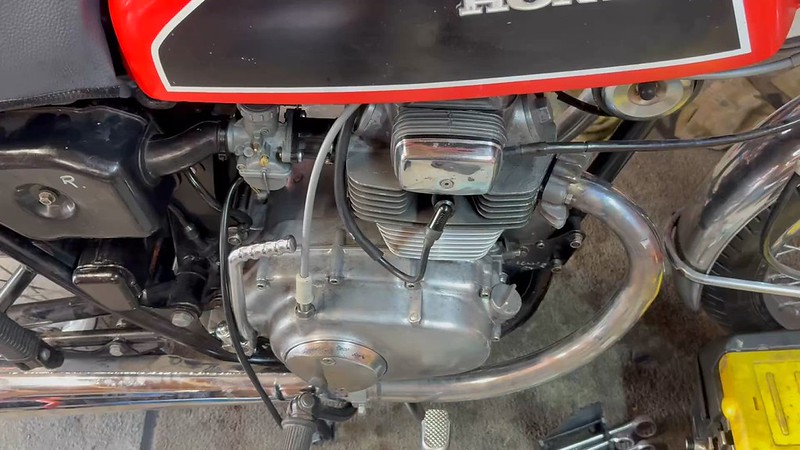 IMG_6664 by Alan Othen, on Flickr
Just dispensing information learned from others far more familiar, but I'm glad it helped you solve the problem. When a carb-knowledgeable individual like Mike Nixon says it, I'd suspect it to be true. Honestly, I've had my share of disappointments with kit parts even a few decades ago (missing pieces, incorrect gaskets and/or o-rings) so with time it seems to have only gotten worse.Ancientdad was spot on about the float needles in the refurbishment kit
Many thanks - you called it just right - which saved me hours of head scratching. I also used the original float chamber gaskets as the replacements weren’t a very good fit.Just dispensing information learned from others far more familiar, but I'm glad it helped you solve the problem. When a carb-knowledgeable individual like Mike Nixon says it, I'd suspect it to be true. Honestly, I've had my share of disappointments with kit parts even a few decades ago (missing pieces, incorrect gaskets and/or o-rings) so with time it seems to have only gotten worse.
It all looks straight and level to me:Is your right side cylinder head cover (#21 in the manual,p13) installed flush and straight?
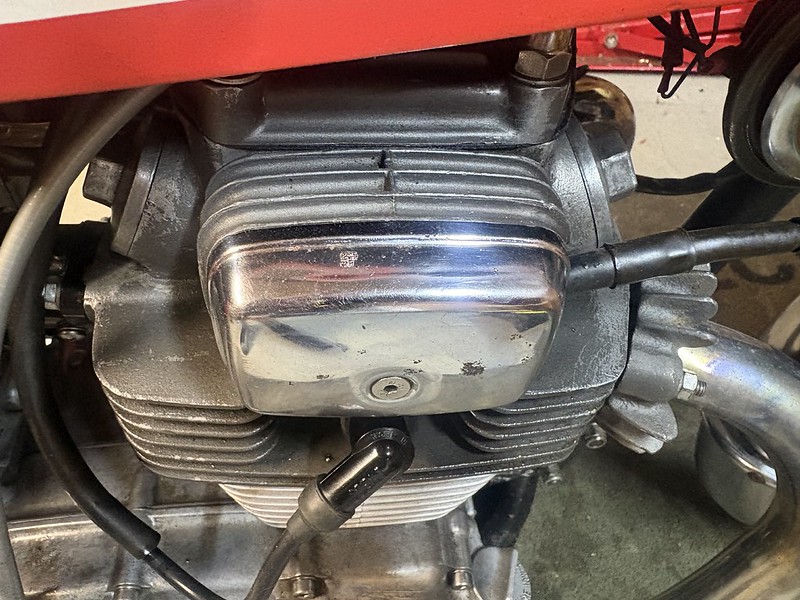 IMG_6713 by Alan Othen, on Flickr
Tach drive not engaged? That's the only other thing I can think of would cause it.You would have to take off the tach cover and look straight at it, preferably moving the crank with the kickstarter by hand to see if there is any movement of the cover. It's possible to assemble misaligned, where it will run but not quite right. The easiest way to identify this is the case is if the kickstarter is harder to move than expected by hand due to friction on the camshaft. Think this issue was mentioned in a very long cb200 post on "the other site" where improvements were documented. This scenario has happened twice to me when reassembling, and it wasn't due to improper valve timing.
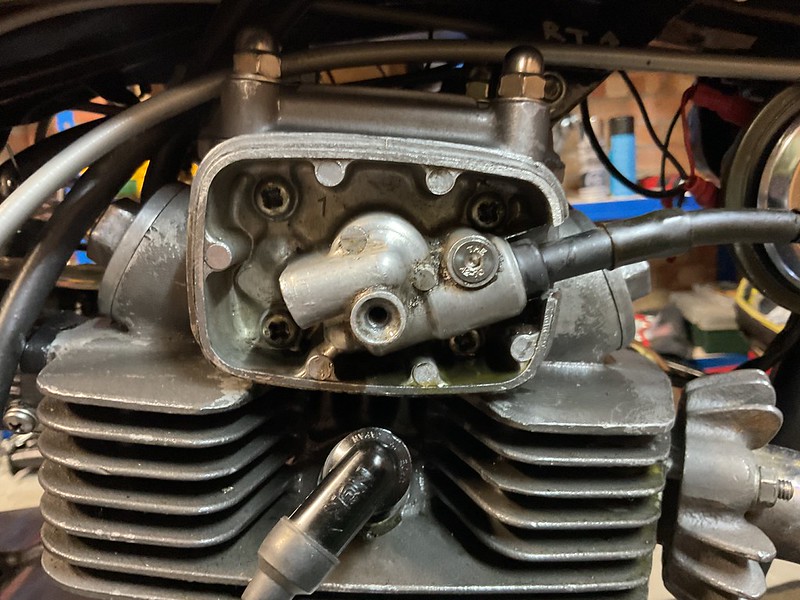 IMG_0654 by Alan Othen, on Flickr
assumed so too at first, but the tach was turning, and the camshaft wasn't being pushed in as occurs when the tach drive isn't engaged.Tach drive not engaged? That's the only other thing I can think of would cause it.
Not at all. I used one of the new gaskets supplied by the PO in the parts box, aftermarket but I think from DSS. I don‘t remember it saying anything about having to file the gasket for it to fit in the manual.@Othen When you put your head gasket on, did you make sure to verify you aligned it based on the position of the cylinder seals, not the bolts? The repro gaskets I have purchased have all been stamped incorrectly, requiring filing out the bolt/oil channel holes to make the cylinder seals align correctly.
Do you think it would be worthwhile to just take the tachometer drive, back to the right cylinder head cover off, then refit it taking careful attention to the drive being properly engaged on the camshaft?Tach drive not engaged? That's the only other thing I can think of would cause it.
… as I asked Ancientdad in the post above, would there be merit in stripping the tachometer drive back to the cylinder head cover, and then refit-fitting it from scratch, taking care to make sure it is fitted correctly?Is your right side cylinder head cover (#21 in the manual,p13) installed flush and straight?
Understood. In that case maybe leave it.If the tachometer is working properly then the drive is assembled correctly, and if the gasket is sealing at the tach drive/cam bearing cover and the head then it would seem to be seated on the head correctly. If you do decide to remove the cam bearing cover, you would need to do some prep first - take all valve covers off, rotate the engine to a point where at least both valves on the right cylinder are closed fully, then loosen both valve adjustments on the right cylinder to as loose as possible before tach drive/cam bearing removal.
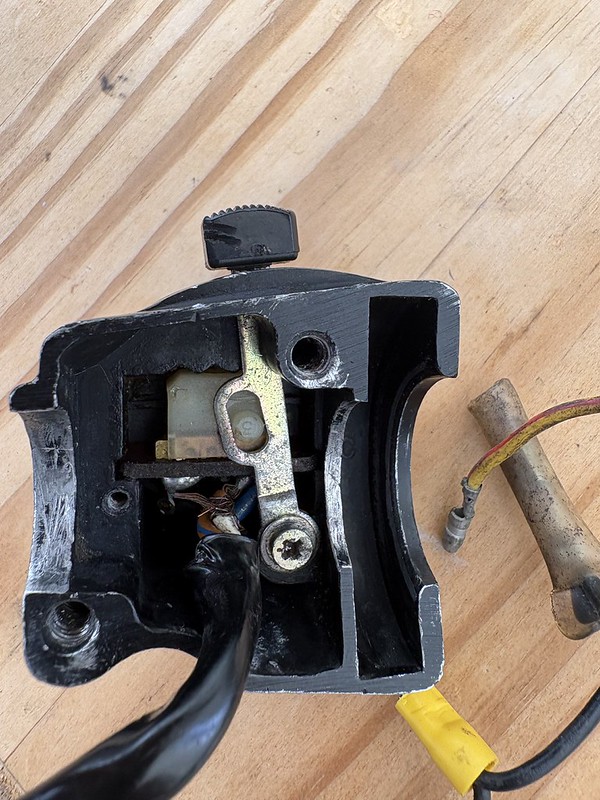 IMG_6718 by Alan Othen, on Flickr
 IMG_6725 by Alan Othen, on Flickr
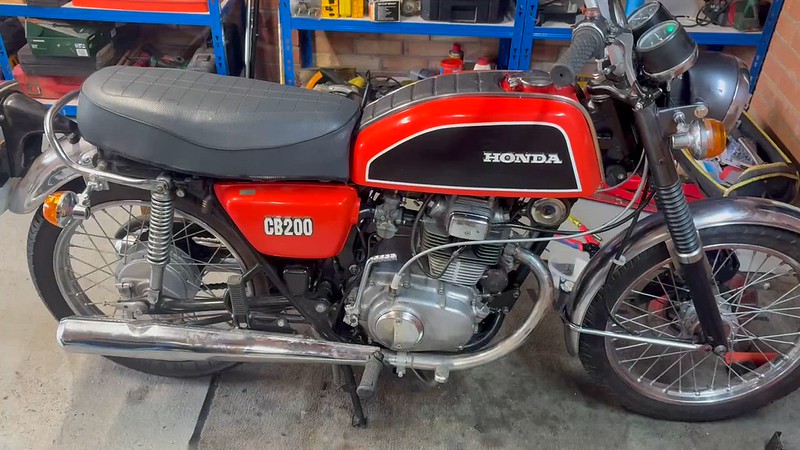 IMG_6724 by Alan Othen, on Flickr .
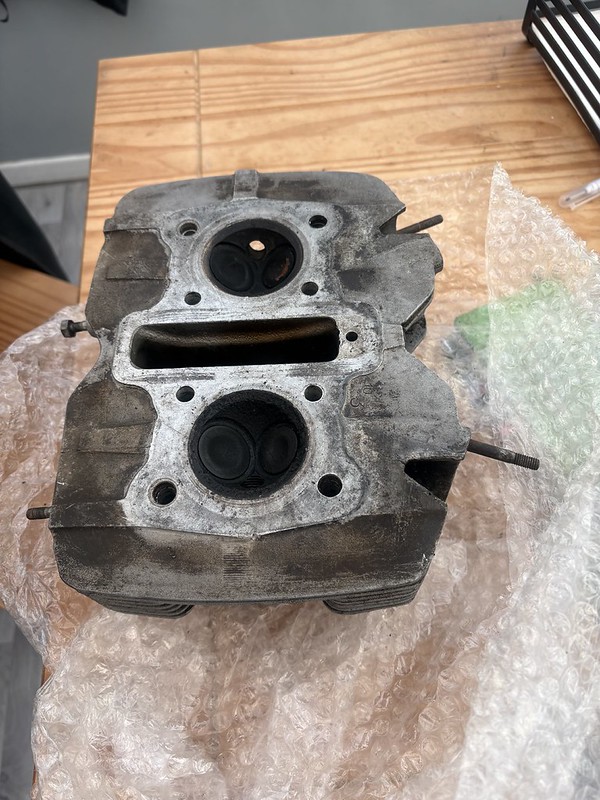 IMG_6741 by Alan Othen, on Flickr

Just to be clear: by exhaust posts you are referring to the two missing studs? The same for bolts - the long studs that sandwich the barrels between the crankcase and the head?Worthwhile to put new valve seals on, old ones may have dried out. And address the missing exhaust posts before install if helicoil is needed. Be prepared to replace bolts, multiple retorques have likely weakened the originals.
I haven’t done anything yet, the replacement only arrived yesterday. I was planning to test it was flat first - so I need to find a sheet of glass. At the same time I’ll do a petrol leakage test on the exhaust valves (inlet valves never leak). If that all checks out I’m planning to remove the valves and send the it off for vapour blasting (I found a place in Boston, about 20 miles away) - then replace the valves with some new seals and grind them in.Are you using the head as is and if so did you leak test the valves for leakage?
Yes and yes. have had to replace all 4 exhaust posts as they have pulled out and at least one of the long studs ended up free spinning, requiring thread repair. A few bottom case bolts have broken as being torqued requiring replacement. Similar experience for my other cb200 as recalled, but that engine hasn't been opened for decades.Just to be clear...
Thank you for that - this will be a good opportunity to check.Yes and yes. have had to replace all 4 exhaust posts as they have pulled out and at least one of the long studs ended up free spinning, requiring thread repair. A few bottom case bolts have broken as being torqued requiring replacement. Similar experience for my other cb200 as recalled, but that engine hasn't been opened for decades.

I gotten a piece of 1/4" glass from a custom shower installer. They often have remnants from larger pieces that are just going to the recycle bin.so I need to find a sheet of glass.
That is a good idea - there is a double glazing manufacturer nearby - I’ll ask there.I gotten a piece of 1/4" glass from a custom shower installer. They often have remnants from larger pieces that are just going to the recycle bin.


Good evening - and many thanks for taking such an interest, it is much appreciated. Some answers:I didn't follow this thread in detail initially because I have never worked on a CB200, but I got curious after following your CB360 thread and tried to digest everything over the last two days. I hope you won't mind a few questions as I get fully up to speed.
Engine noises can be nerve wracking for sure. Hope you can get it sorted.
- The motor came to you with a cracked/broken sprocket flange on the cam. I think you mentioned a "box of nails" sound at one point. Was that in reference to turning the motor over by hand or was it actually running in that condition??
- The cylinders had been substantially overbored in the past, to the point that the cylinder walls were quite thin. Combining this with the cam failure, is it possible that the crank has been damaged, for example, the main bearings?
- I somehow missed seeing and hearing the video in which the motor noise is present after you installed the standard cylinders and pistons. Can you tell me which post that was in? Or, would you mind sharing a recording of the motor in its current state? Does the frequency of the noise follow the rpm of the motor?
- What is the theory connecting the head to the noise? Does that mean the noise is expected to be due to the action of the valves?
- Did you already inspect the tach drive or check to see if there is any wobble visible on the end of the cam?
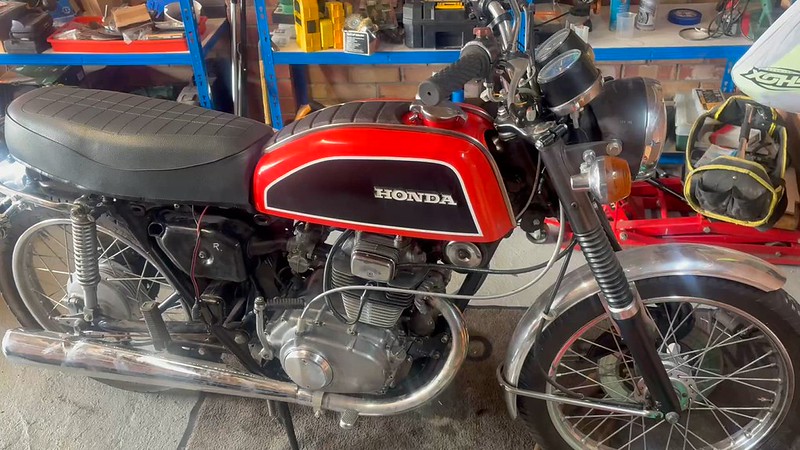 IMG_6454 by Alan Othen, on Flickr
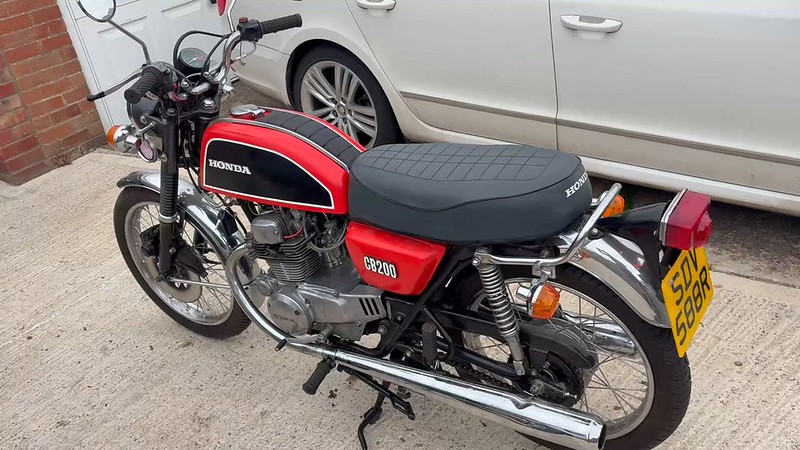 IMG_6654 by Alan Othen, on FlickrIMG_6664 by Alan Othen, on FlickrIMG_6724 by Alan Othen, on Flickr
Please put a zip tie on that loose clutch cable to the frame under the tank, it's driving me crazy.The motor has probably only run for an hour or so since I fitted the barrels and pistons - the little ends seem fine though.
Alan
I can do better than that: I found a couple of genuine Honda cable ties in the spares box the other dayPlease put a zip tie on that loose clutch cable to the frame under the tank, it's driving me crazy.
Thank you so much for responding so quickly, it is much appreciated.Thank you, Alan, for collecting all of the videographic evidence in one place.
Focusing on the most recent video, I do hear a harsh overture in the top end as if from a tappet. I could imagine a motor sounding that way if it were missing one or more tappet covers.
Did you try a mechanics's stethoscope or a length of fuel hose to forget localize the harsh noise on the motor? This helped me realize I had a rotor making contact with the stator not too long ago.
Your tappet covers were replaced with aftermarket replacements, correct? Is there any chance that they are not up to snuff? I'd hate to have you replace them if they are perfectly good. If the old ones have not found their way to the bin, maybe a weight comparison could shed light on their fitness for duty.
When you put the head together the last time, everything with the rockers and tappets looked sound? No cracks, mushroomed ends, etc.?
Aha! I'm mixing the characters together between these two stories!If I recall I only replaced one or two of the tappet covers on the CB200 - and that was with good used original items (the aftermarket ones were for the CB360 - which fortunately work well).
It's easy to do around here with all the stuff we have going on at any one time.Aha! I'm mixing the characters together between these two stories!