1976 CB500T Left side not firing at idle

supedaglup

Member
Joined
May 19, 2026
Total Posts
11
Total likes
2
Location
Washington
Hello,

I am currently facing an issue with my bike where the left side is not firing while at idle. I noticed this when I touched the exhausts and noticed the left side was noticeably colder than the right, so when I pulled the left spark plug boot while running, there was no drop in RPMs, however, after reinserting the left boot and pulling the right boot, the bike died completely, as expected. I have noticed, however, that applying a bit of throttle has the left side come alive, but I hear an occasional misfire as well out of the left.

I have a brand new battery, spark plug, and condenser so we can rule those out. I have bench sync’d the carbs initially with the guitar wire trick but I don’t have a vacuum sync so I can’t do that. The idle with just the right side is sitting at approximately 1100 right now. I tried turning the idle speed screw until the left side came alive but all that did was introduce a sort of “stuck throttle” condition where it was very slow to reduce RPMs after applying throttle as well as a slow idle creep, so I put it back to where I originally bench sync’d it.

Any ideas on where to start? My first thought was to rule out a vacuum leak at the rubber intake manifold boot but if you followed my whole debacle on Reddit it turned out the ones I bought from those guys in Houston were actually ones for the 450 and won’t align properly with my stock airbox setup, so I am waiting for a replacement OEM style one to come in. I unfortunately cannot give any compression readings because the cheap kit I bought from Amazon had their threads immediately misalign and strip on their first use and are not giving me anywhere close to an accurate reading.

Thanks for your help.
 
Oreilly/Autozone will “loan” you a compression tester to get true numbers there.

Have you identified for certain that you are receiving spark at the plug by testing it visually?

If spark exists, I’d start with timing and points gap/valve settings (not the 3X the factory spec setting that some videos use)

Float height and the slow/idle jet being clogged would be other areas to take a look at.
 
Oreilly/Autozone will “loan” you a compression tester to get true numbers there.

Have you identified for certain that you are receiving spark at the plug by testing it visually?

If spark exists, I’d start with timing and points gap/valve settings (not the 3X the factory spec setting that some videos use)

Float height and the slow/idle jet being clogged would be other areas to take a look at.
Forgot to say, but yes, I tested both plugs and saw a good spark. I have noticed carbon fouling too though, I assume its running rich but its hard to tune without it idling properly so I have the mixture screw turned about 2 turns out. I have also cleaned both carburetors and I believe I set the proper float height? I set 20mm but to be honest I didn’t verify its proper spec with the manual I just went with the CM video.

I can look at timing next, I did have the cover open previously to take a look with my test light and it seemed okay but I can check it again. What am I looking for in the valve settings?
 
I can look at timing next, I did have the cover open previously to take a look with my test light and it seemed okay but I can check it again. What am I looking for in the valve settings?
Since you've been watching their videos, let me tell you that you need to follow the FSM for points gap and timing, their method is incorrect and points gap does matter despite what they might say. Set the valves at .002", spec is .0012" but even .0015" feeler gauges are hard to find and so thin they're hard to work with on the DOHC 450 and 500T. Using .002" is only .0008" wider than spec and will be fine, and feeler gauges that thickness are easy to use.
 
Forgot to say, but yes, I tested both plugs and saw a good spark. I have noticed carbon fouling too though, I assume its running rich but its hard to tune without it idling properly so I have the mixture screw turned about 2 turns out. I have also cleaned both carburetors and I believe I set the proper float height? I set 20mm but to be honest I didn’t verify its proper spec with the manual I just went with the CM video.

I can look at timing next, I did have the cover open previously to take a look with my test light and it seemed okay but I can check it again. What am I looking for in the valve settings?
Do you have the service manual for this bike? The valve adjustment process is pretty straightforward, albeit a tad fiddly.
It’s spelled out in the manual but there’s help here if you get stuck or confused.

Floats should be at 20mm from the gasket surface without the gasket.

If the bike sat for a while, take another look at the idle circuit in the carb - it can clog pretty easily.
 
Do you have the service manual for this bike? The valve adjustment process is pretty straightforward, albeit a tad fiddly.
It’s spelled out in the manual but there’s help here if you get stuck or confused.

Floats should be at 20mm from the gasket surface without the gasket.

If the bike sat for a while, take another look at the idle circuit in the carb - it can clog pretty easily.
I'll take a look at the valve adjustment too then, can't get to it today but I'll update as soon as I can.

I measured from the inside of the gasket surface to the top of the float with the carburetor sitting on its side. I hope that means its set properly.

The bike sat for ~3 months while I was gone, but the prior owner told me it sat for around a year before I had it. By idle circuit, do you mean the idle jet? If that's the case, I did clean out the idle jet on my last carb cleaning and made sure I was seeing light through it.

Thanks for your advice.
 
IMG_2788.jpeg

Here’s a cutaway view of the idle/mixture circuit. That tiny tube between the slow jet and the mixture screw can get easily clogged. If your mixture screw isn’t doing anything, that would be the first place I’d look.

Take some carb cleaner spray and jam that little straw in where the slow jet screws in and spray/flush with compressed air (those cans of compressed air for cleaning keyboards works if you don’t have a compressor). It’s a tiny passage and sometimes crud will build up there right where the needle limits flow - that needs to be clean to allow fuel drawn from the bowl through the slow jet and into that mixture adjustment.

It’s probably a good idea to blast out all of the passages and make sure the air cut valve isn’t torn or anything.
 
View attachment 57779

Here’s a cutaway view of the idle/mixture circuit. That tiny tube between the slow jet and the mixture screw can get easily clogged. If your mixture screw isn’t doing anything, that would be the first place I’d look.

Take some carb cleaner spray and jam that little straw in where the slow jet screws in and spray/flush with compressed air (those cans of compressed air for cleaning keyboards works if you don’t have a compressor). It’s a tiny passage and sometimes crud will build up there right where the needle limits flow - that needs to be clean to allow fuel drawn from the bowl through the slow jet and into that mixture adjustment.

It’s probably a good idea to blast out all of the passages and make sure the air cut valve isn’t torn or anything.
Thanks for the tip. I just took apart the carburetor and did like you said: removed the slow jet and blasted it with carb cleaner first, then with compressed air, hoping for a quick fix. Unfortunately, it was still the same upon reassembly: nothing at idle, turning up the idle speed still just gave it that stuck throttle condition. I was really hoping it was just a clogged idle circuit issue like you said since it does seem to function just fine when you introduce some throttle and get it out of idle but that wasn't the case. I'll get to looking at the valve adjustment settings next.
 
I'll get to looking at the valve adjustment settings next.
You never answered when asked if you had the FSM. If you do not, here is a link to it. Read the valve adjustment procedure carefully if you're not overly familiar with this engine, it isn't typical. And as I mentioned earlier, use .002" feeler for the valve adjustment.

 
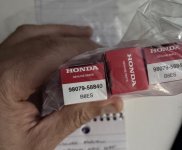
Random question I just thought of: when I got new spark plugs, I am running new NGK BR8ES plugs on both sides. I know I'm supposed to be using the B8ES spark plugs but I couldn't get any, and I heard for these old bikes they can cause issues if they have a resistor plug boot. I actually had changed the right side's ignition coil a while back when I noticed it was having issues and it came with a new plug boot and I was wondering if that could be the reason the left side is having issues since I never changed that side's coil. Do you think the issue could actually be with the spark?
 
1000% possible. Which is why I was asking about visually verifying spark.

“90% of carb problems are electrical”

Don’t have a multimeter? If so, you can test that left side coil/cap to make sure that’s not the issue.
 
Last edited:
I did see a spark (and I felt one too... wasn't wearing gloves) but maybe it wasn't strong enough. I'll quickly test by throwing the old spark plugs in. If it's truly the problem I might just go ahead and change out the left side's condenser as well while I'm at it.
 
Random question I just thought of: when I got new spark plugs, I am running new NGK BR8ES plugs on both sides. I know I'm supposed to be using the B8ES spark plugs but I couldn't get any, and I heard for these old bikes they can cause issues if they have a resistor plug boot. I actually had changed the right side's ignition coil a while back when I noticed it was having issues and it came with a new plug boot and I was wondering if that could be the reason the left side is having issues since I never changed that side's coil. Do you think the issue could actually be with the spark?
The bike need to have resister caps with non-resister plugs or resistor plugs and non-resistor caps. If you have both resistor caps and plugs it will run very poorly. Take a multimeter and check the resistance of the caps, in your case with resistor plugs you want 0 ohms or close to it. Also the resistors in the old caps originally read 5K ohms but are very likely bad and reading much higher.
 
I did see a spark (and I felt one too... wasn't wearing gloves) but maybe it wasn't strong enough. I'll quickly test by throwing the old spark plugs in. If it's truly the problem I might just go ahead and change out the left side's condenser as well while I'm at it.
You need to test the cap and coil before just firing the parts cannon.
 
The bike need to have resister caps with non-resister plugs or resistor plugs and non-resistor caps. If you have both resistor caps and plugs it will run very poorly. Take a multimeter and check the resistance of the caps, in your case with resistor plugs you want 0 ohms or close to it. Also the resistors in the old caps originally read 5K ohms but are very likely bad and reading much higher.
I see. Thank you. My old plug boot didn’t have a label but I just tested it and it’s reading about 9 Ohms. My new one is reading 5, which is what is printed on it. If I’m understanding correctly, both are resistor plugs so I need to swap them out for non-resistor plug boots? Also I double checked my old spark plugs and the previous owner also had BR8ES plugs so I don’t think they caught this either.
 
That 9ohm is way out of spec. What are the primary and secondary resistance numbers for the coil?
 
I see. Thank you. My old plug boot didn’t have a label but I just tested it and it’s reading about 9 Ohms. My new one is reading 5, which is what is printed on it. If I’m understanding correctly, both are resistor plugs so I need to swap them out for non-resistor plug boots? Also I double checked my old spark plugs and the previous owner also had BR8ES plugs so I don’t think they caught this either.
5 ohms, or is there a. "K" on the screen too? If it really is 5 ohms, you can run the resistor plug.
 
Back
Top Bottom