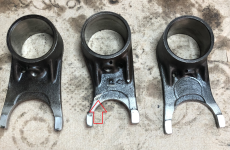
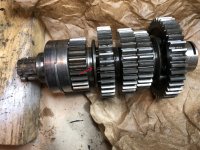
The shift forks are the connection between the shift drum and the transmission gear. This is called a function group because all these parts have one overall function. When you see wear on the shift forks, you should look at all components in this function group, not only the shift forks.
The whole group is larger, being:
- pizza cutter
- shift drum
- shift drum groove
- shift fork pin
- shift fork guide
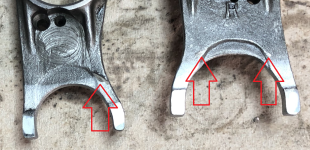
- shift fork "hammer head area" (as you call it)
- transmission gear groove (where the shift fork slides in)
- transmission gear
- transmission shaft
All these parts have a certain tolerance, and the total, cumulative, tolerance will have influence on the amount of wear and pattern.
For example, if the radial play of the shift fork to the shift drum is too large, the shift fork can tilt under force, touching the gear tooth, with the result in a typical wear pattern pointed out by AD. In your case, the "hammer heads " are (probably) good to go (measurements will reveal this), it's the tilting that is the issue here. But it's more complex than this, tilting of the forks is one possibility, tilting of the gear the other one. A tilting gear could mean a worn gear or a worn gear shaft. In most cases, tilting is caused by radial play between gear and shaft.
Looking at the wear patterns of all the parts in the function group will reveal the real reason behind the wear on the sift forks, and in most cases this is not a single part. Replacing the parts with the largest tolerances (low-hanging fruit) will improve shifting accuracy and result in less wear.
The above is just an example, I also have seen shift drum bearings completely worn out, resulting in a tilting shift drum, causing wear on all shift forks while the shift fork to drum play, and shift fork to gear play was minimal.
Unfortunately, the real issue is mostly the gear to shaft radial play, the gear will tilt and hit the shift drum, causing typical wear as AD pointed out. Replacing the shift fork will take away the play between drum and fork, thus tilting between those parts, but not the tilting between gear and shaft.
In your case, the wear pattern on the "hammer heads" is only at the tips, meaning tilting of the gear is probably your enemy.