1971 CB350K3 reanimation project — maintenance log

stl360+450

Veteran Member
Joined
Aug 6, 2021
Total Posts
5,065
Total likes
2,609
Location
St. Louis, Missouri, USA
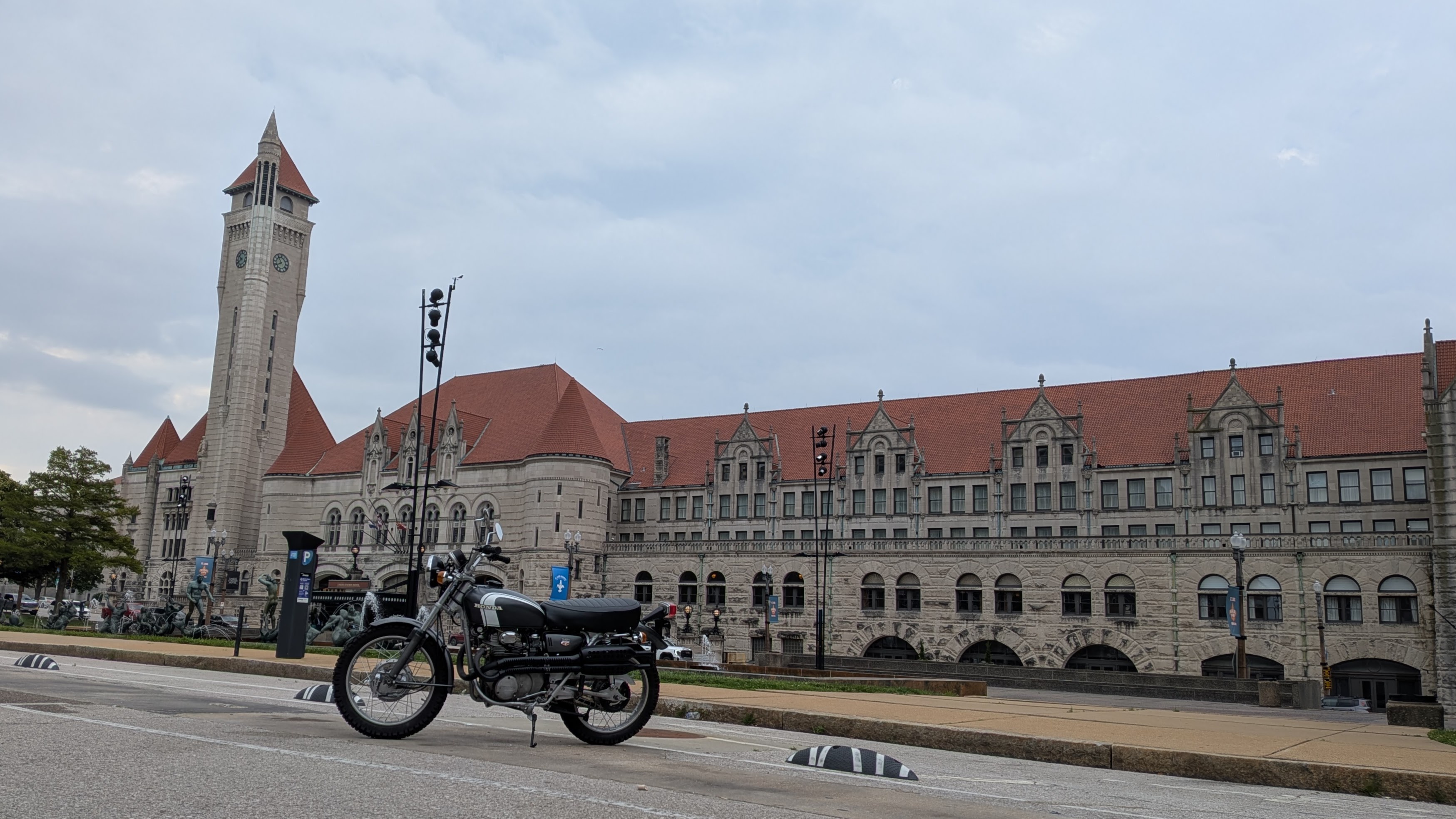
This thread will be used to keep track of and share maintenance work on my 1971 CB350 K3 project, which got off the ground four years ago in another thread. That long build thread had many twists and turns, so it will be helpful to me to start a clean, post-build thread for modifications, repairs, and upgrades. The picture below was taken this morning at the St. Louis Union Station, a landmark of the city that opened on 1 September 1894. I doubt anyone at the time could have guessed that it would eventually be the home of the St. Louis Aquarium after serving as a mall from the mid-1980s until around 2015.
fVutbjq.jpg


This was part of a fifteen mile city ride in order to fully warm the motor for a check on the oil pump, which I believe confirms @tmross's observations that oil is not reaching the head at idle once the motor has reached full operating temperature. The video below is not the best, but showed that oil reaches the head only when the engine speed is raised to about 1500 rpm. This is an original piston oil pump with unknown mileage/hours that came with one of the two salvage motors used for my project.


I guess maybe this explains why I always feel like I'm abusing my air-cooled motorcycles when I'm stuck at a traffic light for a long time on a hot day. Count me among those interested in purchasing and installing one of @Jays100's hotly anticipated CB350 gear pumps.

Another concern that I hope to address soon involves the rims. I disassembled the wheels that came with the original donor bike, had the rims powder-coated, and relaced them with new spokes. The wheels were trued at the shop where I bought the rim strips, tubes, and tires and, when I picked them up, the owner told me they were as good as they could get them. I didn't give it a lot of thought at the time, but since the bike has become roadworthy the roundness of the rims has come into serious doubt. I think the safest option is to replace the rims and go from there, so I ordered a set of black Rising Sun rims that should arrive later today. I'll plan to remove both wheels and take them to a shop to be laced and trued.
 
Last edited:
Well that's a scary discovery, it makes you wonder just how many are out there with that deficiency at idle. Sit there long enough and I can see how it would lead to excess wear and potentially actual damage.
 
Well that's a scary discovery, it makes you wonder just how many are out there with that deficiency at idle. Sit there long enough and I can see how it would lead to excess wear and potentially actual damage.
This is my first CB350 and building one of these motors doesn't give me the kind of experience that people like @LongDistanceRider, @Boomer343, or @Stan Lipert have with this platform. I would be curious to hear their opinions on whether this performance is typical for the stock pump.
 
This is my first CB350 and building one of these motors doesn't give me the kind of experience that people like @LongDistanceRider, @Boomer343, or @Stan Lipert have with this platform. I would be curious to hear their opinions on whether this performance is typical for the stock pump.
It's funny because back when I was in the 350 engines a lot more often, we never once thought about checking oil flow once it was checked after a rebuild and of course, done when first started cold. Certainly an interesting discovery.
 
It's funny because back when I was in the 350 engines a lot more often, we never once thought about checking oil flow once it was checked after a rebuild and of course, done when first started cold. Certainly an interesting discovery.
If I understood correctly, it sounded like tmross was being told something to this effect on the Facebook groups, which I have no part in. So, it may be well known to some, but I agree with you that it wasn't something I ever thought about after confirming flow at the time of first start.

I believe Jensen uses a higher weight oil, like 10w60, and I wonder how that would affect things.
 
This is my first CB350 and building one of these motors doesn't give me the kind of experience that people like @LongDistanceRider, @Boomer343, or @Stan Lipert have with this platform. I would be curious to hear their opinions on whether this performance is typical for the stock pump.

We should do a survey of all the 350 owners here to settle it - take a 30 min ride and check the oil bolt! And yes multiple people on the facebook 350 group said it was normal/not a concern.
 
We should do a survey of all the 350 owners here to settle it - take a 30 min ride and check the oil bolt! And yes multiple people on the facebook 350 group said it was normal/not a concern.
I would never consider a loss of oil flow at idle to be "normal or not a concern". I doubt it's typical, especially doubtful it typical when these bikes were newer. Lots of people idled in traffic every day back when these bikes were regularly on the road, seems like a lot more problems would have happened if it was typical so I'm not sure I agree with that sentiment.
 
well, to be fair, the oil check bolt is a good 3 inches above the inlet channel on the endcap, it is possible there is enough pressure to reach the endcap, at a volume adequate for idling, but not enough to reach the check bolt. When you rev the engine a little it spurts out immediately, indicating the oil is not far from the source.
 
well, to be fair, the oil check bolt is a good 3 inches above the inlet channel on the endcap, it is possible there is enough pressure to reach the endcap, at a volume adequate for idling, but not enough to reach the check bolt. When you rev the engine a little it spurts out immediately, indicating the oil is not far from the source.
Good point, but it still seems like there should be something coming out of it at idle, even if only a dribble.
 
I think there are a lot of factors at play and I really wouldn't be surprised if this performance was typical even when the parts were new.
  • Oil flows very well at idle on a cold motor, so upon startup there will be adequate oil distributed to the head.
  • Oil continues to flow at idle during warm up and at ≈1500+ rpm when hot.
  • Motorcycles, especially air-cooled ones, should not be run at idle for long periods of time, anyways, so the risk of damage is low if this is avoided.
 
Motorcycles, especially air-cooled ones, should not be run at idle for long periods of time, anyways, so the risk of damage is low if this is avoided.
Can't disagree overall, but it's still assumption that enough oil flow is happening to keep the cam and bearing covers happy when it isn't exceeding the level needed to come out of the check port. I'd guess so, but it just doesn't feel comfy and safe.
 
cam bearings aside, the rest of the valve train is lubricated by the cam lobes dipping into the oil reservoirs at the bottom of the cam box and splashing that oil around. perhaps it takes a few minutes for those reservoirs to deplete with no replenishing flow. So they fill up during normal riding, you stop at a light for a few minutes, still getting splash lubrication for a bit. in that scenario you could see how only the bare minimum of oil volume may be necessary at the bearings during idle. wish the guy who designed the oil system was here.
 
cam bearings aside, the rest of the valve train is lubricated by the cam lobes dipping into the oil reservoirs at the bottom of the cam box and splashing that oil around. perhaps it takes a few minutes for those reservoirs to deplete with no replenishing flow. So they fill up during normal riding, you stop at a light for a few minutes, still getting splash lubrication for a bit. in that scenario you could see how only the bare minimum of oil volume may be necessary at the bearings during idle. wish the guy who designed the oil system was here.
It's a valid point that the cam box does hold some oil in it, and as a DOHC 450 guy I'm always thinking along the lines of total oil loss to the sump after pressure/flow lubrication because the 450 head does not have any containment under the cams and followers. So I guess it could withstand some idling before the splash reduced the contained oil too much.
 
A shop near me carries Motul 10w60 and I may give that a try. I still haven't done the initial oil change on this motor.
Valvoline also does a 20W50 JASO MA2 conventional that's relatively inexpensive. OReilly's just had a deal on it that worked out to $5.50/qt I'm switching the 450 over since I never ride in temps cold enough to warrant 10W oils.
 
I would think that no active oil delivery any time the engine is turning is a problem. But that’s just me.
 
I would think that no active oil delivery any time the engine is turning is a problem. But that’s just me.
I can't disagree, but at least the 350 does puddle some in the cam box - but how long it lasts is anyone's guess.
 
I would think that no active oil delivery any time the engine is turning is a problem. But that’s just me.
It's definitely a problem, how big a problem is harder to ascertain.

I wonder if there is a Rotella uncertainty principle at play with the oil check bolt. Might that opening have a substantial effect on the ability of the pump to deliver oil to that location? In other words, maybe it was only intended to be used when the oil viscosity is high at startup?

In any case, I'm glad to know that someone is working on a solution! 😉
 
When I first got my restored CB350 engine running , and after noting comments on this site about waiting 30 to 45 seconds before applying any throttle I thought I would do a little experimentation.
so from dead cold, with the witness bolt removed I started it up and watched the witness bolt hole. Sure enough after 35 or so seconds oil started to appear at the bolt hole. It did not run out as expected but slowly filled the bolt hole diameter to form a miscus across the hole. My oil is Penrite 10w40 Jaso MA compatible.
after leaving the bike to warm up further (a couple of minutes so not really hot) I applied a small amount of throttle and watched as oil broke the miscus and started running slowly out the hole.
So I thought this is good, pump is working I wonder if I can measure it?
I found a compatible bolt drilled a hole through it and sweated on a small diameter copper pipe attached to a small modellers 0 to 10 psi gauge.
after the engine warmed up properly this time I could not see any pressure registered on the gauge. However I could discern a very small pulsing movement of the gauge needle, whether this is coming from the pump or just engine vibration I don’t know.. the pulsing frequency changed with throttle being applied.
the result of all this is yes, oil is getting upto the top left cam area, yes there is sufficient to come out of the witness hole after applying throttle, but no not enough pressure to measure from this hole.
I await Jays new pump with anticipation!!!!
 
I had to go to ever smaller / more sensitive units to get a meaningful measurement on the 450. That is inches of water column. What I found was that at idle, pressure to the top end at idle was 35 “wc. That converts to 1.3 (rounding up) psi. Barely adequate and it’s no wonder your gauge wouldn’t pick it up @GaryJames

The pressure swing or gauge perturbation is an exact insight into the piston pump stroking. Quite fascinating! As I have a remote gauge, I was able to pinch the line to snub the swing to a more average reading.
 
I got started on my to-do list this morning by removing both wheels. The bike has been bouncy on the road and I need to determine the cause.

EJiuykR.jpg


Initially, I was planning to have a local shop swap out the rims, but they wanted almost $400 to do both wheels and it sounded kind of high to me.

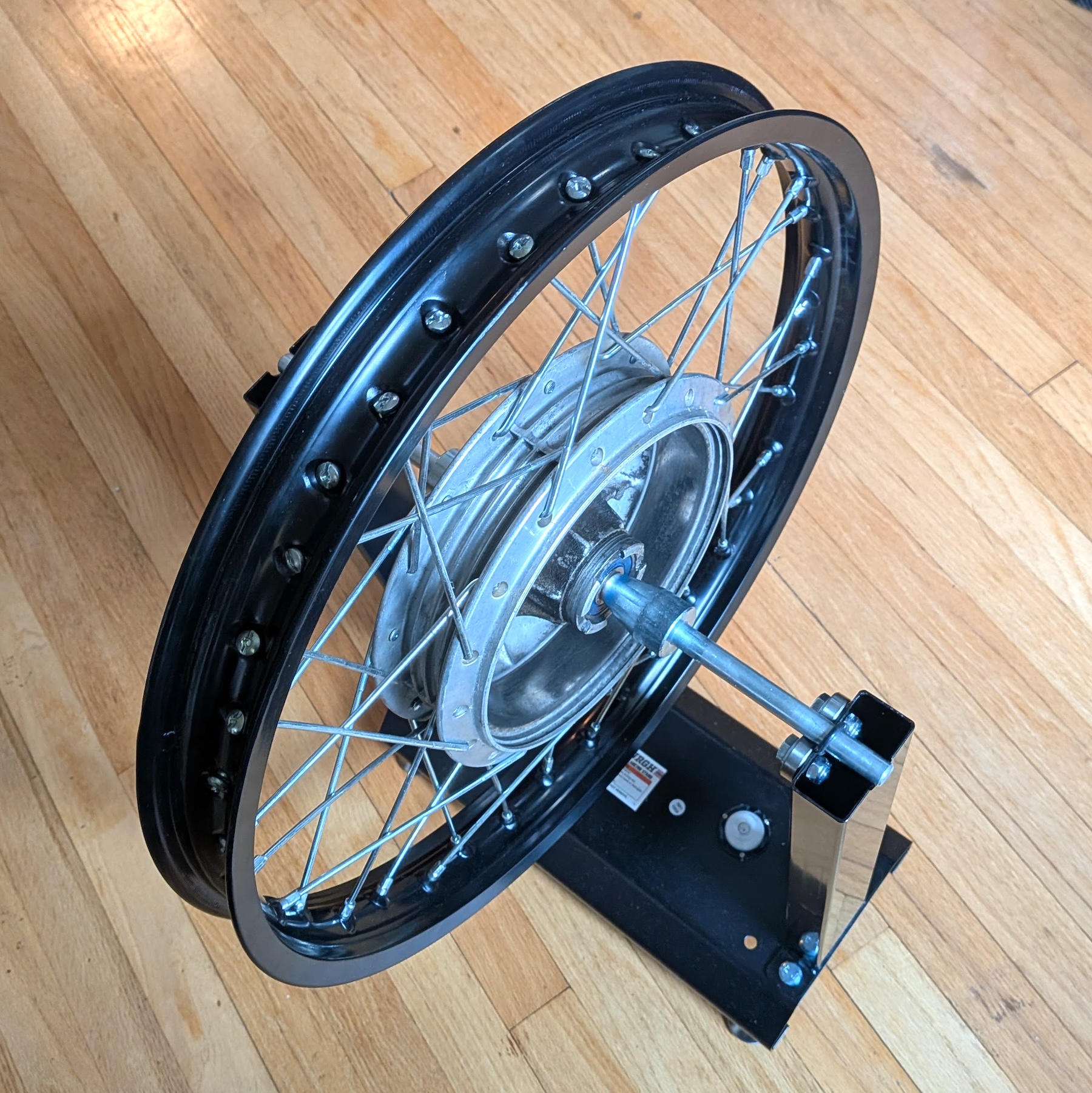
So, I bought a truing stand at Harbor Freight and removed the tire, tube, rim strip, and six 5-gram counterweights from the front wheel. I have it on the stand now and (without a dial indicator gauge) it looks good to me.


Input is appreciated.
 
I have the black Rising Sun aluminum rims (4-into-1) laced up, but am awaiting a proper spoke wrench to true them. I notice that the rim flanges are much thinner on these aluminum rims in comparison with the OEM steel rims. Will the reduction in weight (inertia) be noticeable while riding?

bv4bTQB.jpg


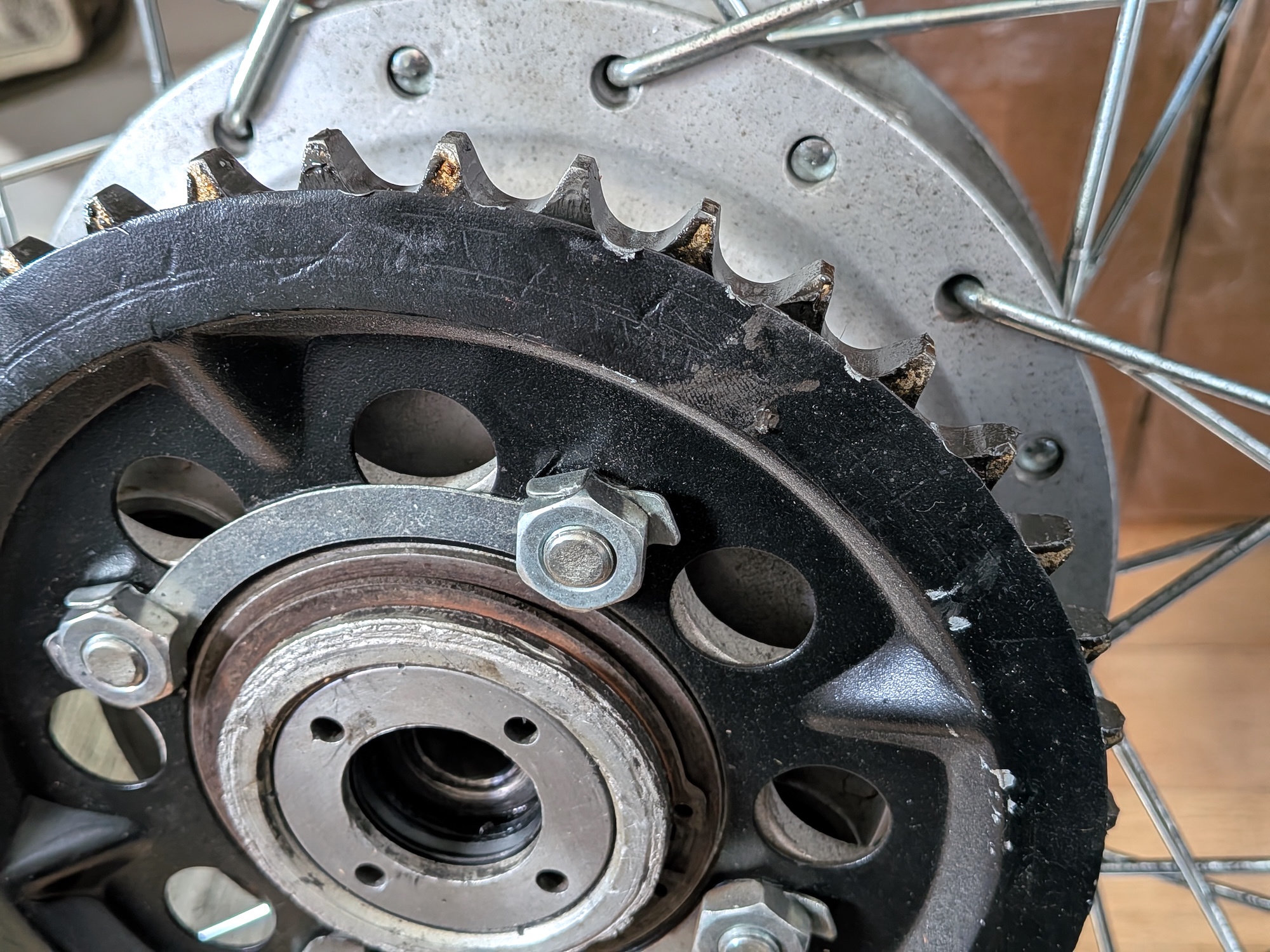
I also discovered that the sprocket plate is making contact with the chain pins in a few places. I will plan to remove that plate and put it into cold storage.

PAxlPoL.jpg
 
Last edited:
So, I bought a truing stand at Harbor Freight and removed the tire, tube, rim strip, and six 5-gram counterweights from the front wheel. I have it on the stand now and (without a dial indicator gauge) it looks good to me.
Side to side looks good, the up and down is a little harder to see due to the straight on angle of the video, but also looks ok.
 
I removed the OEM rims and have been working on truing the Rising Sun anodized rims from 4-into-1 for the last few days. This is my first time truing motorcycle wheels, but I believe I have a handle on the process. Unfortunately, these rims have a severe flat spot at the point where the hoops were welded.

I have been unable to get the radial run-out below 2 mm and it's the spot at the weld that I cannot correct. If it were an oval, things would be different, but the run-out variation is all happening at the weld and I don't think I can get them any better.

Rather than move forward with these rims, I am now looking at aftermarket rims from David Silver Spares USA. [front] [rear]

Does anyone have experience with these rims that they would care to share? For example, are these manufactured to a better tolerance than the budget rims from 4-into-1?
 
I got the front rim and spoke kit for my 450 from DSS. It was my first time lacing and truing a wheel but seemed to be a good product. There was a little hop at the weld but not near as much as you are describing with the Rising Sun rim.
 
I got the front rim and spoke kit for my 450 from DSS. It was my first time lacing and truing a wheel but seemed to be a good product. There was a little hop at the weld but not near as much as you are describing with the Rising Sun rim.
Thanks, Rob. Do you remember if that was OEM replacement (D.I.D.) or the aftermarket option?

When I first got the spokes finger tight all the way around the radial run-out was about 5 mm!
 
It is the OEM replacement, stamped DID. For my 450 it only shows 2 options, Genuine part and OEM replacement.
Thank you. I was considering gambling on the aftermarket replacement available for the CB350K3, but opted for the D.I.D. rims to play it safe. I've already wasted money on those other rims and don't want to repeat that mistake.
 
Back
Top Bottom