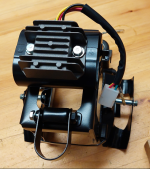
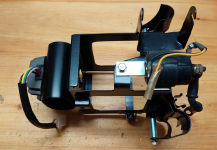
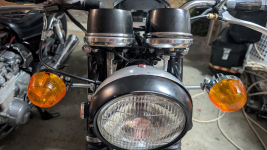
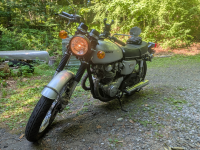
1970 CB450 K3 - Bringing it Back project

MrMoonbeam72

Member
Joined
Jul 15, 2025
Total Posts
31
Total likes
8
Location
CT
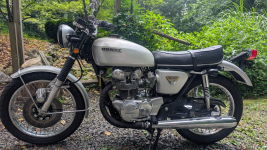
Purchased on 7/13/25 and ridden home that night about an hour away from Farmington CT
It has been a busy week since I picked this up, and I've spent most of it documenting and going over what I'd like to have done

It seemed to start ok, but the owner I purchased from only had it for a month before he decided it was too much as a new rider, and sold it at a loss.
As a result it had only really idled, over the last few weeks.
It struggled to maintain a steady idle for me though, and died several times on the way home (was too low) so I found I needed to blip the throttle to maintain it whenever I came to a stop
The battery was also really low and kick starting quickly became the only way to bring it back to life.
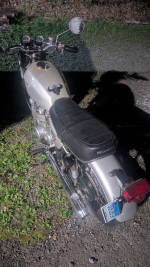
1753100158750.png

I dont know much about the history, other than it largely had one other owner prior to mine for years who would take it to an area mechanic and re-tune it, so I'm thankful to have some service records

Prior Repairs/Replacements/Upgrades
  • New tires
  • Painted fenders front - grey
  • Painted fenders rear - grey
  • Painted gas tank - grey
  • Painted forks - black
  • Painted headlight grey with black trim
  • New electrical lines to flashers - front & rear
  • Bullet style flashers front 1”
  • Bullet style flashers rear 2.25”
  • New battery
  • Full Carb removal ultrasonic clean and retune
  • Wrapped exhaust pipes (both)
  • Replaced clutch cable
  • New spark plugs, caps and lines
  • Added fuel filters (1 per carb)
  • Front brake calipers rebuilt
  • Rebuilt master cylinder
  • New rear and front sprockets
  • Replaced chain 2020

This is my short list (soon to be longer) of what I'd like to address:

ToDo
  • Sort out idle
  • Obtain auto wire 14g v 16g Black, Green, Red (25ft spools)
  • Replace headlight bulb with LED
  • Replace rear brake bulb with LED
  • Replace front flashers and bulbs (LED)
  • Replace rear flashers and bulbs (LED)
  • Rectifier/Regulator replacement
  • Replace Wiring harness?
  • White Yellow mod (perform same time as rectifier repl)
  • Strip and repaint fork to Candy Gold
  • Strip and repaint headlight to Candy Gold and chrome

I have an idea of how to approach a lot of the changes, but Ill definitely be posting here looking for advice on others.
It could use an overdue washing so I may know more when I give it a once over.
Somewhere in the past the owner began to make this look like a cafe racer, but I much prefer the traditional look, so I'll be looking to get things back in line as I can, and bring back the Candy Gold (though I'm unclear on what the original paint job was)
I've scheduled a DMV appointment next week, and I'm hoping I can drive this to work perhaps once a week with good weather once it is registered

More pictures and updates to come :)
 
Hi,

I do understand your wish to personalise and upgrade your bike, but I would invests some time to read-in on this forum, download a FSM, and go through the engine, starting with a compression measurement. Next step would be to take the fuel tank of, take off the valve covers and see how your cams look.

btw, do you have experience with these bikes ?

Jensen
 
The battery was also really low and kick starting quickly became the only way to bring it back to life.
These engines' alternators do not have positive output at idle, the engine has to be above 2500 to 3000 rpm in order for the charging system to begin recharging the battery, so idling sitting still and making carb adjustments is only discharging the battery.
Full Carb removal ultrasonic clean and retune
If carb kits were used, then the carbs may well have replacement aftermarket jets and float needles in it that will affect the way it runs and your ability to properly tune it.
New spark plugs, caps and lines
New plug wires? On the correct/original style coils for the bike, the plug wires are permanently attached. Are the new plugs the BR8ES resistor version? If so, non-resistor caps are necessary but the stock caps are resistor (B8ES non-resistor plugs are NLA)
  • Rectifier/Regulator replacement
Your best value for a top quality rec/reg combo unit is Sparck Moto - http://www.sparckmoto.com/Products/Detail/7
  • Replace Wiring harness?
Unless hacked to hell, it may very well be okay. But if you do need one, Sparck Moto also has quality harnesses at good prices as well.
  • White Yellow mod (perform same time as rectifier repl)
Absolutely
 
Thanks for the line by line breakdown - most of that I was aware of, having been lurking in the forum shadows.
I'll have to look at the plugs to have an idea about the type, but to be fair, I have little concern at the moment over those along with compression, and carb replacement kits
I was able to speak to the mechanic who did most of the prior work, including the once over before it was sold, and is VERY familiar with these older bikes.
In fact its all he works on is 70s motorcycles, so I'm confident he would have done it right, but it cant hurt to verify and double check.

I'm the type who has enough repair experience to be dangerous, so I approach the work cautiously and with a good amount of research beforehand.
My son also recently purchased a CB650 so we're dipping our toes in together.
If it comes to taking the motor apart that may be the limit of my skills, partially from know how and partially from lacking specialty tools to do so.
I figure I'd be in a good place if I could at least perform the majority of routine maintenance and checks myself, and hand off as needed.

After opening the empty tool box, it looks like getting my hands on a DIY personal portable tool kit is in order too - most of my existing tools are too long to fit in the box, which seems limited to 7 inches.

I have seen recommendations for both Sparck and for those guys in Houston for both the rectifier/regulator and LED changes, and I'm led to believe quality is similar between them so it is more of a personal preference.
If anyone has personal anecdotes I'd love to hear them before I make that another purchase
 
I have seen recommendations for both Sparck and for those guys in Houston for both the rectifier/regulator and LED changes, and I'm led to believe quality is similar between them so it is more of a personal preference.
If the two units are the same - and when you look at close-up pictures of them both, it appears they are - then the decision should be easy. $65 from those guys in Houston vs $37.50 from Sparck Moto, and the owner of Sparck Moto is a member here (@Sonreir) and will personally offer support if you need it. Seems like a no-brainer to me.
 
  • Like
Reactions: J-T
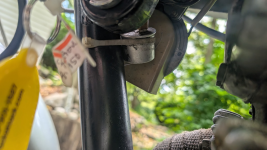
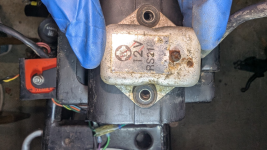
So I noticed this the other day - a random electronic part zip tied to the front fork next to the horn
Can anyone ID this and perhaps tell me how to properly and correctly mount it?
Anything I should consider replacing? Looks rather dated - no markings I can see
I have not traced out to see where it connects to as of yet

1753188822015.png
1753188864404.png
 
Another day and another step of progress.
Its the little things...
  • Ordered spare key
  • Installed LED rear bulb
  • Gave it a thorough washing and detailing
  • Made basic idle adjustments.... although I need more tinkering obviously. Got it to low idle around 800, but after maybe 5 minutes it kicks off (set choke off after perhaps 1 minute.) Did not run it around the neighborhood for a proper warm up so I'll do that tonight before making further adjustments
  • Short video here: https://photos.app.goo.gl/xCmwnTCJCJqPR1Qb9
1753275168405.png
 
Idle speed should be 1200 rpm +/- 100 rpm for proper mixture adjustments and yes, take it for a ride around the neighborhood before doing the adjustments.
 
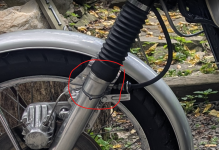
I happened to see this in the picture
Looks like I have more work to do
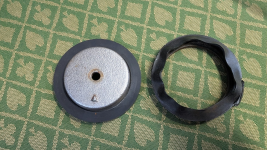
I did a quick lookup and watched some semi-related videos but how exactly the bottom of that gasket connects isnt at all clear to me
I'll reapply a zip tie onto the outside for now, but I want to do it right

1753302181094.png
 
There is a lip on the inside of the rubber boot that fits in the groove of of the fork. No zip ties or clamps are required for the stock rubber boots. These are likely aftermarket boots.
 
There is a lip on the inside of the rubber boot that fits in the groove of of the fork. No zip ties or clamps are required for the stock rubber boots. These are likely aftermarket boots.
That makes sense. This one was rather loose and slightly oversized. Any recommendations to locate the proper one? I cant imagine a refurb is in order, as I expect 50yr old rubber to be pretty worn so I might just stick with a better fitting replica part
 
Part number is 51611-300-000 and David Silver Spares has the repop for $27.50 a pair and the original Honda Boots for $46.84 each. FWIW I purchased a pair of repop boots from DSS for my S90 when I refurbished it and they did not fit properly. I have since ordered a pair of Honda boots for it but haven't got around to installing them yet,
 
August Update

Bike is now fully registered.
I keep returning to the name of 'Misty Morning' for the bike. I thought it was a good pairing of the current foggy grey color that I'll be eventually replacing back to Candy Gold
I think I'll apply some short term gold racing stripes until somewhere down the line I can pull things off to get it repainted, but that is pretty much the lowest priority item on my list.

I had purchased an H4 headlight bulb, only to find this has a sealed unit just over 6 inches in diameter.
After some lookups it seems those guys in Houston has a replacement reasonably priced that mimics the stock unit, while allowing the standard H4/9003 bulbs to be used instead, so I'll put that on my ToDo.
Parts have arrived for the gas tank gasket, rectifier/regulator and replica signal/flashers/winkies

So since I've had the bike I've noticed the wrapped header pipe on the left side smokes after perhaps ten minutes of runtime
Someone had suggested it could be a bad or faulty valve, so I wanted to put it out here for any other opinions, and possible solutions.
In time, I'm planning on removing the wraps as I prefer a clean look, not the cafe racer one


As an extra ask, I made some idle adjustments, and the bike now runs adequately, but it idles high around 3K RPM at stop lights, and takes perhaps 30-60 seconds to come back down to 1200
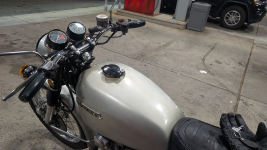
Is this more of an idle screw adjustment or the fuel mix screw - im guessing i need to lower (screw out) the idle
Thanks for the input!
 
I made some idle adjustments, and the bike now runs adequately, but it idles high around 3K RPM at stop lights, and takes perhaps 30-60 seconds to come back down to 1200
Is this more of an idle screw adjustment or the fuel mix screw - im guessing i need to lower (screw out) the idle
Before any carb adjustments are made, you should go through the entire tune-up - adjust cam chain, adjust valves, then check the operation of the spark advance, then adjust points and timing, then test ride to get everything up to temp and then adjust the carbs. Your slow return to idle may well be sloppy advancer return springs and/or dry rusty parts that need to be cleaned and lightly lubed (but not with grease).
 
Update 8/11
So first - the smoking pipe appears to be a result of oil or brake fluid spilling onto the pipe.
The leak is way underneath and I lack a bike stand, so I'm still trying to A figure out where it is coming from and B prevent/fix it
I'm not sure if it is one vs the other as I dont have the nose/eyes to tell which is which
Luckily it is a slow drip and a tiny puddle each time, but I want to address it in any case

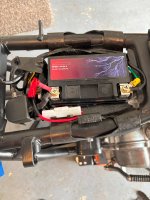
Second - I began to replace the rectifier and regulator with the combo unit this weekend.
There was a snarl of wires and while I was hoping to avoid removing the battery case it seems this is the best course of action.
Somewhere down the line the side panel bolts were swapped out on the left and fudged with an acorn nut to screw into as a stop, so I had a bear of a time trying to hold it from spinning, while unscrewing the bolt.
Wedging some thin screwdrivers beside it seemed to do the trick.
Now once I had a better idea of what I was looking at I dont seem to have enough length to mount the new unit onto where the regulator was

There is a lead going to the positive side of the battery, that also includes a fuse someone wired in - this was wrapped around the top of the battery, and under the rectifier screw mount.
Looking at the picture the bottom left is where negative goes, and the red taped lead goes to positive side
I've test connected the new unit per the picture, but this seems to have only about 4 inches and needs just about double that to remount to the desired spot, where it will also wire into the old regulator lead
As I see it I have these options:
  1. Create/use a wire extension to the main positive lead
  2. Create/use a wire extension to the replacement regulator/rectifier
  3. Mount the new combo unit somewhere other than where the old regulator was
  4. Unwrap the wire bundle covered in electrical tape and see if I can get more length out of it, separating the connections to the new combo unit
1754918002601.png

Looking for advice and direction on how others have approached this
Thanks as always!
 
I mounted mine under the tool box. You have to elongate the mounting holes in the new rec/reg to fit the spacing of the holes on the tool box. The wires were long enough to plug into the old rectifier plug on the harness. I would remove the battery box to make it easier to work on and you can also ditch the rectifier at the same time.

1754936849463.png
 
I mounted mine under the tool box. You have to elongate the mounting holes in the new rec/reg to fit the spacing of the holes on the tool box. The wires were long enough to plug into the old rectifier plug on the harness. I would remove the battery box to make it easier to work on and you can also ditch the rectifier at the same time.

View attachment 48276
Can you explain the picture some more?
I'm seeing the combo unit mounted in the same spot as the old regulator here, and the wires go down, not up to the harness as I would expect.
Is that oval space also considered a tool box? I wasnt sure what purpose it served as the enclosed tool bar with a door is just below it.

BTW this bike is seemingly IMMACULATE and I'm amazed at how clean everything is. Mine still has road grime in all the nooks and crannies.
 
BTW this bike is seemingly IMMACULATE and I'm amazed at how clean everything is. Mine still has road grime in all the nooks and crannies.
It may not be obvious to you (yet, but you'll get used to it if you hang around here long), but his bike had not yet gotten on the road in that picture - notice there's no front sprocket or chain installed in that picture. The wiring for the rec/reg unit was not yet connected, hence it facing the wrong way.

And no, that oval space is the interconnecting tube between factory air filters top help balance the intake air flow.
 
A video link of how to mount this, is posted on that particular Honda parts website that i will no longer name 😆
 
Sorry, I meant to say it was mounted under the cross over tube, not the tool box. The wires are hanging down because, as AD says, I was in the process of assembling everything. The wire would normally go up towards where the rectifier sits. I don't have any pics of the connection to the main harness, the only ones I have are of the battery box.

BTW, I stripped the whole bike down and did mostly a frame up restoration - it had it's share of crud and grime when I started out ;)
1754964746412.png 1754964798878.png
 
So lo and behold, my harness was well wrapped, and when unwrapped I found I had the length I needed.
I was able to split the leads so they could go in the right direction.
I'll rewrap them when I'm done, but first I need to mount the new combo unit and clean the battery cage and surrounding area before putting it all back together

Side NOTE: Has anyone done anything with the space left when the rectifer is removed? Just dead unused space now?

1755173482650.png

1755173565829.png

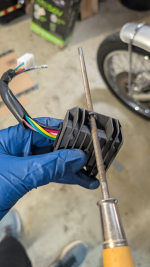
I noticed I needed to file out both holes towards the center to match up the old mounts for the regulator - otherwise they wont spin in

1755173581933.png
1755173601891.png
 
So I had originally thought the black lead coming off the new combo unit should be reconnected into the old black lead the old regulator was using.
After coming across this post here however, it seems that is specific to the battery type.
I currently have the Mighty Max gel battery, so therefore once I connect the combo unit in, I tape off the old regulator connections and the single black new one and I'm good to go?
@Sonreir care to confirm?

1755203407595.png
 
Last edited:
We've upgraded our R/R since that post. Black wire from the R/R to the old regulator location is a great option. You can drop the charging voltage by a tenth or two by splicing the red and black wires together (on the R/R), but 99% of the time it doesn't need to be done.
 
Yeah, the charging systems are marginal at best. Two mods are recommended.
— convert to LED bulbs, Sparckmoto has the instrument bulb wiring (for turn signal indicator) as they connect to + on one side and - on the other…LED don’t like that and his conversion works. All other bulbs connect same.
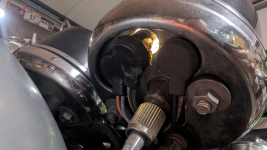
- connect the yellow to white wires in the headlight shell. See your wiring diagram. Full charging doesn’t happen until the headlight is on. This mod makes full charging happen at all times.
 
Post weekend update:
Finished off the rectifier combo unit replacement with great success - it lives again!
Fuel tank gasket replaced
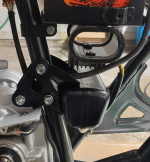
I also began swapping out some of the dial and indicator lights with LEDs, and found a real hokey mount in place for the high beam indicator - it just sits there inside the right turn mount?!
I'm rather shocked it doesnt have better fitting, so I just taped it up with some electrical for now to better fasten it, but I'd be interested to see if others have a better fix
I'm thinking 2 inches of some small diameter hose might hold it in place better

Also found the main dial light came out, but wont stay in.
Looks like the person before had the same issue as it looks like some sort of glue-ish residue
Any harm in using some silicone caulk here? Maybe a thin piece of rubber to jam in the side?

1755520482291.png
1755520510956.png
1755520544892.png
1755520581824.png
 
Update end of September
So I began to swap out the signals in the front, taking care to connect them and test before mounting in place.
Lo and behold by rule of Murphys Law, they flashed a single time then never again.
I began taking a closer look at the wiring only to realize several of the related leads simply broke where the bullet points were connected and I need to recrimp new ones in place.
Here's the problem though - silly me didnt document what went into where before I began since this was all a one for one replacement.
Learning lesson for sure...
The bike still starts, bike works and runs, highbeams and more, but the only affected items are the left and right signals, both front and rear.

By chance does anyone have a simple diagram or better yet, pictures of the actual connectors the front left and front right go into?
I've tried to review the shop manual but the lines are super tiny and unclear as to where they connect into, only the color of wire more than anything else.
There is a bundle of orange cables, another of green and another light blue, while the last I believe is black.
At least that was what I recalled...
 
Last edited:
Orange and light blue are the power to the signals (can't recall which is left or right), and each needs a green ground wire.
 
Thanks! That makes sense - diagram lists Lt Blue to right and Orange to left - that and a ground seems straight forward
 
So I was able to swap out the front signal flashers in the end.
Testing all showed the lights themselves worked just fine.
I swapped the old flasher relay back in - and they began to work. All attempts to use the new relay failed.

A little surprising and shocking that a 50 year old relay works (albeit not as brightly or fast) than a new one that lasted barely three weeks
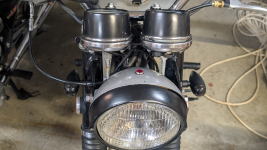
Switched the front from torpedo lights to old school

1756493704964.png
1756493718339.png
 
So for the first time last night I managed to run out of gas.
Puttering along, I came to a stop at a light and the bike just died.
After a few attempts it started up, so right there I was worried about the state of things.
After going up and down a hill or two after that the engine power just kept dropping, and I went slower and slower until I pulled over, when it up and died once more.
Then I realized it was likely just gas - flipped over to the reserve and away I went until I refueled a bit later after my meeting finished.
1756990326141.png

So my whole point here, is how is everyone dealing with their lack of gas gauges?
Just mark down the mileage at refill, go maybe 100 miles and top it off again?
Open the tank once in a while and just add more as needed?
I'd really like to track milage and MPG just as I do with my other bike and car if I can, but I'm not sure if that is viable unless I always refill the same amount each time

On top of this I find I cannot fill it to the top because it slosh/leaks around the cap around turns, so I put in no more than 2.5 gallons to compensate.
Is this typical, or does it point to pinhole leaks around the fill area? (considering I recently changed out the gasket)
 
The CL tank is a lower volume, 2.5 gal capacity. I refill as you say, at around 100mi before reserve. Fuel economy is right at 50mpg. Reserve adds about 30 miles to my range.

However, you have a CB, volume is 3.5 (or is it 3.6?) gals. You should be able to go 150 miles before reserve.

I think the crossover tubes, one or both, may be clogged. I certainly had that issue on one of my fuel tanks.
 
So my whole point here, is how is everyone dealing with their lack of gas gauges?
Just mark down the mileage at refill, go maybe 100 miles and top it off again?
Prior to tripmeters in our speedos, you just rode until it went on reserve and then headed to a gas station. I switched from K5 gauges on my CL450 to a CB77 headlight and combination tach/speedo with no tripmeter, so now I have to remember the last couple digits of my mileage as a 'gauge' since I only have 0.4 gallon reserve (when it works). So I get about 40 mil;es to my tiny 1.4 gallon tank.
On top of this I find I cannot fill it to the top because it slosh/leaks around the cap around turns, so I put in no more than 2.5 gallons to compensate.
Is this typical, or does it point to pinhole leaks around the fill area? (considering I recently changed out the gasket)
Hard to understand with a new gasket in place. The caps are vented because it's gravity feed, but typically they don't leak unless the bike falls over and fuel comes out of the vent.
 
So my whole point here, is how is everyone dealing with their lack of gas gauges?
I use pure gas (no ethanol) and there are no stations nearby that carry it. So I'm filling at home and I'll just open the cap and take a peek every couple of rides and top off as needed. It's easy to be deceived when looking inside the tank with poor lighting, so I recommend using a flashlight and jiggling the tank gently.

I keep very systematic mileage data for my car and wanted to do that with my bikes, but gave up on that a while back, mainly because I fill from gas cans. Most of my riding is stop-and-go, so the actual mileage would be well below the capabilities of these bikes on an open road, anyways.

If you want to track the gas mileage, I would average over multiple refills to smooth out error between the amount of gas consumed and the amount of gas pumped. You can just record odometer readings and gallons purchased with photos or create a Google Sheets document on your phone to store that data. In my spreadsheet, I usually show the single trip mpg, lifetime mpg, as well as an average over the last five refills.

Next time, hopefully, you can just flip over to reserve as soon as it starts to show signs of fuel starvation (often at a light when you finally start to go again, or maybe that's just me).

I recently changed out the gasket.
There are quite a few parts involved — more than I would have thought. Maybe confirm that it was done correctly. The cap should feel snug around the rim of the fill neck. You might also confirm that none of the parts have been modified, say, to correct a plugged vent hole in the past.
 
Since we have a gas station in our street, I fill the bike up every time I come home. If I go for a long trip I fill the bike up after 200 km when using back roads, or 150 km when using mainly highway. I keep track with the GPS, a trip meter, or just the speedo.
 
Update late Sept
So after successive fillups I'm noticing that while I opt for the highest octane available, this can affect the performance differently.
My first fillup was at 91 octane and the bike ran well idling at 1500 after warm up, and consistently dropped to down at stop lights and such.
The last fillup however was 93, and the idle is closer to 2500 RPMs with a slower drop down at stops.
Not sure if this is an aspect of different quality gas, or of the octane levels

I'm also seeing the front brake may be partially engaged and not fully releasing the pads.
This is because I hear a tiny squeak frequently when i first start out, as the tire rotates in repeat, and again notice when parking sometimes.
I'm hoping a simple squirt somewhere might help, but I've also considered I might need to adjust the levers to allow for more play, and that it might perhaps be engaging too soon without my pulling the brake in?
 
Yeah, I noticed that on my bike too. Seems the fuel quality is influenced by manufacturer (Mobil works best in my area) and if the last car to fill up was lower octane to clear the hose volume.

Edit: don’t forget there is an adjustment on the front brake caliper so the fixed caliper hovers away from the disc.
 
A long overdue update...

Several components have been replaced or given a thorough cleaning:
  • Carbs fully removed, cleaned and reinstalled with new carb gaskets and synched
    • Intake gaskets were not replaced, but have been sourced after the fact, but seem to working well with no leaks
  • Rear flashers replaced with STOCK :) incl new replica rear mounts
  • Removed petcock and cleaned out and refit
  • Relocated Flasher relay from a zip tie behind the forks to underneath the tank
  • Crafted an underseat prop from a spare tent peg
  • Replaced tank rubber rear mount
  • Slow leak onto muffler resolved by tightening stator cover - I have a replacement gasket I may put in, but since it isnt leaking I may just hold off to address bigger things
Is there a way to fabricate new gaskets for the flasher/lens mountings?
I have another complete spare unit, but the gasket is done for

Notable issues:
-Rear flashers do not play nice with LED bulbs, despite LED already being in place up front (replica flashers)
-Pending front caliper rebuild to address a failure to fully retract
-Bike runs well overall, however I'll see an issue where the tachometer bounces around, and throttle response is bogged down. If I reduce the throttle this seems to work ok with a slower increase in speed. Feels like a fuel flow issue to me. I have a replacement petcock and may just start with that because I have it
-Headlight and rear running light do not come on, but somewhere down the road after a warm up they do. I've noticed when I come back to park and they are all still on, when I turn off the bike with the key and turn immediately back on, they do not come back on. Placing the battery on a trickle charge to full does not seem to matter.

1782319327307.png
Left most flasher after a cleanup, and middle flasher before cleanup still with tarnish. I used plastic cleaner/polish on the lenses to make them clear from cloudy

1782319558550.png
 
Your lighting issues on the rear point to bad grounds. The easiest solution is to add a dedicated ground instead of relying on the case grounds.

As for the bogging down, it's highly unlikely the petcock has a lick to do with that - much more likely that the fuel/air mix needs to be dialed in, or the float level is too high. If it spiked revs and then backed off, it would point to bad fuel flow causing a temporary lean condition - you're sounds more like overly rich (possibly a slightly sticky advance unit, or springs way too tight).
 
Your lighting issues on the rear point to bad grounds. The easiest solution is to add a dedicated ground instead of relying on the case grounds.

As for the bogging down, it's highly unlikely the petcock has a lick to do with that - much more likely that the fuel/air mix needs to be dialed in, or the float level is too high. If it spiked revs and then backed off, it would point to bad fuel flow causing a temporary lean condition - you're sounds more like overly rich (possibly a slightly sticky advance unit, or springs way too tight).
So for the rear lights ground, do I run a lead to the interior screw of the signal, back out alongside the other lead and into ground? Or do I need to connect that elsewhere inside the signal?

I neglected to say I had replaced the sparkplugs when I cleaned the carbs, so if I pull them out, the visibility on the tips might give me a sign of how things are - thanks!
 
Running it direct to the bulb socket is best. One of the easiest ways is to just solder directly to the little wire tag that goes to that screw, or you can just run a lead with a ring terminal from that screw. Headlight areas is the same - often that relies on the bucket being grounded to the frame, which has a ton of fail points.

When you cleaned the carbs, did you also set the float height level?
 
Back
Top Bottom