VERY VERY Tight Cam Chain

mitch_in_oregon

New Member
Joined
Jul 31, 2023
Total Posts
6
Total likes
2
Location
Oregon, USA
Bike is a 1964 CA95. Trying to wrap up a complete engine rebuild. I've installed a new base gasket, cylinder head gasket, and torqued the head down. The cam chain is so tight I can barley install the cam sprocket. Almost no slack in chain at the contact point with the tensioner wheel. The chain is a correct 219 endless with 78 pins.

Looking at numerous online photos of other CA95's, I see the tensioning wheel push the chain approximately 3/4 to 1 inch to the left.

In the photo of my bike (below), I have used the adjustment rod to push the piston down to where the wheel barley touches the chain. Also during reassembly, I noticed "discoloration" ring on the tensioning piston approximately 1/2 inch below the current position. This indicates that prior to the rebuild, the piston sat 1/2 inch higher than the current position.

I'm stumped. its acting just like the chain is too short, but I double checked the size and 78 pins. I can add additional links, but this seems like a band-aid solution.

Thank in advance,

Mitch
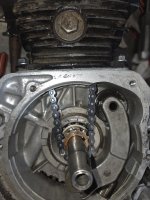
Cam_Chain_01.jpg
 
You mentioned that you have the correct length cam chain, but is it new? If you replaced the cam chain with new the adjustment position should likely be toward the looser side than it was previously (given that some maintenance was done along the way). According to the FSM, to loosen the adjustment you would loosen the lock nut and turn the screw to the left (counter-clockwise), so it would seem possible that you currently have it adjusted too tightly.
 
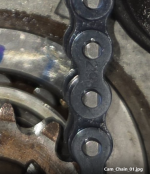
Is the chain seated correctly? Might just be camera angle, but it looks kind of strange around the bottom of the sprocket.
 
You mentioned that you have the correct length cam chain, but is it new? If you replaced the cam chain with new the adjustment position should likely be toward the looser side than it was previously (given that some maintenance was done along the way). According to the FSM, to loosen the adjustment you would loosen the lock nut and turn the screw to the left (counter-clockwise), so it would seem possible that you currently have it adjusted too tightly.
Hi AD. Very much appreciate your fast response and knowledge in this area. The chain is new and is very tight even before I install the tensioning system. I agree that a new chain will be "shorter" than a fully broken in chain. So it is expected that a new chain will offer less slack when initially installed. Are you offering that my near zero slack is normal for a new chain and that I'll gain the much needed play when the chain loosens up?

Not clear on your second point. I believe the threads on the adjusting rod are normal right-hand threads. Turning the adjusting rod counter-clockwise will raise the rod, allowing the piston to move up and the wheel to move to the left. This adjustment is normally used to counter excessive slack. I do not have any slack at all.

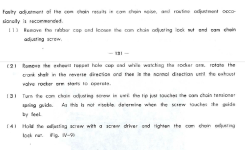
I currently have the depth of the adjusting rod set to where the wheel is barely touching the chain. I'm using the procedure listed in the FSM for Honda 125 and Honda 150 models C92, CS92, CB92, C95, CA95 for 1959 - 1966 dated Jan 31, 1963. This FSM is commonly available on-line. Section IV-6 on Page 131 covers the optimal adjustment of the cam chain tensioning system, but does not address a situation where there is too little slack. An interesting note is that Fig 28 on page 13 of this FSM show a photo of the cam chain and tensioning system. I assume the FSM photo is of a new engine using a new cam chain. In this figure, the chain has approximately 1" of slack being taken up by the tensioning system. This is what is driving me crazy.

Thanks in advance.
 
Not clear on your second point. I believe the threads on the adjusting rod are normal right-hand threads. Turning the adjusting rod counter-clockwise will raise the rod, allowing the piston to move up and the wheel to move to the left. This adjustment is normally used to counter excessive slack. I do not have any slack at all.
This could be another translation issue from these FSMs back then (there were many), but I was quoting the passage in the FSM on how to adjust the cam chain. The wording implies that turning the screw in (clockwise on standard threads) will hold the tensioner roller against the chain, so the assumption is that the screw pushes the tensioner roller toward the chain, hence the reason I described turning it counter-clockwise to allow some tension relief. Could be a total misinterpretation based on poor translation.

1775651960093.png
 
  • Like
Reactions: J-T
The chain is a correct 219
There are two (2) "219"s chains. 219H is incorrect, but if forced onto the sprockets the chain will be tight and won't seat exactly right. DK219 Chain & link is correct. I have used the DK219's with a master link with absolutely no issues. I know about the 219H as I made that mistake at one time.

Another possibility, and just a thought, is that the rubber cam passage seal, kind of a rectangle "O" ring may not be seated, or perhaps the index pins in the head are too long, if they are aftermarket.
 
There are two (2) "219"s chains. 219H is incorrect, but if forced onto the sprockets the chain will be tight and won't seat exactly right. DK219 Chain & link is correct. I have used the DK219's with a master link with absolutely no issues. I know about the 219H as I made that mistake at one time.

Another possibility, and just a thought, is that the rubber cam passage seal, kind of a rectangle "O" ring may not be seated, or perhaps the index pins in the head are too long, if they are aftermarket.
The 219H chain could explain why the wear pattern on the sprocket looks “off”
 
I use pre-owned cam chains for my CA95's including my current 62. Here is a typical listing, pricy but correct. Fitting the cam chain takes some patience. The chain needs a link and in order to connect the chain together, both ends have to be at the 7 O'clock position at the crankshaft. Stuff all case openings with tissue. Link lock butt faces rotation.
 
I just did a Google search 'Difference between 219t and 219h' and the results that came back all suggested that 219t was the correct cam chain to use, 219h had different shaped side plates which caused the problem described in the current thread. H being heavy duty, which matters more when its being used as a final drive chain in a go kart.
 
I just did a Google search 'Difference between 219t and 219h' and the results that came back all suggested that 219t was the correct cam chain to use, 219h had different shaped side plates which caused the problem described in the current thread. H being heavy duty, which matters more when its being used as a final drive chain in a go kart.
Goes right along with the fact that Honda used DID cam chains on many if not most of their engines AFAIK.
 
Thanks everyone. I never would have guessed that there are two variations for a 219 spec chain link. I'm glad the photo had sufficient resolution to spot the incorrect 219H stamp on my chain. I'll start looking to source a DK219.
 
Back
Top Bottom