1964/65 CB72 Restoration

MIBOWL

Veteran Member
Joined
Mar 12, 2025
Total Posts
105
Total likes
73
Location
Oxfordshire
In 2024 I purchased a January 1965 registered (probably 1964 build) CB72 all in bits (engine complete and not yet started on !) minus front forks. Purchased thes plus other bits from David Silver and Honda Classics (GB Automotive)
Stripped the frame down to basics and had the frame, swinging arm, centre stand and rear brake stopper sand blasted and powder coated locally and many parts sent away for chrome plating and zinc plating. Wheels rebuilt with stainless spokes and alloy rims (not authentic but I wish to keep the weight down). Now starting to build up the frame and looking forward to re-wheeling it. Next to start on the engine, no idea of it's condition, time will tell.WIP 02.jpgProgress so far.
 
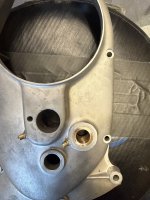
Cases look super nice! Just curious how did you clean them and if you used media did you make sure all screw, bolt and oil passages are totally clean of any bits of media. I have heard some horror stories with cracked cases and burned bearings.
 
Cases look super nice! Just curious how did you clean them and if you used media did you make sure all screw, bolt and oil passages are totally clean of any bits of media. I have heard some horror stories with cracked cases and burned bearings.
I had them vapour blasted, but have to air blow the oilways to ensure they are not blocked.
 
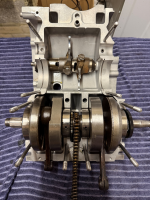
Slow progress but reassembling the engine as per "Bill Mr Honda Silver" instructions. It would appear that although the engine is a 1962 model it has a later model bearing as I have had to machine one of the knock pins to be a stepped version to enable correct installation of the crankshaft. For some reason I am unable to add a photo ??
 
Last edited:
Did you replace the cam chain ? If I look closely, it seems that the chain rollers are rusted a little bit ? Or is it dust with oil ?
 
Did you replace the cam chain ? If I look closely, it seems that the chain rollers are rusted a little bit ? Or is it dust with oil ?
The cam chain has been soaking in oil for two days, it is not new.
 
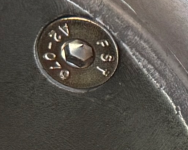
I admit I had to look it up. A4 is marine grade of stainless steel - I guess better corrosion resistance.
View attachment 57140
Yes, in our business we use A4, because detergents can be very corrosive over time. The I use stainless hardware on my bikes, I use A4 on area's where the bike is exposed to (road)salt.

Personally, I'm not a fan of stainless steel in aluminium cases, and when I use it, it is on steel parts.
 
Yes, in our business we use A4, because detergents can be very corrosive over time. The I use stainless hardware on my bikes, I use A4 on area's where the bike is exposed to (road)salt.

Personally, I'm not a fan of stainless steel in aluminium cases, and when I use it, it is on steel parts.
I always use copper slip on stainless going into aluminium.
 
When you combine different metals, a voltage difference is created.
  • Copper vs. Aluminum: Copper is a more "noble" metal than aluminum.
  • Electrolyte: As soon as moisture (water/road salt) is present, the copper grease acts as a conductor.
  • Result: The aluminum (the least noble metal) acts as a sacrificial anode. It will corrode to "protect" the copper particles in the grease. This can cause the aluminum threads to dissolve or seize the bolt permanently.
For the combination of stainless steel and aluminum, it is better to choose an insulating or metal-free mounting paste:
  • Ceramic Grease: This contains no metal particles and does not conduct electricity. It withstands very high temperatures and prevents the metals from reacting with each other.
  • Aluminum or Nickel-based Anti-Seize: These are safer for aluminum surfaces than copper.
  • Teflon Grease (PTFE): Good for applications that do not reach extreme temperatures.
  • Duralac or Tef-Gel: Specific anti-corrosion pastes widely used in marine environments to protect SS bolts in aluminum masts or hulls.
 
When you combine different metals, a voltage difference is created.
  • Copper vs. Aluminum: Copper is a more "noble" metal than aluminum.
  • Electrolyte: As soon as moisture (water/road salt) is present, the copper grease acts as a conductor.
  • Result: The aluminum (the least noble metal) acts as a sacrificial anode. It will corrode to "protect" the copper particles in the grease. This can cause the aluminum threads to dissolve or seize the bolt permanently.
For the combination of stainless steel and aluminum, it is better to choose an insulating or metal-free mounting paste:
  • Ceramic Grease: This contains no metal particles and does not conduct electricity. It withstands very high temperatures and prevents the metals from reacting with each other.
  • Aluminum or Nickel-based Anti-Seize: These are safer for aluminum surfaces than copper.
  • Teflon Grease (PTFE): Good for applications that do not reach extreme temperatures.
  • Duralac or Tef-Gel: Specific anti-corrosion pastes widely used in marine environments to protect SS bolts in aluminum masts or hulls.
Thanks for that Jensen, I will endevour to use the correct paste from now on.
 
When you combine different metals, a voltage difference is created.
  • Copper vs. Aluminum: Copper is a more "noble" metal than aluminum.
  • Electrolyte: As soon as moisture (water/road salt) is present, the copper grease acts as a conductor.
  • Result: The aluminum (the least noble metal) acts as a sacrificial anode. It will corrode to "protect" the copper particles in the grease. This can cause the aluminum threads to dissolve or seize the bolt permanently.
For the combination of stainless steel and aluminum, it is better to choose an insulating or metal-free mounting paste:
  • Ceramic Grease: This contains no metal particles and does not conduct electricity. It withstands very high temperatures and prevents the metals from reacting with each other.
  • Aluminum or Nickel-based Anti-Seize: These are safer for aluminum surfaces than copper.
  • Teflon Grease (PTFE): Good for applications that do not reach extreme temperatures.
  • Duralac or Tef-Gel: Specific anti-corrosion pastes widely used in marine environments to protect SS bolts in aluminum masts or hulls.

Thank you Jensen. Now printed and hanging in the garage.
 
Back
Top Bottom