1981 CX500C - The Next Project

webbs150

Veteran Member
Joined
Mar 2, 2025
Total Posts
100
Total likes
39
Location
New Hampshire
Hi all,

Grabbed a 1981 CX500C a few weeks ago on FB Marketplace. Have ordered and received some parts, done the basic servicing, and today got it up and riding successfully. Happy with my diagnostic work (and happy with the informative FSM that came with the bike).

Despite no obvious air leaks, the bike is a little low on power and throttle response. I did a full carb rebuild (kept original brass, just cleaned and replaced gaskets). I hear some pretty wicked ticking - already checked valve clearances before I ran the bike and attempted to set the cam chain tensioner, but not sure if the bike has previously had that part serviced. Video of idling below:


Big departure from the Twinstar and I know that this forum isn't focused on non-parallel twins, so I have created an account over at theCX500 forum. That said, really appreciated all of this forum's support during my previous project and figured it wouldn't hurt to pose the question.

Thanks in advance if anyone has any ideas about the power issues or noisiness,

Hans
 
My hearing is not that great so couldn't make out much from the video but just wondering could the ticking be an exhaust leak?
 
Your idle sounds a tad high - could be the ticking.

Were the carbs synced after rebuild? Assuming you pulled the pressed in jet? (Actually, 81 might have the screw in one) that one is a bear to get out and get clean enough.

I’d definitely eliminate exhaust leak as an issue, but it does seem like it’s not getting the right mix off throttle.

Are you still running stock ignition? What do the plugs look like?
 
Thanks for the rapid responses, exactly what I've come to expect here at VHT!

Interesting to hear about exhaust leak... I did use some JB weld to plug a small rusted hole in the H-Box, but are you saying at the valve seats rather than somewhere along the header and muffler?

According to my digital tachometer the bike is right around 1100RPM which is to spec. Carbs were just "bench" synced, didn't pull the pressed in jet but removed the rubber plug and cleaned what I could.

I believe both cylinders are firing properly but the spark isn't the strongest I've ever seen. There was also a mouse nest in the air filter when I bought the bike. With this in mind, planning to:
  1. Buy new spark plugs after work today. The ignition coils on the bike are apparently pretty new, and I have the original ignition coils in a box of spare parts. Hoping some new plugs might just do the trick after the bike has sat since ~2017.
  2. Order a new air filter in case the filter media is clogged to the point of not allowing enough airflow when the engine is under load. I am not that experienced with motorcycles and this is my first CV carb, so not sure if that actually makes sense.
 
Ah. Ok. Given the new info, that would possibly explain the crappy performance side of this. Those VB carbs have to be vacuum balanced or you’ll really see reduced performance. It’s a little finicky, but not difficult. Air cleaner is a must. I’d even pull it entirely right now just as you test. No sense in adjusting fuel/air if you’re choking the bike at the same time.

The ticking noise though, if that’s an exhaust leak it’s going to be much closer to the head. Videos suck for finding those, if the exhaust was pulled and put back on, it’s very possible that they’re misaligned - otherwise, if you found one hole in the Hbox , there’s probably more.

I hate to say this, because I know the pain of getting those carbs on and off, that lower jet needs to get pulled and cleaned. I know the GL’s in 81 went to a screw in jet, I can’t remember if the CX’s did as well.

I’d do all that, adjust the cam chain again (rotate to TDC-left, release lock bolt, tighten lock bolt) there no way to inspect cam chain condition or if it’s out of tolerance without pulling the engine and removing the rear case - in which case you might as well do the mechanical water seal. An exhaust leak that loud you should be able to feel or find relatively quickly.

If it’s not that, it’ll be time to dig in a bit deeper over the winter.
 
Hi all,

Embarrassing update about my discoveries yesterday...
  1. The lamest finding - looks like I didn't tighten one of the lock nuts good enough on the left cylinder intake valves, so it had backed out and was rattling around rather than holding the 0.003 it was supposed to. Whoops, easy fix at least...
  2. Bought new spark plugs (D8EA) and when I was removing the plugs from the previous owner I discovered that they were an incorrect kind. They were sparking and the number was super close to the two recommended NGK plugs from the FSM that I moved too quickly and didn't catch the discrepancy. I hope that with new and correct plugs everything may play nicer.
Only had time yesterday to fire it up momentarily after correcting the issues above, and everything sounded much better. Need to play with the idle again since my prior tinkering was setting it up for poor spark and fuel intake, but then I suspect everything will work nicely. Doesn't mean I won't investigate a vacuum balancing for the carbs, but I think I am much closer to proper running than I thought previously.

Also ordered a new air filter and oil filter, planning to swap in the air filter ASAP and then use the oil filter during the first oil change once everything seems in working order.
 
Nothing embarrassing, you realized things were off and then you trouble shot until you found the issues and corrected them so sounds like a win to me. looking forward to hear how she runs when you have time to take her for a ride.
 
sometimes it’s simple stuff that isn’t supposed to fail.

If that adjuster did back off on its own, you’re going to want to inspect the threads really well - once they start rattling loose, the threads get torn up and it’ll keep happening.

Don’t skip the vacuum balance, those carbs are fickle - if they’re out of balance you can manipulate it to idle fair, but you’ll struggle at any kind of power band.
 
Time for an update:

Got the new air filter and no dice, can get the bike running but anemic power and strange throttle response. Did some reading about the exhaust and realized I might be getting tricked - sure enough, seems like the left cylinder isn't firing. Doh!

The previous owner says his buddy had replaced the ignition coils "for no apparent reason" - I think I have determined that the statement is false but also sort of true. See picture below:


Image


Flipped the coils upside down for easy access and testing. Confirmed spark on the front/right coil, nothing on the left even after cleaning and rethreading the spark plug boot to the ignition coil wire. The bike came with the old, theoretically decent ignition coils - different mounting hardware/length so did my testing off the bike with some alligator clips to establish ground and power. Was able to determine that the front/right coil power/ground worked fine even with the old coil, and the rear/left power/ground is not producing spark.

Followed the yellow wire and it disappears into the CDI box. Haven't done enough research yet, so turning to the forum folks - is this a known issue? Something failing within the CDI to prevent spark, or does it go deeper into the bike's electrical system? Hoping it could it be as simple as replacing the CDI.

Thanks in advance!
 
I have read a bit about stator testing and figured that might be my next step. Funny enough, I have found some testing results tucked away into the service manual from the PO, see below:


Image


I am beginning to think this "ran when parked" bike may have been parked for a reason! If I am interpreting everything correctly, the W - G would match the 5/9 Source Coil Low Speed test, indicating low results. Not sure why the PO wouldn't have tested the LH and RH low speed coils too, but I suspect the LH results would be out of spec and the RH would be functioning.

I did do a charging test while idling on one cylinder and the voltage at the battery goes up while the bike is running, so I believe the alternator charging system is still functioning.

Went down the rabbit hole last night, seems like I am looking at a Rae-San Hall CDI/ignition replacement kit to substitute for the failing pulser. Happy for any feedback to the contrary, but otherwise will look to order a kit ASAP so that I can try to get it installed for test riding before the season is over.
 
Man - I wrote a big ol reply and forgot to hit "post", but it looks like you went down the path I was suggesting in that post. The low speed pickup fail is a known pain point with these bikes, since replacement of that requires the back panel to come off, it's common to run a triple or quadruple bypass at that point (Cam Chain and guides, mechanical water pump seal, starter clutch and stator).

It is possible to avoid that stuff and do just the Rae-San swap. I'm running his unit in all of mine. Get the 12V Hall conversion - by far the cleanest and simplest of the bunch. You can do that one with the engine still in the bike (sort of), but it requires some pretty flexible and skinny hands to do so.

Personally, I'd do the triple (cam chain, replace the stator with a G8 or repro version, water pump seal) and install the Rae-San.
 
Thanks EZ Pete! Glad to know I set myself on the right path. Tempted to just do the 12v Hall conversion for now, and then if I choose to hold onto the bike I can commit to a more extensive rebuild in the future.
 
Thanks EZ Pete! Glad to know I set myself on the right path. Tempted to just do the 12v Hall conversion for now, and then if I choose to hold onto the bike I can commit to a more extensive rebuild in the future.
The most difficult part of that one is getting the coolant bottle out of the way - although I do think they redesigned it slightly for the 81+ models. Otherwise, you need to pull the 3 main engine mount bolts (upper L/R and the long lower), then on the front hanger remove the rearward side and loosen the front (keep a jack under the engine while doing this).

You can then swing the engine a bit and slide the coolant bottle out of the way.

You’ll have to modify the rubber plug at the point all the wiring comes out and delete the pickup wires from that bundle (leave the yellow obviously for the AC current).

Don’t forget to order a new gasket for that cover. Goldwingparts.com has them and there’s an EBay seller out of Oregon (I’ll have to look it up) that sells those as well. Pay attention to which style it is. There’s 2 and the gasket sold with some kits doesn’t match the 81+ model years.

It can be done in an afternoon fairly easily. Make sure to spec the coils and read the installation instructions a couple of times before diving in.
 
I am beginning to think this "ran when parked" bike may have been parked for a reason!
Usually seems to be the case. Something breaks or becomes unreliable so it gets parked until they decide to fix. Years pass and they don't remember or don't want to fix it and sell it to you.
 
Usually seems to be the case. Something breaks or becomes unreliable so it gets parked until they decide to fix. Years pass and they don't remember or don't want to fix it and sell it to you.
A likely story for sure.

Ended up ordering the kit a while back, the seller had a backlog but just got it in the mail the other day. Hope to have it in hand next week, and then aiming for a quick install to try and get some late season riding in.
 
A likely story for sure.

Ended up ordering the kit a while back, the seller had a backlog but just got it in the mail the other day. Hope to have it in hand next week, and then aiming for a quick install to try and get some late season riding in.
Install is pretty straightforward, I’d use it as a chance to get some of the battery wiring cleaned up.
 
Well, part arrived from Australia last week but I've only just started wrenching this morning. Took a long time to accomplish very little, but was eventually able to get enough parts removed/out of the way that I could access and unbolt the rear engine cover to expose the advance mechanism. Will be saving the actual electrical work until tomorrow at this rate.

Something that caused me a lot of grief was the H-box of the exhaust system. I tried unbolting it to make bottom access for the rear cover and coolant reserve easier, but I couldn't get the exhaust headers to let go of the rest of the exhaust. Definitely rusty with age and all that. Was ultimately able to get the plastic coolant bottle out with some force and tedious bolt removal, but I don't relish the idea of getting some of the lower bolts back in place with the H-box still attached. Any advice?
 
Well, part arrived from Australia last week but I've only just started wrenching this morning. Took a long time to accomplish very little, but was eventually able to get enough parts removed/out of the way that I could access and unbolt the rear engine cover to expose the advance mechanism. Will be saving the actual electrical work until tomorrow at this rate.

Something that caused me a lot of grief was the H-box of the exhaust system. I tried unbolting it to make bottom access for the rear cover and coolant reserve easier, but I couldn't get the exhaust headers to let go of the rest of the exhaust. Definitely rusty with age and all that. Was ultimately able to get the plastic coolant bottle out with some force and tedious bolt removal, but I don't relish the idea of getting some of the lower bolts back in place with the H-box still attached. Any advice?
You’re going to need some really thin hands to get in there and loosen those without dropping the exhaust.

A thin head ratchet with a 8mm can get them broken loose and some really tedious finger spinning can do the rest.

If you can free the rear engine mounts, the rearward upper mount and the H- box from the frame, you can swing the engine forward and give yourself a lot more workspace.
 
Like I said, was able to get everything unbolted and access the hatch. Just remains tight space to operate in, and getting it all back in place will be hard!

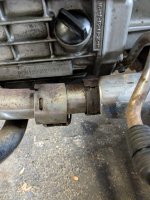
Shared the picture of the front H-Box clamp. Clamps at undone on both sides but no amount of tugging and PB Blaster seems to slip the H-box off the exhaust headers
 
Yeah. They freeze in place pretty good, you usually need to rotate them and pull at the same time.

I’d swing the engine forward or pull the exhaust entirely.
 
If you decide not to do that, removing the rear wheel can provide some access that isn’t at a 90 degree angle in the dark.
 
Thanks for weighing in, EzPete. Does seem like taking the exhaust headers off would be the play if I need to remove the exhaust system in the future, but happy to report in that after a rough two days I have made some progress even with the exhaust left in place.

Spent the better part of today struggling to remove a stubborn advance assembly screw to make way for the new Hall effect system. Had to buy a rotary tool and a grinding bit to make a flathead groove after I stripped the screwhead, and then used an impact screwdriver to finally break it free. Once that was behind me, was pretty smooth sailing to actually install the new setup and test the LEDs for proper timing. Got it pretty close (hopefully close enough!), used some blue loctite, and got the rear engine cover back in place and the coolant reservoir bolted back in too.

Didn't get to start the new wiring for the CDI box replacement, but hoping that will be an easier project after what I've just been up against. Very excited to see two blue sparks when I turn the engine over, after which I'll get the carbs back on and be off to the races. Fingers crossed!
 
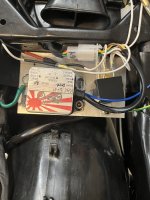
After a month off due to busy work and colder weather, finally trying to get back to this project. Spent an hour this morning with a test light and temporary connectors, and proved that the hall effect sensor is working - and got spark in the left cylinder, which was the point of this whole journey! Picture provided of my short term rat's nest.

A couple questions for the community:

1. What is the best way to get the three new 12v wires connected at the brake light power wire? I'm looking into 4into1 bullet connectors now, but I figure there might be a more savvy solution. I have a crappy solder gun but figure it might be better to have a not so permanent connection.

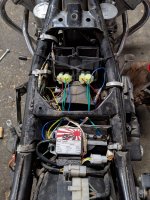
2. Any good pictures out there of how folks have fit all the new electrical boxes and wires neatly under the seat? I'm open to ideas!!!

Wiring Mess.jpg
 
Get the connectors from vintage connections - forum sponsor and they’re not just relabeled Temu tin.

I’ll go through my build thread. I’ve got pics there of how I tucked my RaeSan
 
IMG_0399.jpeg
Not the greatest pic, but you get the idea. I cut a small aluminum plate and bolted it to the exiting ground spots. This gave room for the unit and other wiring to stash.
 
I haven't read all replies but I would say valve clearance was checked in wrong position, overlap instead of TDCC
If your really really unlucky, I have seen 'soft tip' valves where adjuster has hammered in about 0.010"
Honda made several changes to cam chain tensioner, officially 3 but I know there were at least 5 (I was working at Honda dealers when CX was launched in 78)
As long as it isn't ridden gently, cam chain tensioner isn't much of a problem, keep it over 6K when riding and it lasts longer, just do regular oil & filter changes
Even the final 'automatic' tensioner only lasts 18,000 miles if engine isn't kept revving (during tests, Honda ran CX motor 10,000 rpm on dyno for a week -24/7 without stopping - no problems)
Customers, thinking they were 'saving' engine riding round 3~4k were breaking them in a few months (I had to do one 4 months old with bosses broken off crankcase, that was a 78 and first tensioner mod)
Is the inspection cap (behind right cylinder) the extra tall type with breather hose?
 
Thanks EzPete - I already have a plastic tub of single bullet connectors from my previous motorcycle project (needed a LOT of wiring fixes), but I will review the Vintage Connections site and see what else they offer! I've always been a little skittish about the "fabrication" side of things, but crafting a new mounting plate makes enough sense. A question and a comment for you:

1. The pre-existing grounding screws are larger diameter than the connection point of the primary grey box of the Rae-San CDI. Hard to tell from your photo, but did you just drill out a larger hole to make everything work?
2. Not sure which version of the product you have, but seems like you just have a single, smaller black box rather than the two larger ones I am confronted with. Slightly harder to tuck away, but I will just have to apply some critical thinking skills!

Thanks for your continued help!
 
I haven't read all replies but I would say valve clearance was checked in wrong position, overlap instead of TDCC
If your really really unlucky, I have seen 'soft tip' valves where adjuster has hammered in about 0.010"
Honda made several changes to cam chain tensioner, officially 3 but I know there were at least 5 (I was working at Honda dealers when CX was launched in 78)
As long as it isn't ridden gently, cam chain tensioner isn't much of a problem, keep it over 6K when riding and it lasts longer, just do regular oil & filter changes
Even the final 'automatic' tensioner only lasts 18,000 miles if engine isn't kept revving (during tests, Honda ran CX motor 10,000 rpm on dyno for a week -24/7 without stopping - no problems)
Customers, thinking they were 'saving' engine riding round 3~4k were breaking them in a few months (I had to do one 4 months old with bosses broken off crankcase, that was a 78 and first tensioner mod)
Is the inspection cap (behind right cylinder) the extra tall type with breather hose?
Hmm, this comment makes me (appropriately) nervous! I will have to check about the inspection cap and get back to you. Regarding the valve clearance, I followed the FSM and checked clearances at the timing marks from the viewing hole - can I ask where you think I miss-stepped? Would love to not hurt this old engine!
 
Regarding the valve clearance, I followed the FSM and checked clearances at the timing marks from the viewing hole - can I ask where you think I miss-stepped? Would love to not hurt this old engine!
What PJ is trying to convey is, you can't adjust the valves on TDC every time the piston is there, because one TDC is on exhaust stroke and the exhaust valve is closing (but is still partly open) and the intake valve is starting to open for the next intake charge. That position is called overlap, and if you adjust the valves there they will both be way too loose once you rotate again. Valve adjustment has to be done on TDC of compression stroke when both valves are completely closed. You find that position by rotating the engine while watching the intake valve open, then close, and THEN rotate to and immediately stop at TDC. And you only adjust that set of valves (not both cylinders at that same point, or the other cylinder will be wrong). You adjust that set of valves, then rotate again while watching the other intake valve open, then close. Rinse and repeat.
 
Thanks EzPete - I already have a plastic tub of single bullet connectors from my previous motorcycle project (needed a LOT of wiring fixes), but I will review the Vintage Connections site and see what else they offer! I've always been a little skittish about the "fabrication" side of things, but crafting a new mounting plate makes enough sense. A question and a comment for you:

1. The pre-existing grounding screws are larger diameter than the connection point of the primary grey box of the Rae-San CDI. Hard to tell from your photo, but did you just drill out a larger hole to make everything work?
2. Not sure which version of the product you have, but seems like you just have a single, smaller black box rather than the two larger ones I am confronted with. Slightly harder to tuck away, but I will just have to apply some critical thinking skills!

Thanks for your continued help!
I’ve got the 12v Hall on all of mine. The 78 has a relay to keep the kill switch functionality (small black box in my photo).

I just drilled out the hole in the case for the RaeSan a little bit to accommodate an M6 screw. This way the case ground stays solid.
 
What PJ is trying to convey is, you can't adjust the valves on TDC every time the piston is there, because one TDC is on exhaust stroke and the exhaust valve is closing (but is still partly open) and the intake valve is starting to open for the next intake charge. That position is called overlap, and if you adjust the valves there they will both be way too loose once you rotate again. Valve adjustment has to be done on TDC of compression stroke when both valves are completely closed. You find that position by rotating the engine while watching the intake valve open, then close, and THEN rotate to and immediately stop at TDC. And you only adjust that set of valves (not both cylinders at that same point, or the other cylinder will be wrong). You adjust that set of valves, then rotate again while watching the other intake valve open, then close. Rinse and repeat.
Ah, gotcha - I am familiar with the concept, but definitely not sure if I confirmed which TDC I was at. I believe I am okay, and at least did not adjust both cylinders while only at LTDC or RTDC. Will check again before firing her up to be sure.
 
I’ve got the 12v Hall on all of mine. The 78 has a relay to keep the kill switch functionality (small black box in my photo).

I just drilled out the hole in the case for the RaeSan a little bit to accommodate an M6 screw. This way the case ground stays solid.
Makes sense, thanks for sharing!
 
There is a 10mm head special bolt for cam chain tensioner, it's on the vertical part of crankcase behind right cylinder near inspection cap.
It's only sealed with an O-ring and probably why Honda added the extra breather?
If you have the 'short' inspection cap (same as CB350, etc. valve cover) you should be able to get the long cap with breather if parts guy is even half decent,
Stefan Gotteswinter in Austria made some stainless steel water pump impellers for the German CX 500 club a couple of years ago, originals are NLA in Europe and probably the rest of the world?
He didn't know what they were so I contacted him and asked.
 
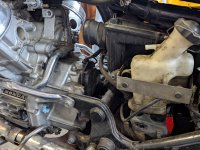
Not the best cable management the world has ever seen, but got everything secured and put the carbs back on.

Turned on the motorcycle tonight and proved it worked on both cylinders, which was great! Definitely needs some fiddling with the pilot screws and idle screw, but it was mostly steady operation and a great relief.
1000002927.jpg
 
I replaced the CEI ignition with an IGNITEK at least ten years ago. It was a completely different bike afterwards. As I sorta remember, it would not go faster than 50 or 55. Made a big difference…. I have to go back and reread this post because I thought there were something else that I saw for you….

motomentem.com Has a lot of parts. I recently bought the intake insulators for about $13 each……. Let me re read this entire post.
 

The bike is up and running nicely with the Rae San, and I otherwise rebuilt the steering head bearings and did a bunch of lubrication before riding this season. No issues with top speed, once this puppy is mid-range in the RPMs (~4000 and higher) I am very pleased with the power and performance.

Issue seems to be on the lower end, especially when warming up. Low power, struggles with quicker throttle twists, et cetera. Had the carbs off already this past weekend and have done endless fiddling with the fuel mixture screw. The latest issue I am encountering seems to be fuel starvation - at idle, I notice my fuel filter is not flooded with gas, and is just barely trickling. I think the surging (see video) is related to this, but I am looking for verification before I take the carbs off again to mess with the float needle height.

Thanks in advance!
 
Did you vacuum sync the carbs? And remove/clean the stupid slow jet that’s buried deep in the carb?
 
Did you vacuum sync the carbs? And remove/clean the stupid slow jet that’s buried deep in the carb?
I have not vacuum synced the carbs, just bench synced the two butterfly valves. Also did not remove the slow jet because it would require extraction that risks damaging; I just used a lot of spray carb cleaner and it seem to send fluid to all of the places I would expect.
 
I have not vacuum synced the carbs, just bench synced the two butterfly valves. Also did not remove the slow jet because it would require extraction that risks damaging; I just used a lot of spray carb cleaner and it seem to send fluid to all of the places I would expect.
Both are critical to idle performance. Being an ‘81, there’s a decent chance it’s got the later version of the jet that screws out.

While carb spray can possibly get the center of the jet cleared, the cross drilled holes won’t get clear and start causing issues like that.

I’d start with the balance first, but there’s a really good chance you’re going to need to pull that jet and clean it.
 
Early optimistic update: I went to drain the float bowls and got almost no fuel out of the left carb, which seems to corroborate the fuel starvation concern I had. I adjusted the lengths of fuel hose between the petcock and the carbs, placing the fuel filter closer to the carbs such that it sits more vertical. I also used a clear length of tubing to confirm that the float heights seemed appropriate when fully filled, and I believe everything is to spec.

Added 3 ounces of Seafoam to my nearly full gas tank as an extra measure, and then fired the bike up. Didn't ride super long, but wasn't loping at idle and had appropriate power/acceleration in the lower range (I think). The clear fuel filter seemed full of fuel the whole time, too.

Will update again after a few more days of riding for longer distances/times.
 
Rode to work this morning in low-to-mid 30 degree temps. Power was a bit low and was hearing some popping through the exhaust, so I pulled the choke partway and things cleared up.

If I'm understanding the carb theory correctly, I was enrichening the mixture to counter the cold. I suppose I could adjust the fuel-mixture screw, but then I'd probably be too rich when up to temp.

I assume it is fine to ride with partial choke as long as I eventually turn it off when the engine is at temperature? And the the choke on are just rich mixture, meaning lower fuel economy and potential to foul plugs?
 
Correct. Although it shouldn’t take more than a couple minutes of runtime to reach a point that you don’t need any choke at all.
 
Rode to work this morning in low-to-mid 30 degree temps. Power was a bit low and was hearing some popping through the exhaust, so I pulled the choke partway and things cleared up.

If I'm understanding the carb theory correctly, I was enrichening the mixture to counter the cold. I suppose I could adjust the fuel-mixture screw, but then I'd probably be too rich when up to temp.

I assume it is fine to ride with partial choke as long as I eventually turn it off when the engine is at temperature? And the the choke on are just rich mixture, meaning lower fuel economy and potential to foul plugs?
A minute or two longer warmup sitting still at home would help get the engine past that temperature point so you wouldn't need choke while riding.
 
Seems like the issue was using liquid gasket for the intakes - I have been waiting for proper o-rings to arrive, and got them today. Also bought a synchronizing tool.

Did my best job with a bench sync, and installed the new o-rings today for the intakes. Got the bike back assembled and running, smooth idling and no apparent vacuum leaks when spraying starter fluid around the carbs.

Seemed to be performing well, still a little slow on acceleration at lower RPMS but that might just be the nature of the over square pistons - i.e. not really hitting power until closer to 5000RPM?

Slight popping on some instances of deceleration, not all. Could mess with the pilot screw a bit more in the coming days now that the idle is stable. Will also hook up the vacuum gauge and see how close I got it.
 
Yeah. You won’t find much power in the low RPM range.
 
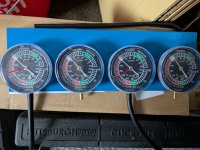
CX500C Synchronizer Results.jpg

Okay, rode to and from work today and seemed like the previous issues were still present - a little poor at accelerating without the choke partially engaged.

Hooked up the new synchronizer tool and got the above results (approximately). Left gauge is left cylinder is "driver's left", opposite for the right.

Per the shop manual, should be looking to get within 40mm. Seems like 200 and 275, so I will have to try playing with the vacuum synchronizer screw in the coming days. Turning the adjuster screw clockwise should reduce the vacuum on the right cylinder and attempt to bring it closer to the left.

Anything I am missing? The red zone for the left cylinder says "Late valve timing or leak at intake manifold or heat riser" but I don't know if that message holds any water.
 
Did some more reading. There is a ticking noise I can hear when the bike is running that I was attributing to the radiator fan, but after watching some videos I think it could be an exhaust header leak.

Reckon I should order new exhaust gaskets? (copper crush washer type)
 
Back
Top Bottom