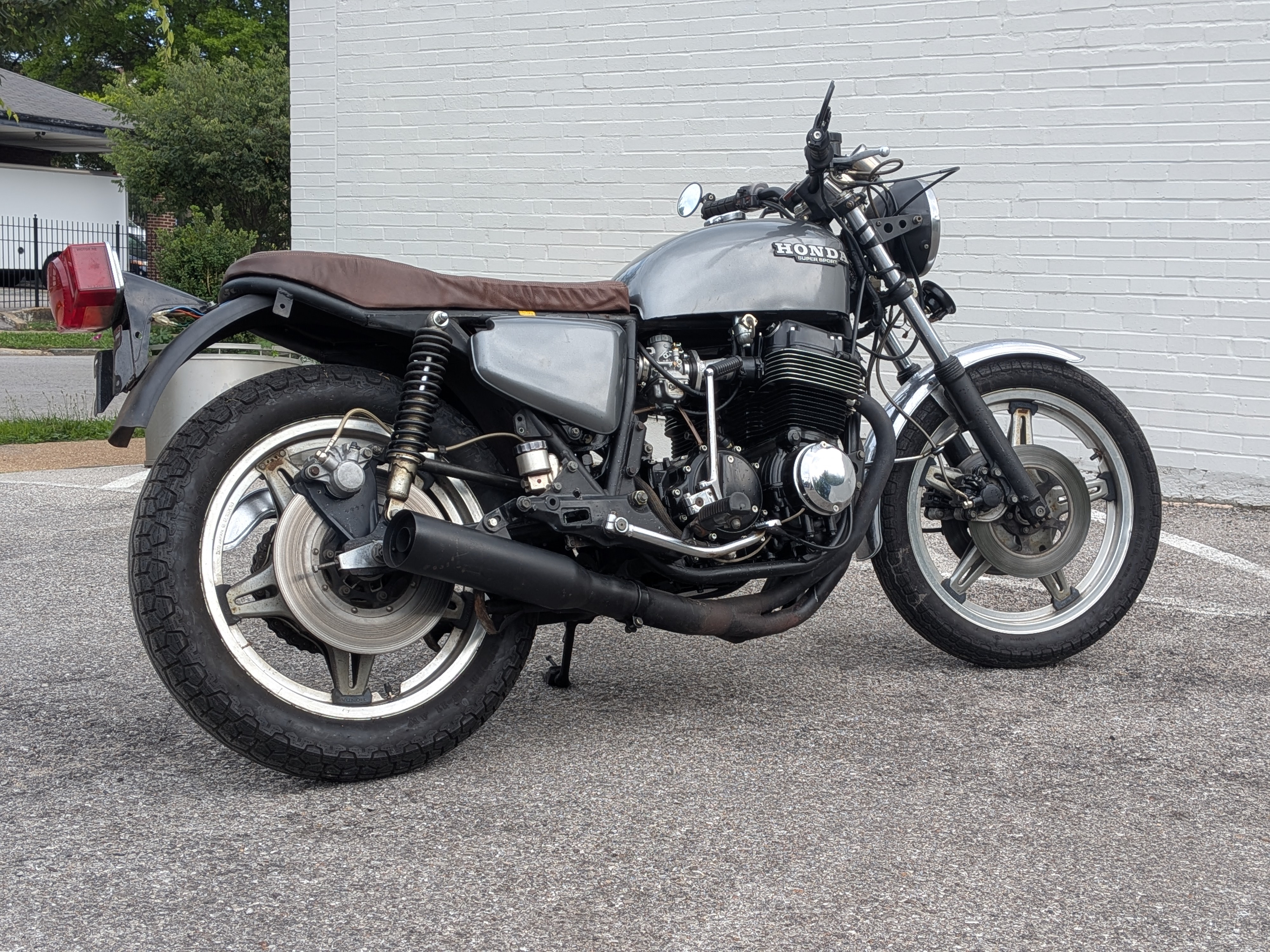
1977 CB750F2 . . . skeleton in the garage

stl360+450

Veteran Member
Joined
Aug 6, 2021
Total Posts
5,288
Total likes
2,808
Location
St. Louis, Missouri, USA
Back in 2015, I owned two vintage Hondas: a 1974 CB450K7 and a 1974 CB360G. The 450 was my first vintage bike and I bought it "running" in 2011. The 360 was a much neglected yard find acquired in the summer of 2014 that gave me a low-stakes opportunity to learn how to do my own maintenance and repairs. After the 360 was running and registered I wanted to start another project and started watching Craigslist. A strange ad appeared near Springfield, Illinois in which a guy was selling a variety of old bikes for $300 apiece. There were two Yamaha XS650's among the group and I went with the idea of buying the earlier model among those two. The only problem with my plan was that the guy was selling first come, first served and that bike was gone by the time my friend and I rolled in. I guess I figured I couldn't go wrong for $300 and started looking at the other options. All of the bikes were stored out in his side yard and the other XS650 had a crankcase cover off, so I wrote that one off immediately. The only other bike that really caught my attention was a 1977 CB750F2 and without much delay I made the choice to buy it. The picture below shows what I brought home.
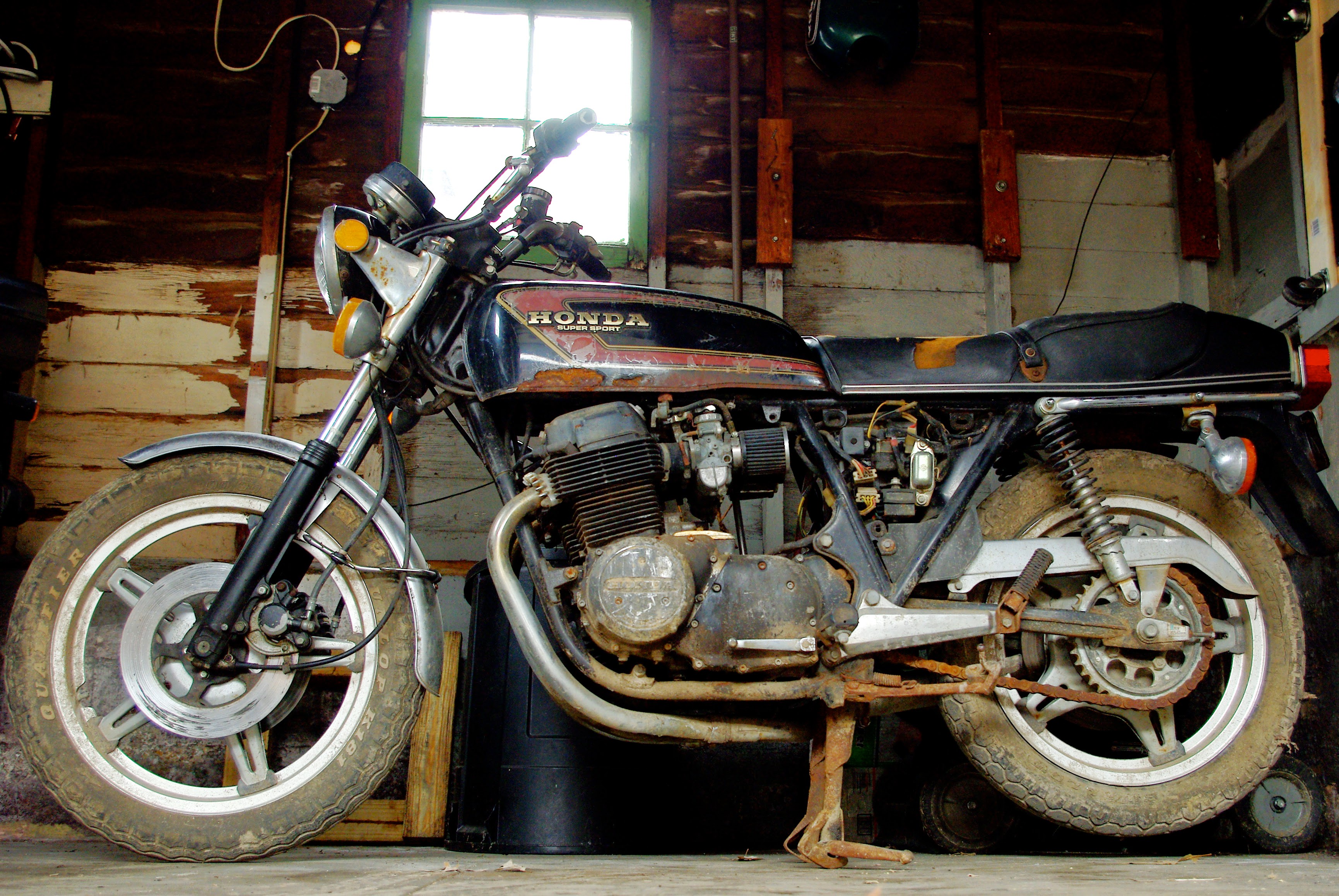
fe9Ohpf.jpg


If I knew then what I know now, I expect the rest of the story would be very different. I saw a bike in very rough shape and I didn't think it would be possible for me to do any kind of restoration, so decided it would be okay to modify things I didn't like about the bike as I got it going. The tank was riddled with holes and had to go. The tachometer, air box, and side covers were absent. I didn't like the original seat, rear cowl, or low-reaching rear fender. The next picture shows the state of the bike in September 2015, after I had it back on the road.
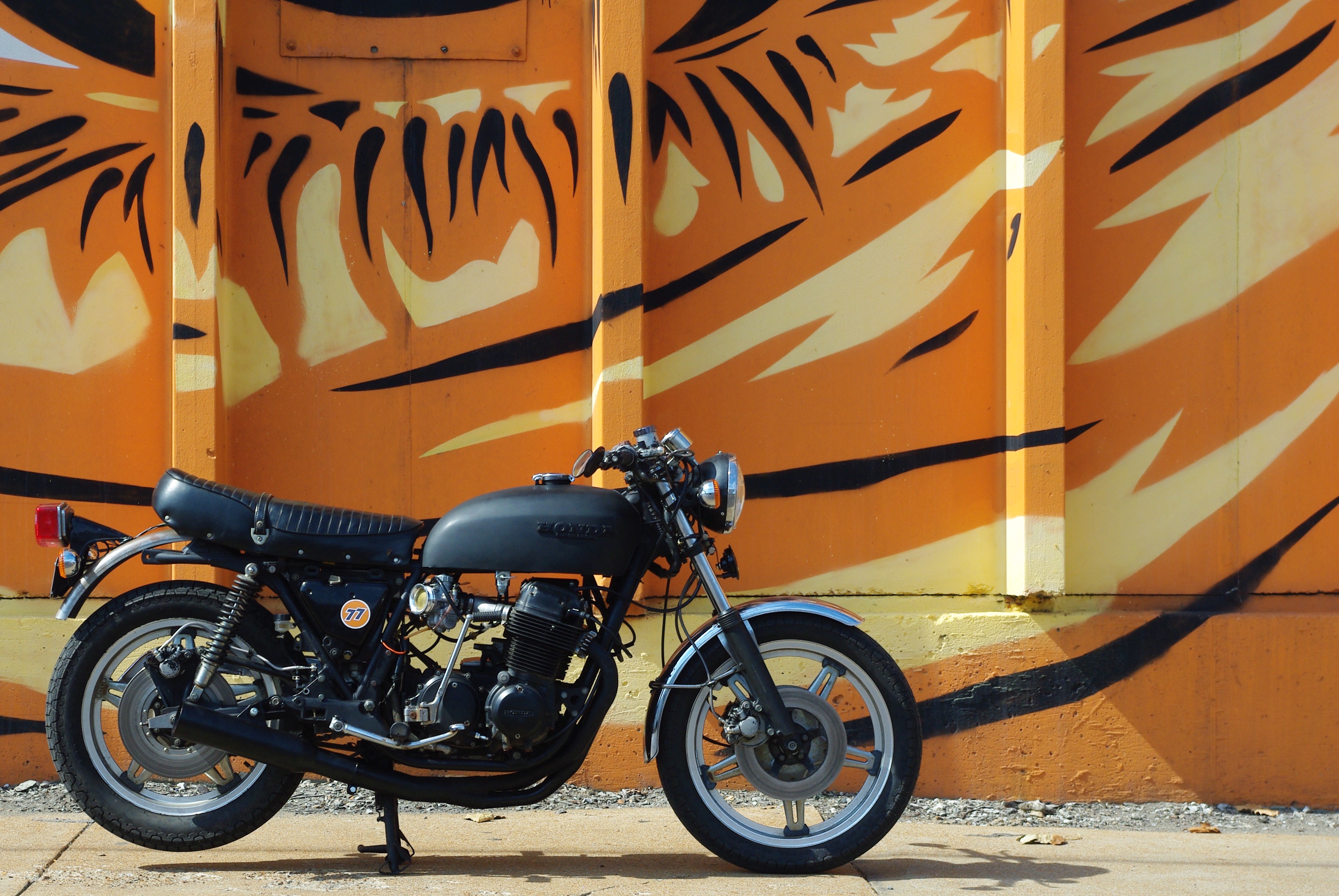
O5cCzFg.jpg


The most notable changes include a steel rear fender, a tail light from a CB450, a seat from a CL450, a tank from an earlier 750K, an aftermarket 4-into-1 exhaust, Cycle-X intake manifolds, and a pair of Mikuni VM32 carburetors with ridiculous velocity stacks due to the lack of space for filters. I upgraded the electrics to include a rec/reg from Oregon Motorcycle Parts and bought a set of small stainless gauges. I did not do anything in the way of motor work, other than the usual tuneup stuff. It's a testament to these motors that it ran pretty well for a while and I put about a thousand miles on it in roughly this state.

After a year or two, a good friend helped me out with some cosmetic improvements. He is an excellent welder and upgraded the frame with a rear loop and two brackets for the rear fender. He made a a custom battery box and fabricated a seat pan that I later had upholstered by someone else. He also repainted the motor and did some nice highlighting on the fins and valve cover. Unfortunately, the bike was not running well by this point and could foul plugs about as fast as I could put them in. Over the next couple of years I would try to get the bike going off and on without a lot of success. Finally, I rebuilt the motor with +0.5 mm pistons and a rebuilt head from Cycle-X (exchange program). I went back to the round top carbs for a while, but had issues with the warm idle and the wiper seals on the throttle shafts. It was also awkward mounting that heavy rack of carbs without a proper airbox for support. The intakes from Cycle-X didn't really fit in the frame, so I opted for a new set from Murray's Carbs with a pair of Mikuni VM34 carbs. These intakes at least allowed me to install small pod filters and keep everything inside the frame. This brings the story to 2021, which is the last time I really put any miles on the bike.
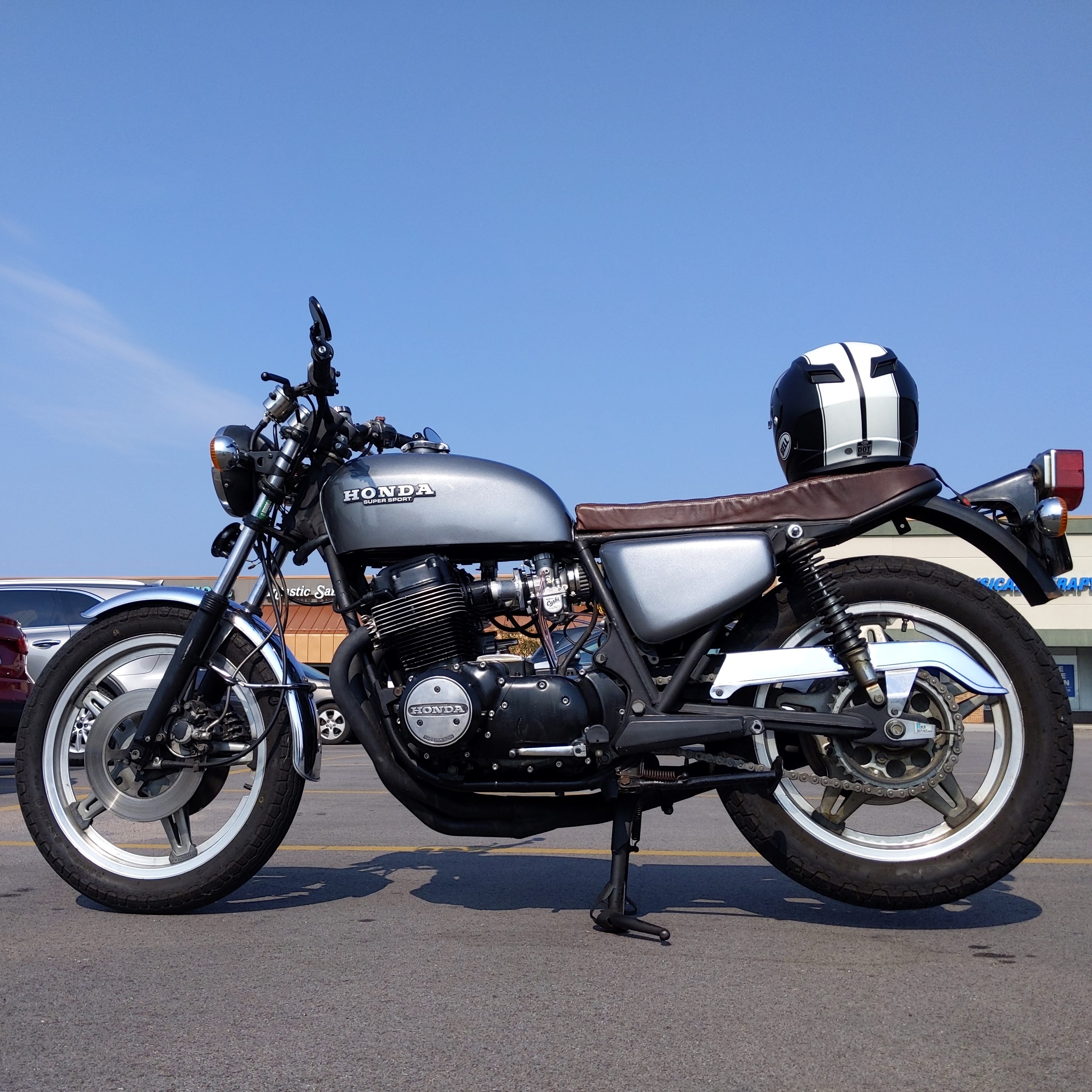
USTHeGo.jpg


The bike seemed to be running well after the rebuild and with the new carb setup, but this was also short-lived. I recall a short trip in the neighborhood during which the bike died and did not want to restart. I think I pushed the bike about three blocks home after rolling a couple of blocks downhill and I was sweating pretty good by the time I got it in the garage. I had three other bikes at this point (after buying an XL350 in 2016) and ended up banishing the 750 to the corner of my garage for the next three years.

The goal of this thread is pretty simple. I would like to reanimate the bike and make one ergonomic improvement. The custom seat is too low for me and lacks padding, so I am planning to go back to a CL450 seat to gain a few inches of leg room. I also think I will be happier with that aesthetic. I've already been digging into the bike over the last week or two, but I will share more about that in subsequent posts.
 
Glad you finally started a thread on this one, so much we've missed along the way. Yet another yard rescue you've brought back to life. AFAIK you would be the first person on VHT to have tried Murray's carb setup (and the Cycle-X version which I was not aware of). I see Reddit members all the time talking about how great Murray's setup is and I briefly considered it for my 900.
 
Glad you finally started a thread on this one, so much we've missed along the way.
Thanks — this thread is long overdue, but it feels good to be getting back to it. The last picture I shared in the first post is also part of my intro post, so the dormancy period for this bike essentially coincides with my VHT membership. I think it would have been in a much better place now had I been part of a forum when I first started working on it.


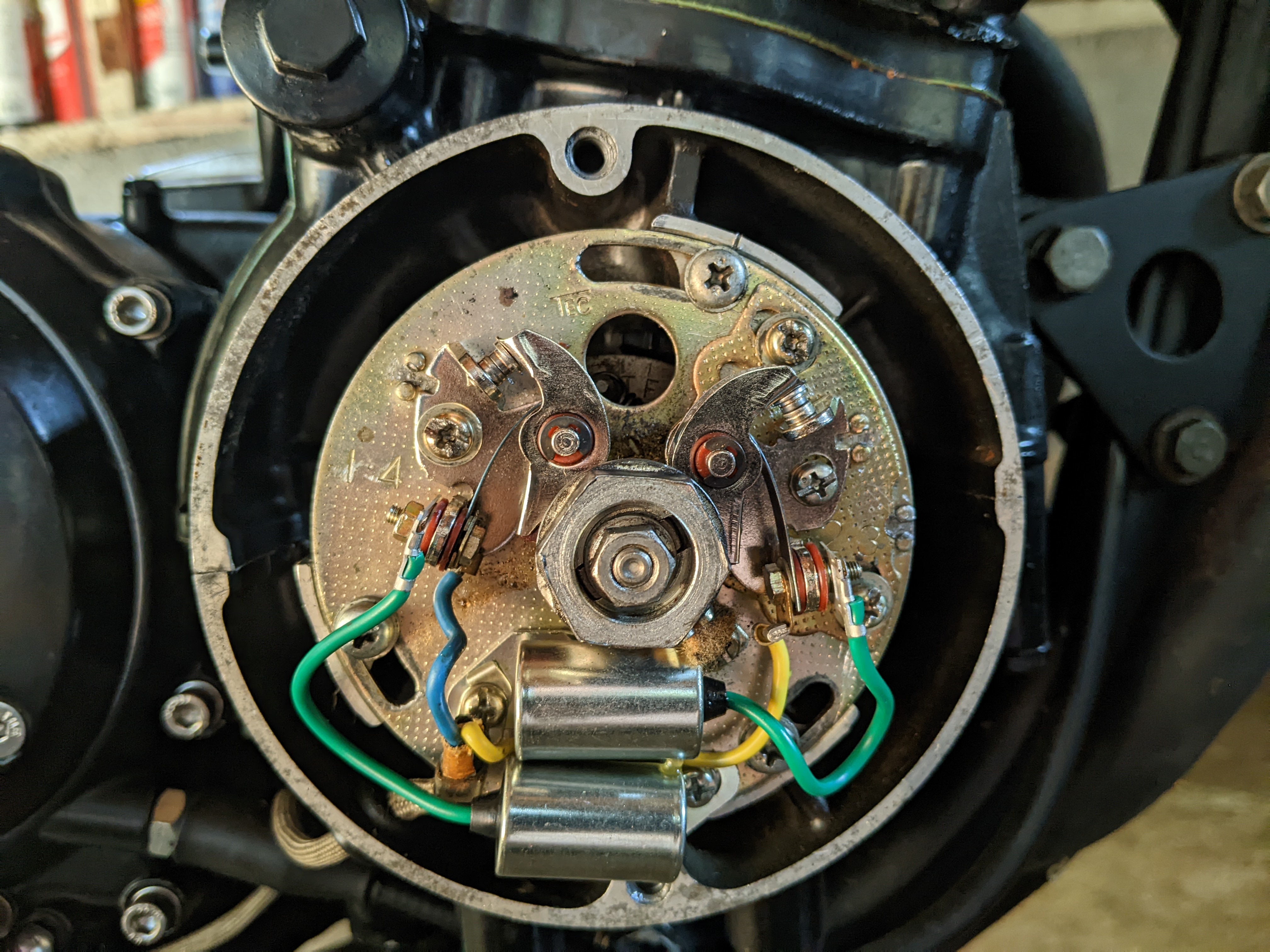
The first thing I did last week was remove the sparkplugs in order to set the valve clearances and ignition timing. The plugs were new ones that I had put in at some point during the last three years, but never used. The valve clearances seemed to be where I had left them, but I redid them all at 0.003" on intake and 0.004" on exhaust. Moved on to timing. I like to use a voltmeter when setting static ignition timing, clipping one lead to ground and the other to the point. The observed resistance will increase at the moment when the points open. I had the bright idea to buy a set of cheap alligator clip jumper wires on eBay a couple of years ago and eventually learned that they were not very well made and had enough resistance to cloud measurements. So, this summer I got a set of nicer 14 AWG jumper wires that I use when setting ignition timing.

LDs6M1H.jpg


The resistance on the 1/4 cylinders with the points closed was noticeably higher than that on 2/3, but came down after I dressed the points with sand paper. I then found that both the 1/4 and 2/3 points were opening just after the respective T marks. Timing is something that I kind of take for granted. Once I set it and believe it's correct, I tend not to doubt it. However, this could provide a reasonable explanation for the fact that the bike died and wouldn't restart when I last remember riding it. Plodding along, I adjusted the base plate to obtain correct timing on 1/4 and then checked 2/3 and found it was also on the money. It struck me that the plate was at maximum advance.

mHejTgf.jpg


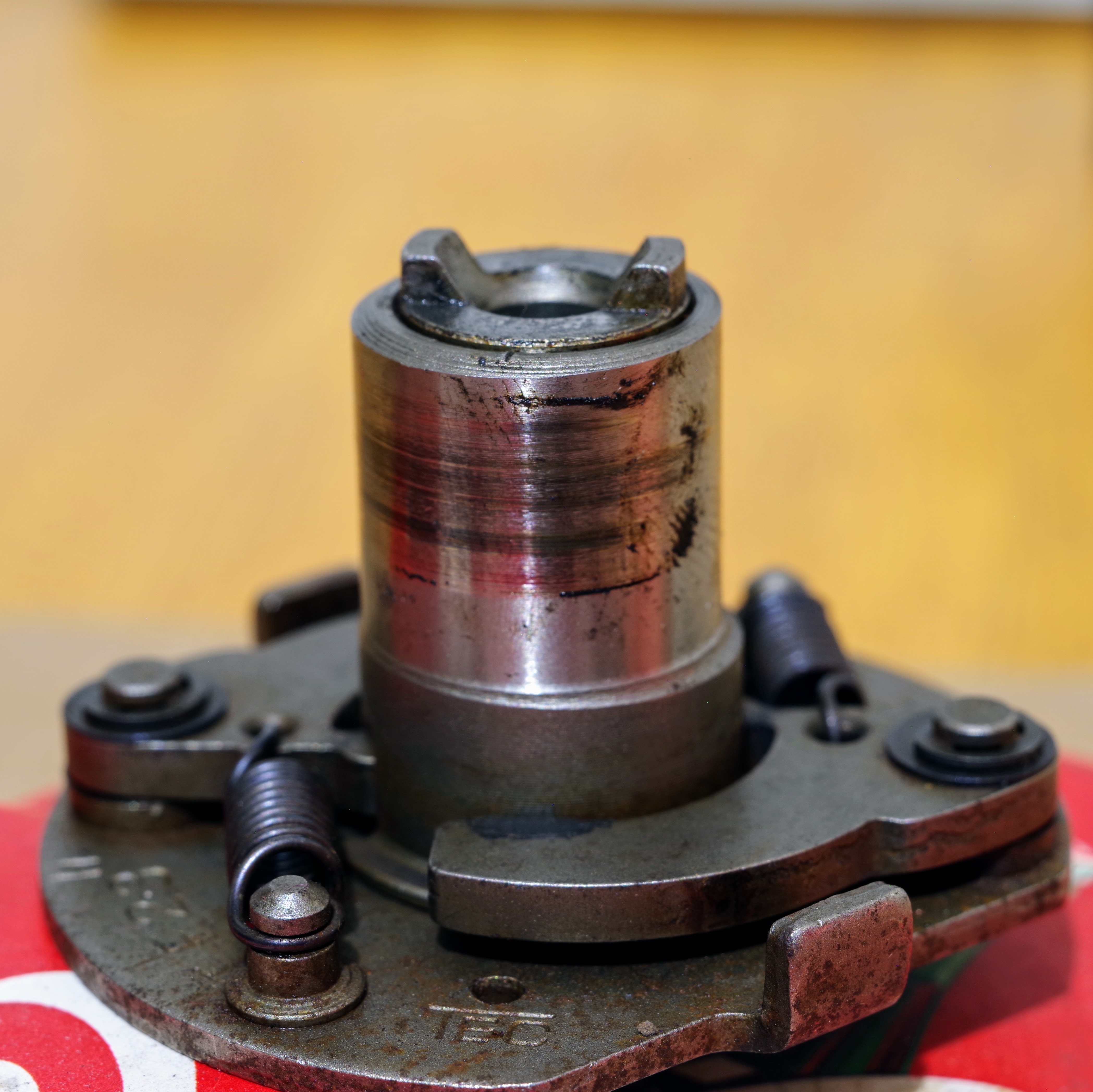
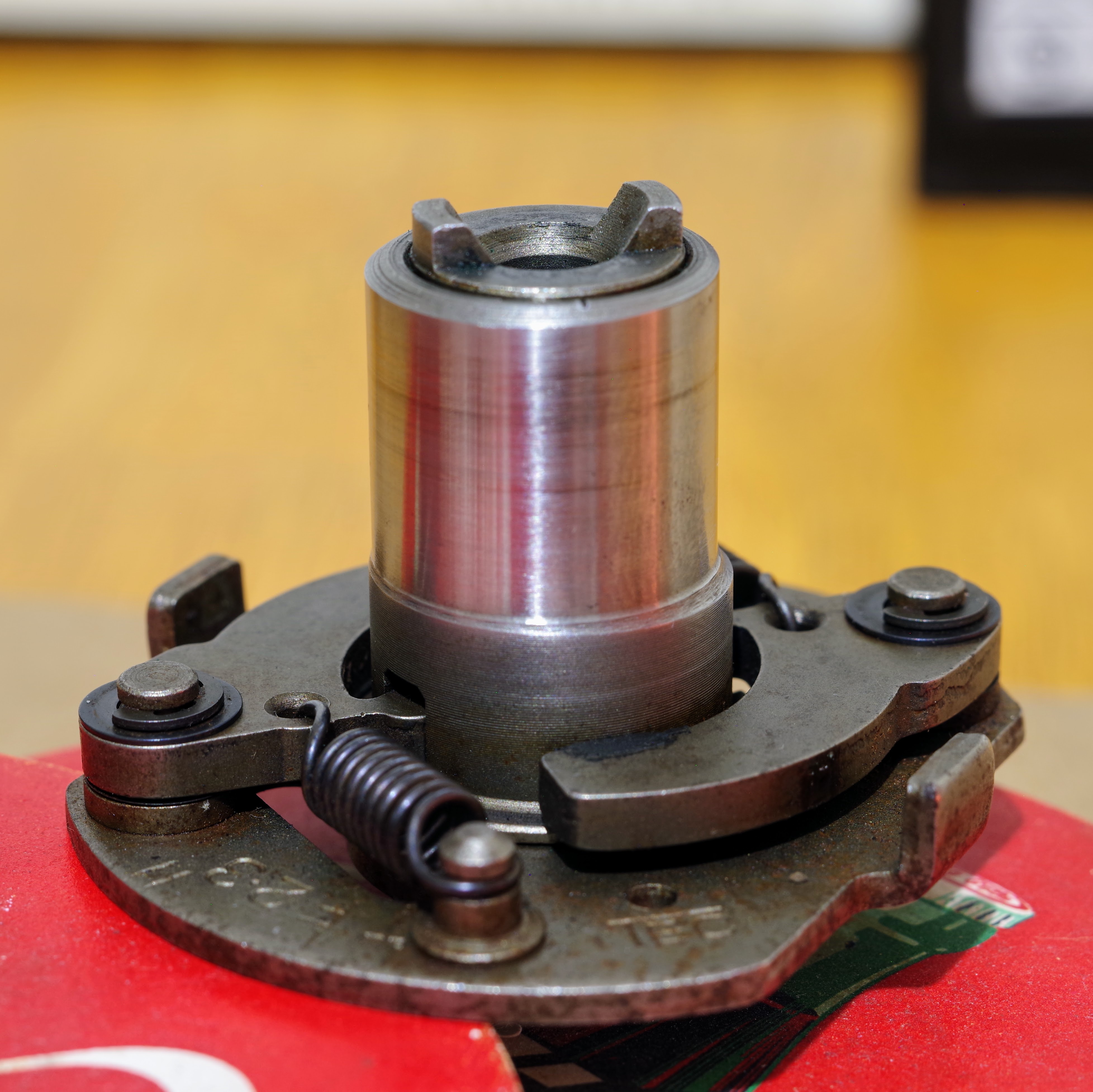
I was instantly reminded of the situation @Violet was experiencing with the points cam wearing down the followers on the points of her SL350, which was the first time I had heard about this possibility. I removed the points plate to have a closer look at the advancer and, specifically, the points cam. The picture below shows the crud and wear marks on the rising slope of the cam, which gave me some hope that this could be a major player in my past troubles with this bike. Only hope at this point. The back side of the points cam was clean and, honestly, the whole cam felt smooth to the touch. The end of the points felt was black and dry, so lack of lubrication may have been a factor. The second picture shows more or less the same part of the points cam after cleaning with a Scotchbrite pad. Some hints of the previous marks remain.

SfzGpOL.jpg


1ESe0Qb.jpg


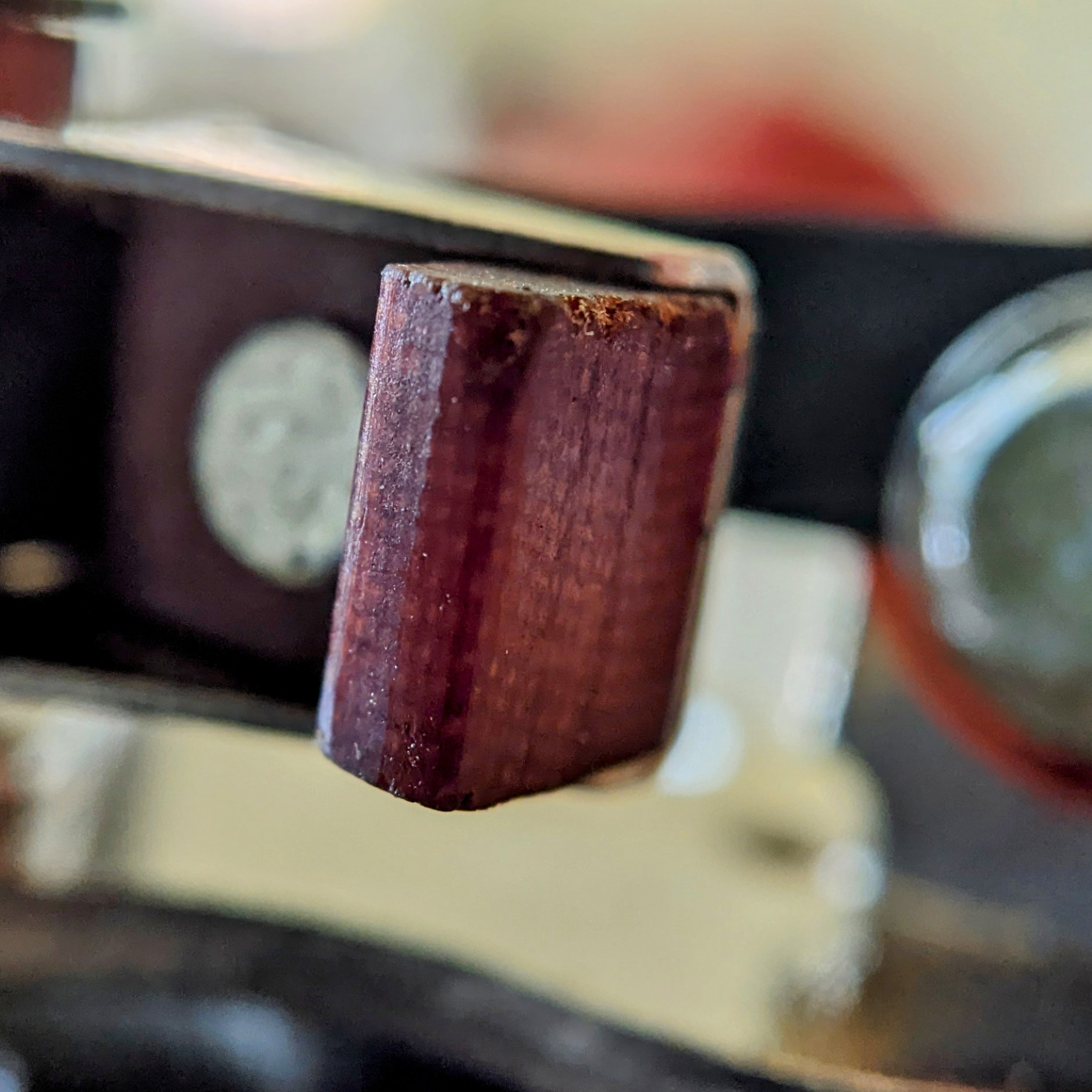
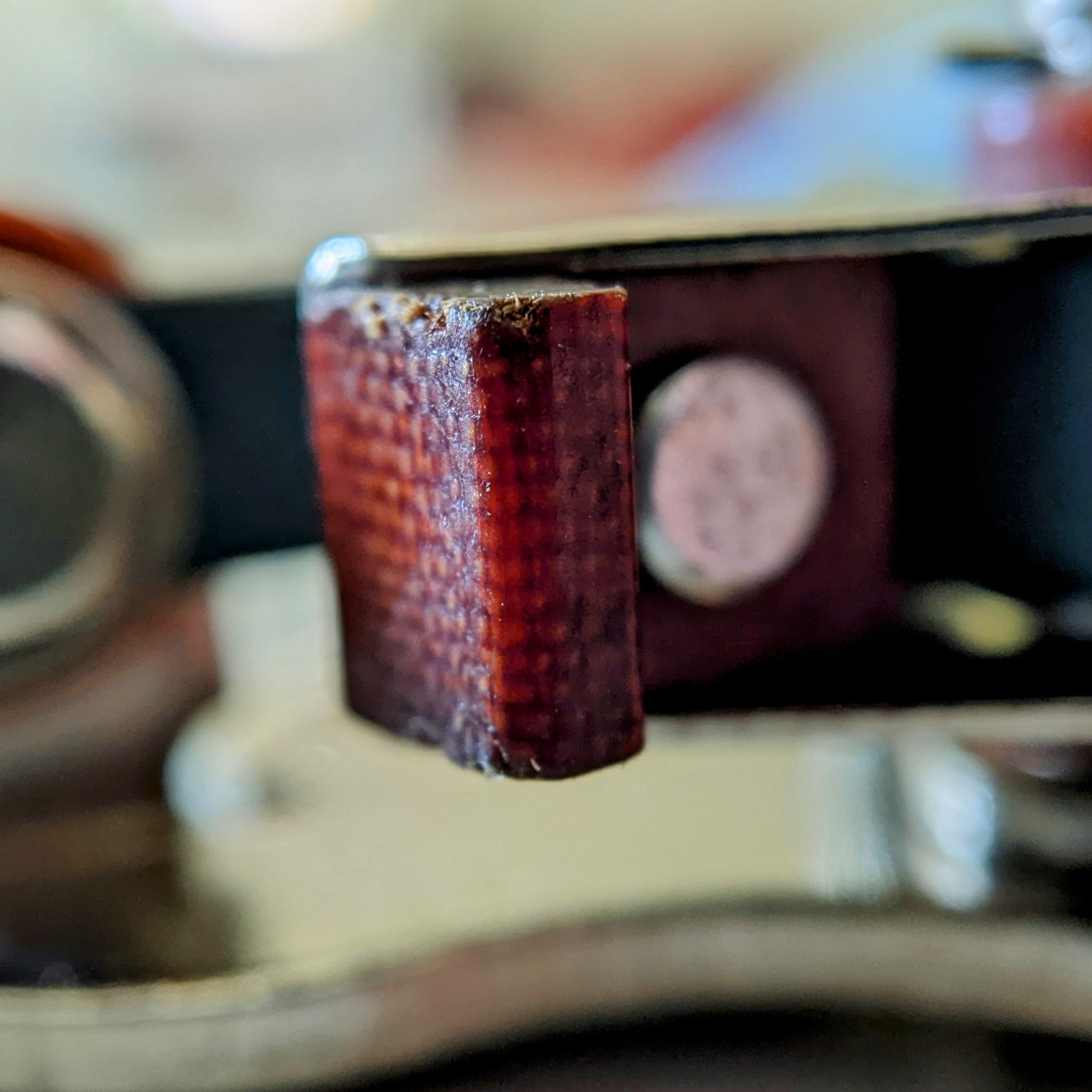
I was then hoping to find some obvious signs of wear on the points followers. It's hard to tell without a new set of points for comparison, but I have some pictures below. I went to 4-into-1 to order new points and found that they have a kit that includes a new advance mechanism and decided to spring for that, no pun intended. The kit should arrive in the next couple of days, but I won't have the chance to install it until Monday.

EB4TTTK.jpg


y5Aopqm.jpg


I was doing some reading in my copy of Hondaman's book and noticed a section about the advancer shaft. He mentioned that the shaft can be easily bent if the motor is turned in the wrong direction. Given that this bike has a long unknown history prior to my ownership, I decided to check this out and even ordered an aftermarket replacement. My simple check so far was to watch the shaft as I kicked the bike over. Not as good as a dial indicator, but I could see no eccentricity.

Feel free to chime in with comments, thoughts, and admonishments.
 
It always bugs me when people talk about rotating the engine backward being a problem in any way. I've done it hundreds of times with no ill effects. On these earlier 4 cylinders with the 6mm bolt attaching the large nut on top of the advancer for rotating the engine, the most important thing is to make sure you are square to the assembly when you rotate the engine with it. Using a wrench can allow you to put too much downward force off-center and influence the assembly sideways, which can bend the long 6mm bolt in the center. I like to use a ratchet and socket on that big nut (can't recall the size) and hold my hand around the socket as support while rotating, but the best tool for that job would be one of those Kowa t-handle sockets like Mike Nixon has pictured in one of his tool articles. That way the torque would be applied equally on both sides of the assembly. The only time rotating an engine backward would be a problem is if the cam chain was ridiculously loose, risking it jumping a tooth. And the only other potential reasoning for reverse rotation being a problem, especially if you're using a wrench to turn the engine at the advancer assembly, could be because of the added drag of the starter motor because the starter clutch would engage going backwards and add more resistance to the rotation.

When using a meter for the points break moment, I've always thought the continuity beeper built into some is the better way so you can simply hear the break and not have to be trying to watch two different locations at once.

Retarded timing will always make for hard starting, and a narrow points gap can help cause a weaker spark. The points cam looks good now, and it really wouldn't have been much of an issue in its previous condition though it certainly could have used a cleaning. As to the position of the plate, which should be more centered in the slots normally, the points gaps might be the reason. You didn't mention the gaps you used and if closer to the lower end of the range (.012") you would have to advance the large plate more. Did you adjust the small plate separately to achieve the right side (2/3) points?
 
As to the position of the plate, which should be more centered in the slots normally, the points gaps might be the reason. You didn't mention the gaps you used and if closer to the lower end of the range (.012") you would have to advance the large plate more. Did you adjust the small plate separately to achieve the right side (2/3) points?
I was acting as if the gap was set by my former self and only adjusted timing using the base plate. The 2/3 side was timed properly once the 1/4 timing was corrected via the base plate. My curiosity got the better of me and I took it all apart without checking the final gaps. Usually I try for 0.014" with the initial setting and will plan for that with the new points.

You have a knack for getting me (probably others, too) to think about things in a better way. The part of the quote above I put in bold makes perfect sense, but I hadn't considered that before you wrote it.
 
You have a knack for getting me (probably others, too) to think about things in a better way. The part of the quote above I put in bold makes perfect sense, but I hadn't considered that before you wrote it.
Well, it doesn't hurt that decades ago I'd been there hundreds if not thousands of times before, and had to reason my way through it while building mental troubleshooting habits along the way. Glad I can help put things in better perspective for you.
 
Last edited:
I would not use the 4 into 1 points, as they will be cheap crap. Have you read Hondamans or Mike Nixon’s thoughts on these cheap Chinese points that end up causing more issues? The cheap Chinese condensers are also a no go for any of these bikes. Major issues with the condensers for sure, with early failures.

Find the correct Honda OEM ones and buy them as they are still out there, or sometimes Honda makes the entire OEM base plate fully loaded with all new parts available. Usually around $120 for the entire plate.
 
I would also use a timing light to verify the correct timing, especially for the mechanical advancer check. By adjusting the points you change the base plate position. So you will usually need to adjust both the 1-4 main plate and the 2-3 mini plate when checking with a timing light.

I just put my CB550K back on the road after a 42 year sleep. That was an interesting get it running again project after all that time. I did what your doing initially minus the static adjustment first and then used the timing light to fine tune and adjust the final timing. I set my point gap to 014 in the middle of the range suggested.
 
Have you read Hondamans or Mike Nixon’s thoughts on these cheap Chinese points that end up causing more issues?
Thanks for your input. I'm out of town this weekend and didn't pack Hondaman's book, but I read (maybe reread) this article on The Motorcycle Project. It makes sense that lower quality manufacturing could compromise performance and durability. (Edit: I have now reread Hondaman's comments on points. He mentions cracked rubbing feet being more common on Chinese made points and generally recommends points brands manufactured in Japan.)

My general philosophy towards aftermarket is to learn what works, rather than assume or accept anything as given. This is mostly because I want there to be reliable replacement parts for those of us in the hobby and sometimes the OEM stuff is hard to get. A bad aspect of the market is that lots of people join the hobby and buy the cheapo aftermarket stuff right away, which enables the manufacturers to keep producing garbage parts. Maybe it will help in the long run if bad parts get tested and objectively reviewed on sites like 4-into-1. I dunno.

At the same time, I trust your advice and want to eliminate any potential problems as I work to reanimate this bike. I found and ordered a set of unused Tec points on eBay as well as a used plate that seems to have Tec points mounted, gambling that the condensers will also be OEM and good.

would also use a timing light to verify the correct timing, especially for the mechanical advancer check.
Will do. So, you did not do a static timing adjustment first? Do you have another approach to setting up new points?
 
Last edited:
I just set the points per the Honda book at .014 and it does affect the position of the points plate. My points were really too closed up when I checked them initially with a .012 feeler guage, so I reset them at .014. The new adjustments I did now affected the main base plate (.014) and the 2-3 mini plate when I put the timing light on the point opening slot to check them. I readjusted the base plate to get the timing in spec with the timing light, plus the mini plate. I was able to get the timing bang on on 1-3 and about 1 degree off on the 2-3 plate. The advancer was right between the two lines for its adjustement when fully advanced, so I called it good. My main base plate still has a little room for adjustement, if needed in the future.

I don't normally mess with points since most of my rider bikes are factory electronic ignitions. So it's not a regular procedure that I perform with most bikes. I have done the static check on some older bikes in the past and it is a good point to start with in setting up the system. I think the timing light should be used if for nothing else but to check that the advancer position is correct.

You should be good to go there for sure now with a used set and a new set of points and a used set of condensors.

Hondaman sells a black box that becomes the switch point for your ignition coils and the original points only are used to trigger the black box which activates the coil function. It removes the possibility of the points faces getting pitted and worn from the voltage spikes they normally handle. Wear on the points bakelite pads that ride the points cam is the only wear point now with that black box in place.

I restored a 1976 GL1000 Goldwing years ago and used Marks black box and I never needed to adjust that set up the 5 years I rode that bike.
 
I just set the points per the Honda book at .014 and it does affect the position of the points plate.
Absolutely. With a wider gap, the heel of the points is closer to the points cam so it breaks earlier which means advanced more. And conversely, which is something I point out a lot on Reddit, as the gap closes due to wear the timing slowly retards. I responded to someone there a week or so ago who talked about having set his points a year or so ago and was asking about other things that might cause hard starting. I told him if he put more than 1000 to 1500 miles on it since then, he needed to go back and do the complete tune-up before looking elsewhere.
 
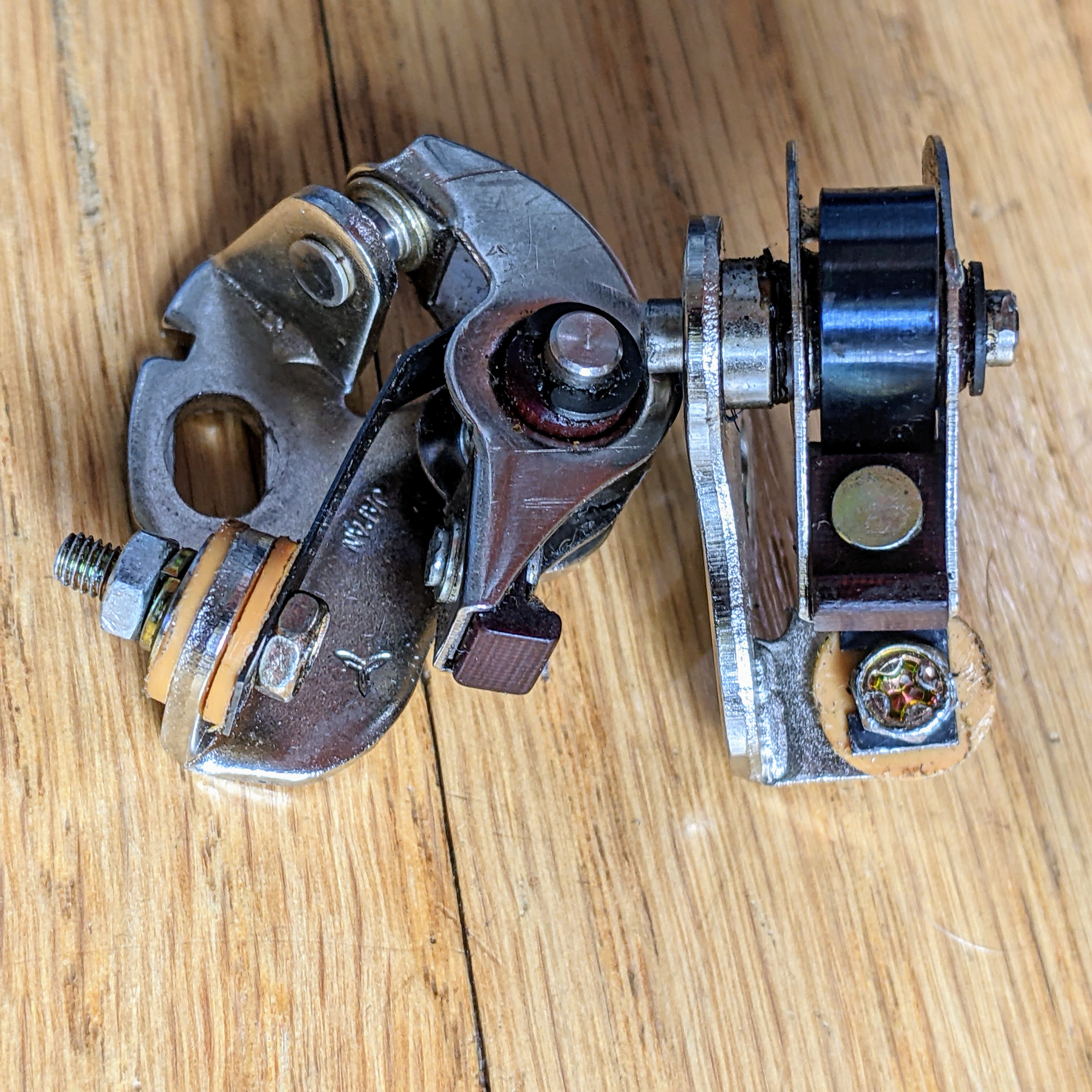
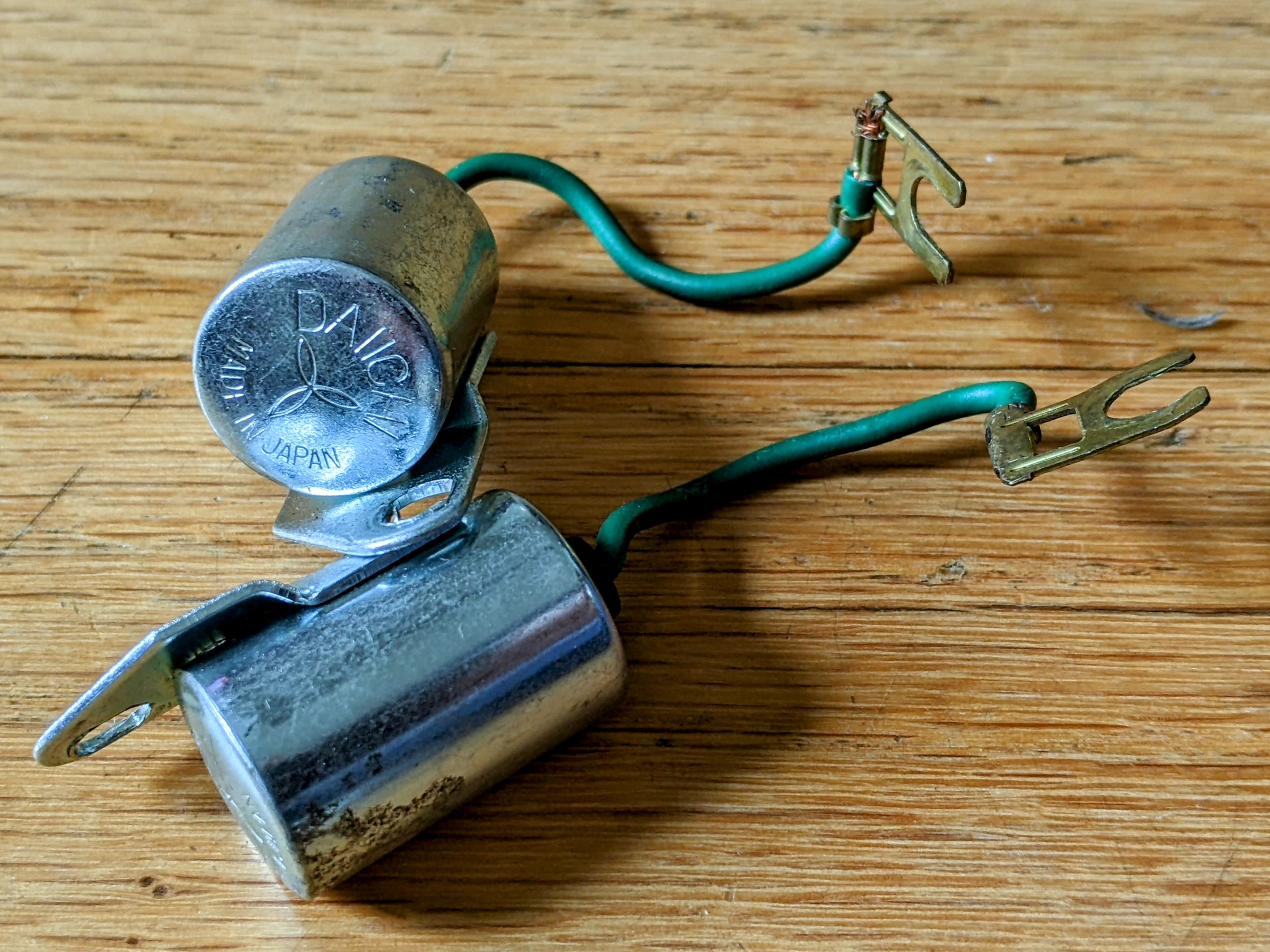
I got to wondering about my original points and condensers and looked in the only obvious location. Found them and remembered why I replaced them. Both the points and condensers are Daiichi (made in Japan), but the 2-3 point has a bent base. I remember discovering that at one point and having the impression that the whole plate was a little off and I had I replaced the plate with a used one (Tec). The bent point is on the right in the next picture.

PUgnwrh.jpg


The condensers show a little corrosion and I still have another used, loaded point plate on the way, but I'll install these for now.

IzbQIaB.jpg


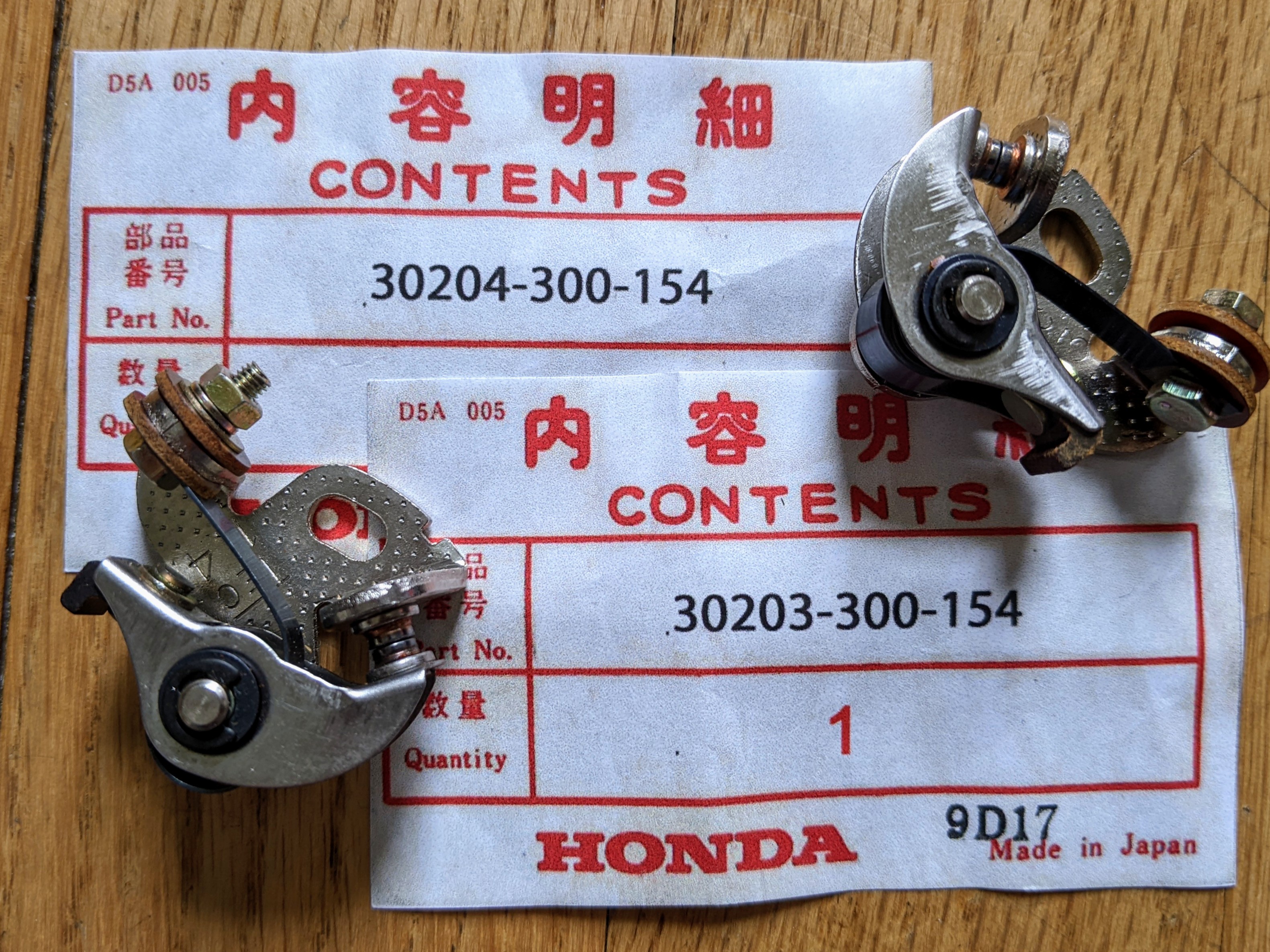
And, finally, the Tec points I ordered have arrived so I should be able to attempt starting this beast soon.

SBQAgtj.jpg
 
The bent point is on the right in the next picture.
That reminds me of the points and plate that was on one of my used 450 engines. I believe someone foolishly used an impact driver to loosen the screws on something they obviously didn't realize was too soft to handle the impact.
 
I installed the advancer and points plate this morning, set the gaps to 0.014", adjusted the timing on both sides, and wound up with final gaps somewhere between 0.014" and 0.015" on both points.

This bike is set up as kick-only with a small AGM battery that was showing 12.2 V when I put it in this morning. I had a hard time starting the bike and had to hold the throttle to keep it running.


After enough kicking to get me completely sweaty and more than a little tired, the lights were noticeably dimmer. I checked the battery, saw only 10 V, and decided to call it a day. I assume that the battery couldn't really power the ignition at that point, so maybe I'll disconnect the headlight next time to see if that makes any difference. I'll also make sure to start with a freshly charged battery.

I'm planning to install new master cylinders, front and back, that should arrive today. The calipers are already rebuilt, so hopefully I can finish the brakes this weekend.

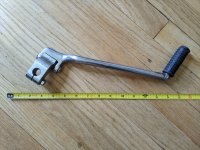
I have one question. The kickstart lever is quite long on this motor and it takes some effort to get my foot up there while standing next to the bike. When the bike is in good running order it's not a problem, but when I need to kick it many, many times it's no fun. The top of the lever is 25 1/4" above the garage floor with the bike on the center stand. For comparison, the equivalent measurements for my CB360 and CB450 are 21" and 19", respectively. Do any of the earlier SOHC 750K's have shorter levers? I think I'd trade the leverage to lower it an inch or two.
 
Last edited:
I haven't compared part numbers but I believe all the SOHC 750s used the same kickstart lever.
 
I haven't compared part numbers but I believe all the SOHC 750s used the same kickstart lever.
EDIT: A quick check reveals that roughly when the F came out the K also used the 392 middle number kickstart lever, prior to that the K used a 300 middle number version. The visual casually looks the same but there must be some difference, though length isn't mentioned of course.
 
I was looking at CMS also and tried searching the SOHC forum through Google, but haven't found anything definitive so far. I'm hoping I can find an eBay listing with a ruler or something in the photos.

Addendum: There is one seller who consistently provides measurements. Here's a comparison of a lever from a 1973 750K with my lever.

Screenshot_20240816-114306.png

PXL_20240816_164419934.NIGHT.jpg
 
Last edited:
EDIT: A quick check reveals that roughly when the F came out the K also used the 392 middle number kickstart lever, prior to that the K used a 300 middle number version. The visual casually looks the same but there must be some difference, though length isn't mentioned of course.
Thanks for looking into it for me, Tom. I certainly wasn't intending to add to your to-do list with research I should do myself. I was hoping someone might know offhand.

That 25" high kicker seems pretty extreme — I had almost forgotten about it until I went to use it this morning.
 
Thanks for looking into it for me, Tom. I certainly wasn't intending to add to your to-do list with research I should do myself. I was hoping someone might know offhand.

That 25" high kicker seems pretty extreme — I had almost forgotten about it until I went to use it this morning.
It only took a few minutes and I was curious as well and I learned that from the first year of the F onward, they both used the later version. In hindsight I really never even used the kickstarter on any of my 750s except possibly to turn the engine a little bit while working on the points side.
 
The second day on the kickstarter went a little more smoothly. I disconnected the headlight and started with a freshly charged 2.9 Ah AGM battery. I think that tiny battery is not up to running the headlight on its own for very long. I wore shorts instead of jeans, which makes it a lot easier to operate that tall kickstarter. It also helped that I only had to kick it 2 or 3 times today. First kick with the starter circuits open resulted in an immediate start and a high idle, probably a little over 2000 RPM. I shut it off and turned the idle adjusters about a half turn out on each carb. Next kick or two got it idling a little lower and then I dialed the idle adjusters down equally until the idle was around 1000-1100 RPM. I grabbed a short video in which you can hear the obligatory, if not obnoxious clutch chatter. I was holding my phone in one hand, so could only operate one control on the bike at a time.


Yesterday I spent some time mounting the replacement rear master cylinder from VintageCB750.com. It is not a direct replacement, so there was some extra work to make it fit. Similarly, the replacement front master cylinder is not compatible with the stock front brake sensor and I stupidly assumed it would be. So, I now have to wait for a banjo bolt brake switch to complete the installation — I had never seen one of those before.
 
The engine sounds typical for an older 4 cylinder that isn't fully synced at idle, but I'd imagine that would be more challenging with the Murray's carb setup because one idle speed adjustment is controlling 2 cylinders (and not a pair that are both at TDC simultaneously with one of them on exhaust like most single-carb twins are set up). Yours is the first I've heard run with that carb setup, and I wonder just how close you can get the idle sync on that arrangement. In theory it would seem simple, but since there's probably some cylinder imbalance I'd have to think that would contribute to the difficulty.
 
I wonder just how close you can get the idle sync on that arrangement. In theory it would seem simple, but since there's probably some cylinder imbalance I'd have to think that would contribute to the difficulty.
I think the 4-into-1 exhaust adds to the difficulty as well and it would be nice if I had space for larger air filters.

There aren't many miles on the motor rebuild and I would say it's probably still in the break-in phase. Hopefully the cylinders are in reasonably similar condition.
 
I believe the kick start lever was altered slightly on the later bikes because of the F muffler.
Thanks. I'll watch out for interference when I receive the used kickstart lever. I notice that my kickstarter has a little contour that puts it half an inch or so further away from the motor than the earlier version, in addition to being an inch or two longer. I'm running an aftermarket 4-into-1 exhaust and it seems to improve clearance, but we'll see.
 
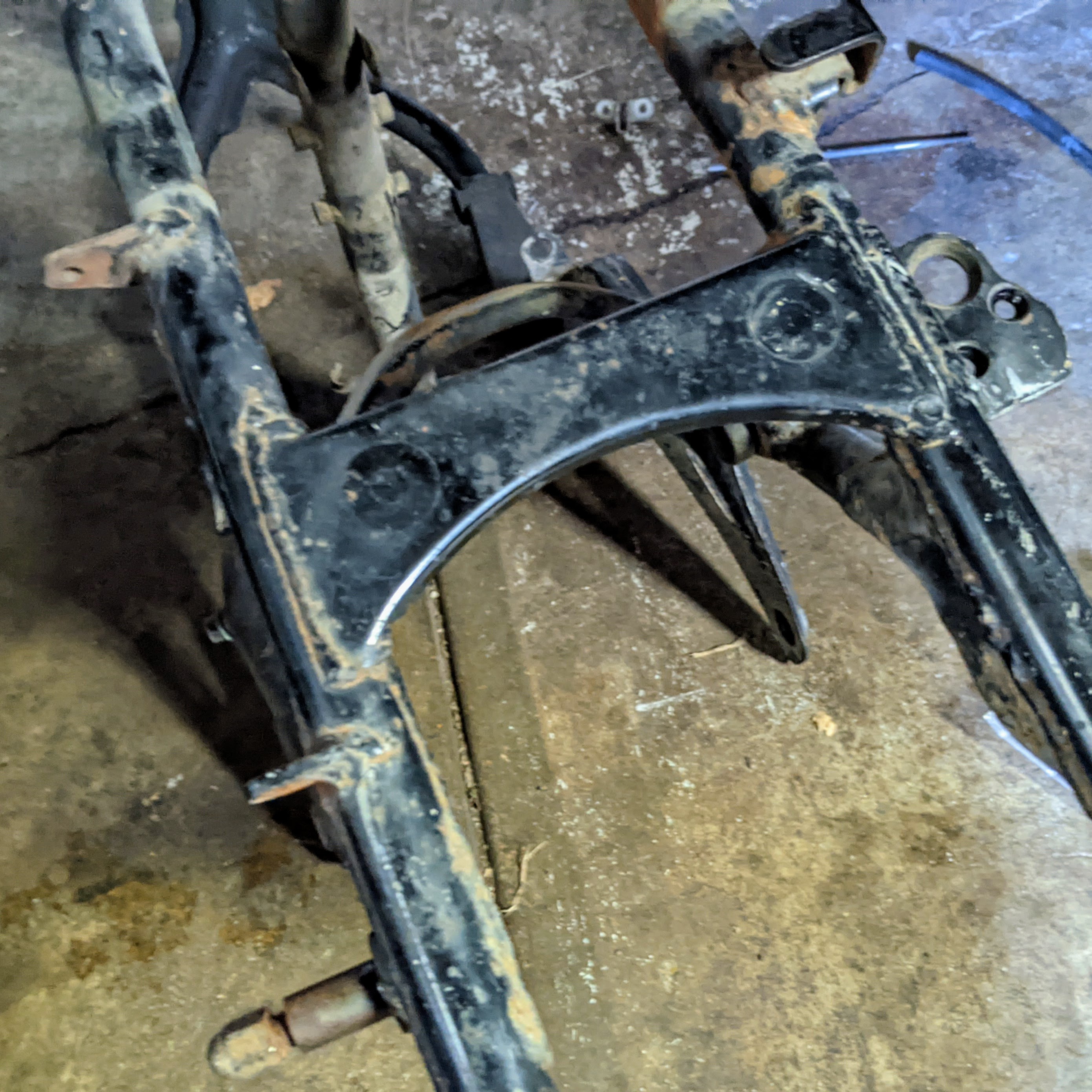
I bought a 1972 CL450 parts bike back in 2017 in order to acquire a spare motor. I've taken a lot of parts off the frame since then and not much remains, but it's going to be a big help in the seat modification for this CB750. The lock mount and hinges were removed from the 750's frame when the custom seat was created, so I will transfer those pieces from the CL450 frame to use with the CL450 seat. I'll bring the whole frame to the welder so he can measure everything in place and cut/weld as he sees fit.

HbNFRv7.jpg


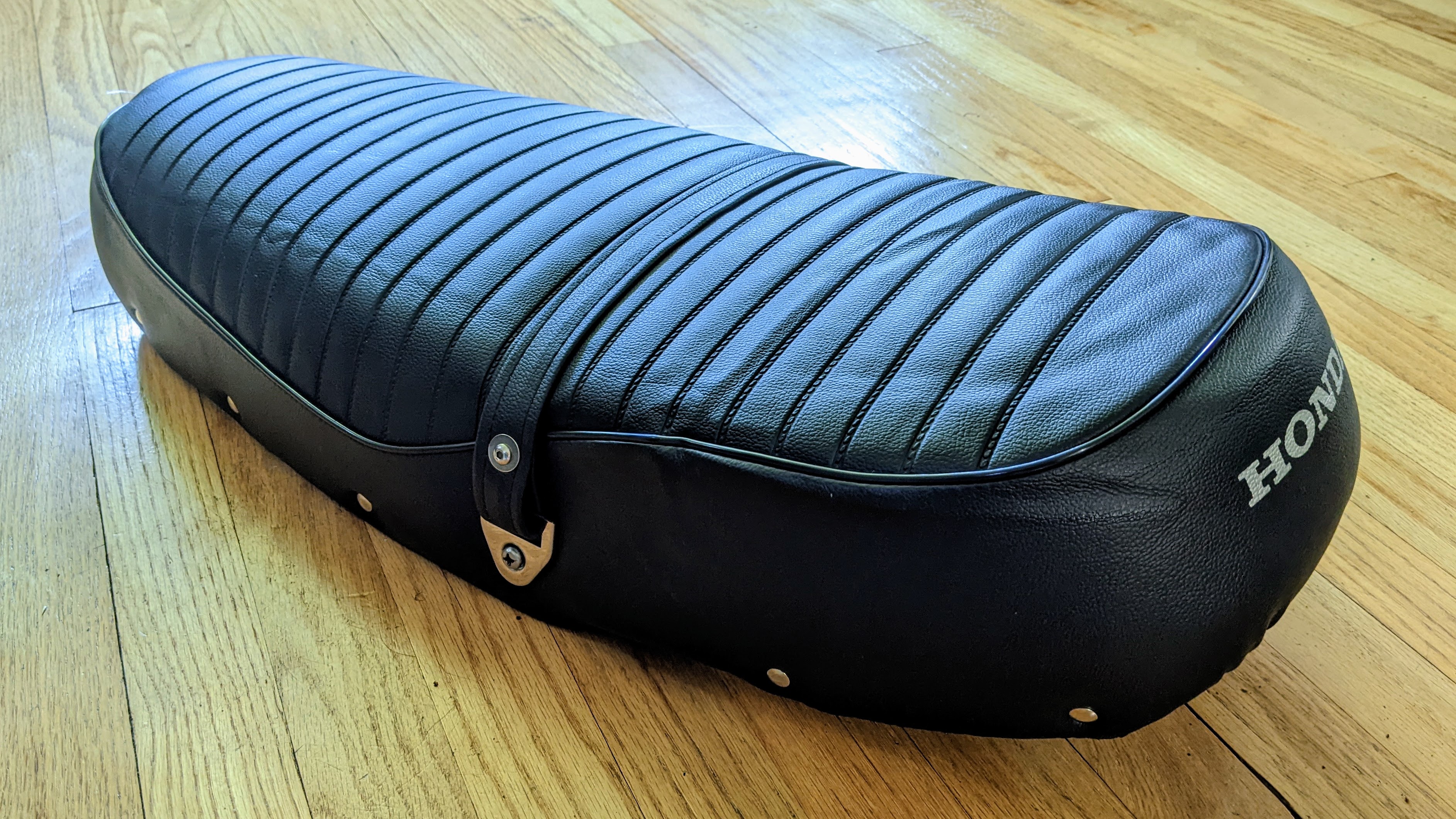
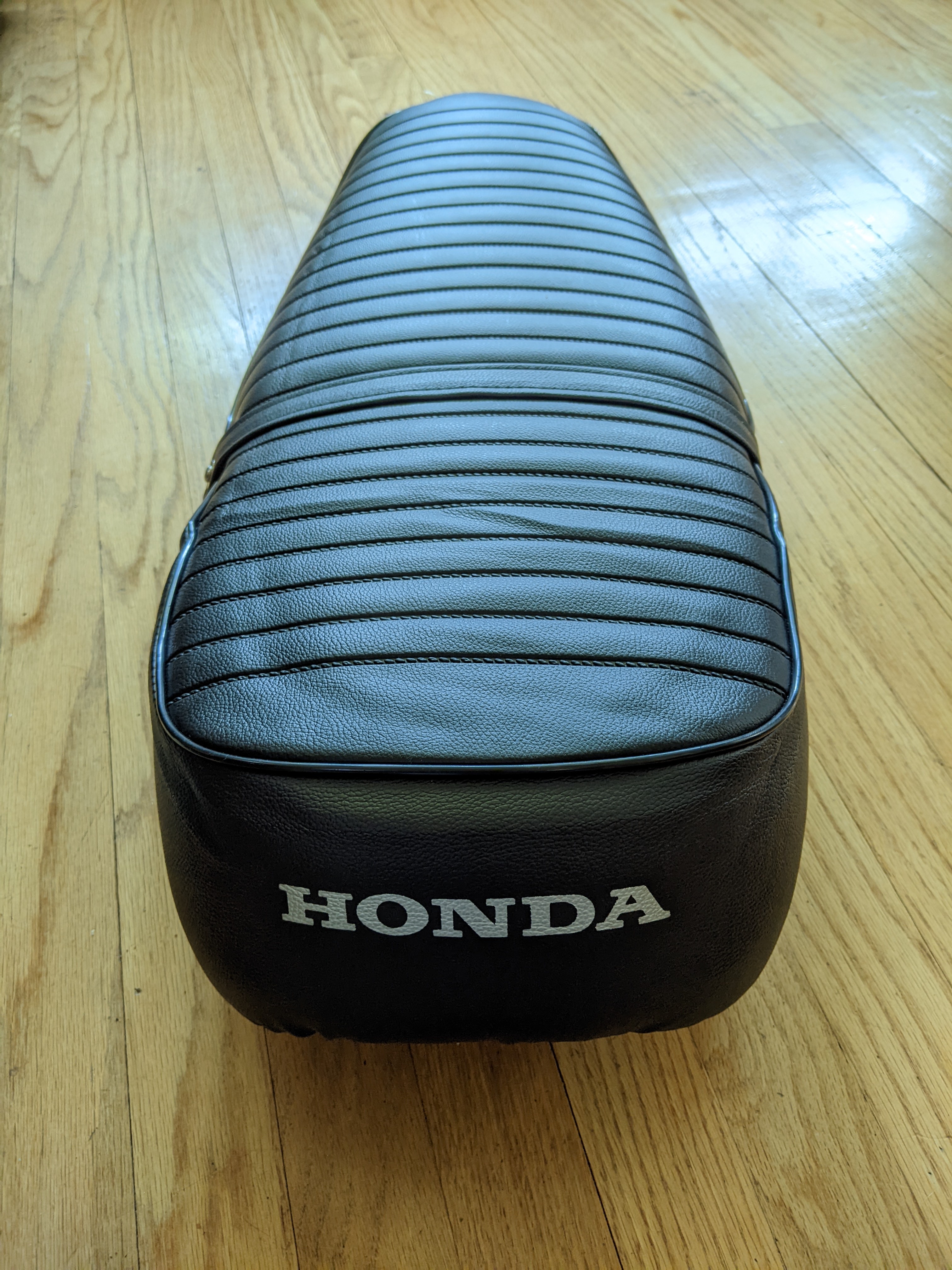
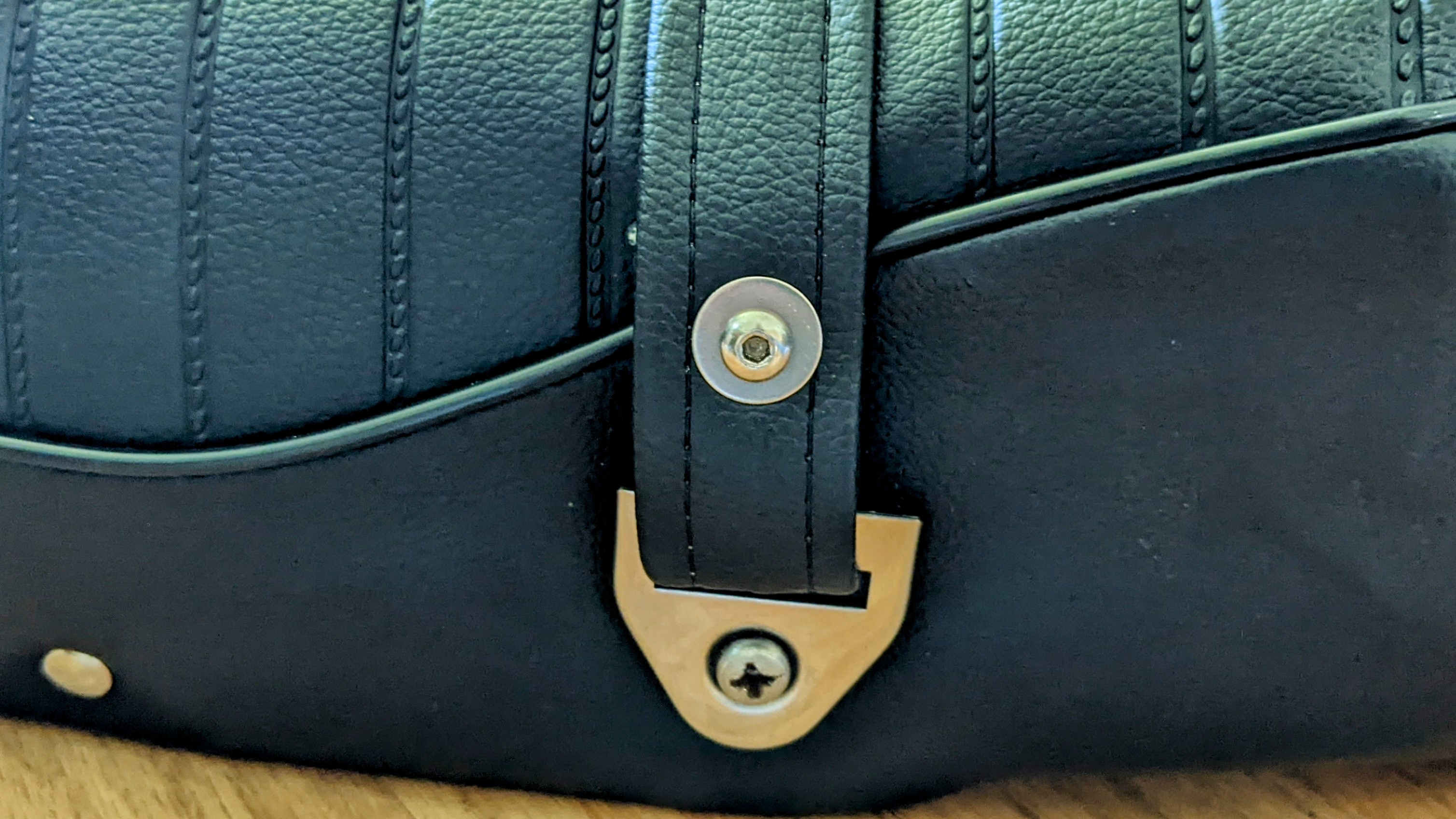
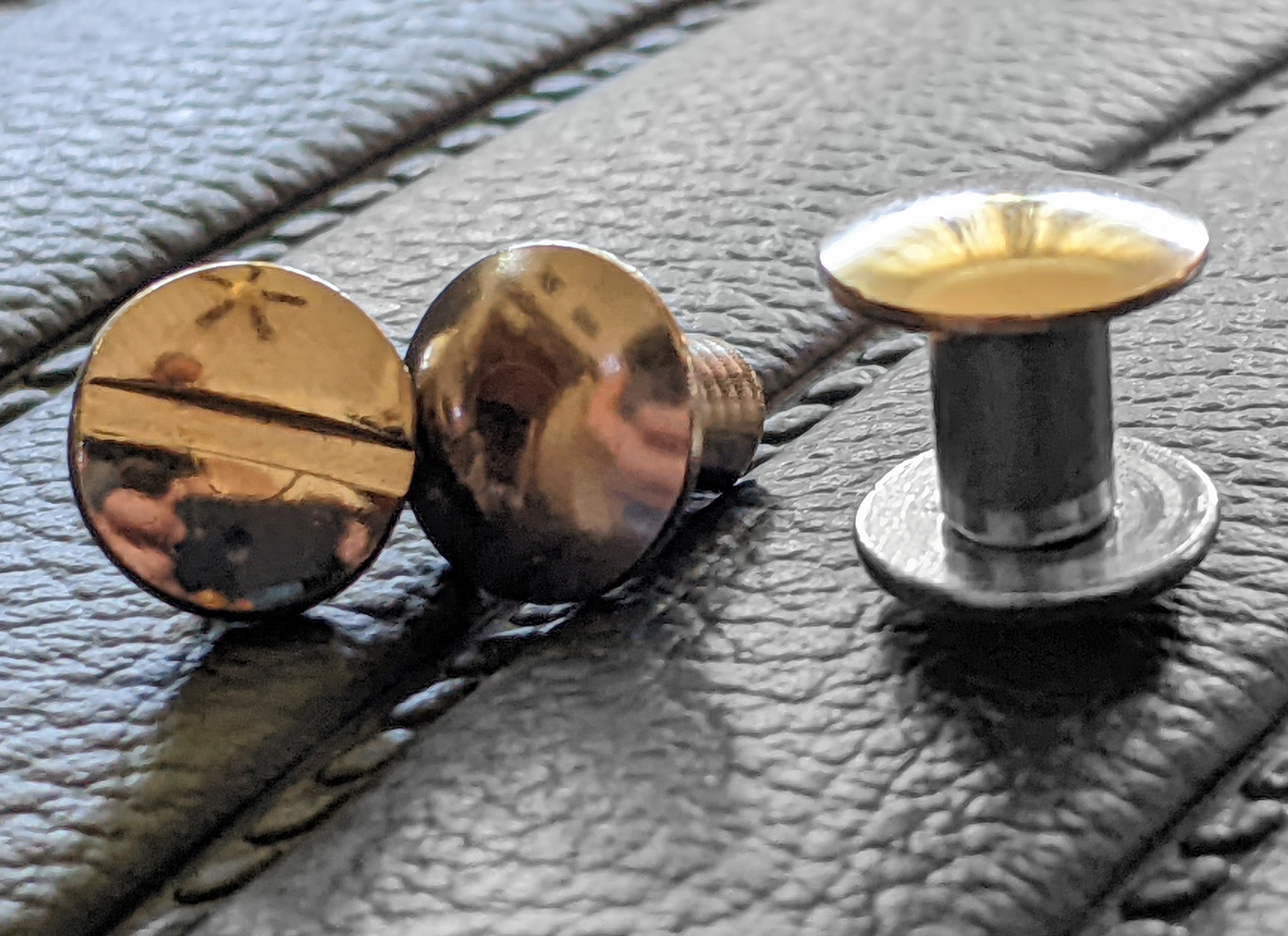
I recovered the seat a couple of weeks ago using an aftermarket cover from the eBay seller hondamotorcyclepart. I'm pretty happy with this cover and I think it was the nicest seat strap that I've ever received with a replacement cover. Often the bracket at the end is square on the covers I've bought and this one is a reasonable match for the original. I also incorporated 1/4" Chicago screws after seeing @Cycleranger and @fxray discussing them on the former's CL350 thread. Mine came from eBay seller somon2827 and I got 25 of them for about $25. The diameter of the screws was just a bit too big for the holes in the pan, so I drilled them out for a snug fit.

u5phnsZ.jpg


334pla3.jpg


WB99wvb.jpg


OKRt4kp.jpg


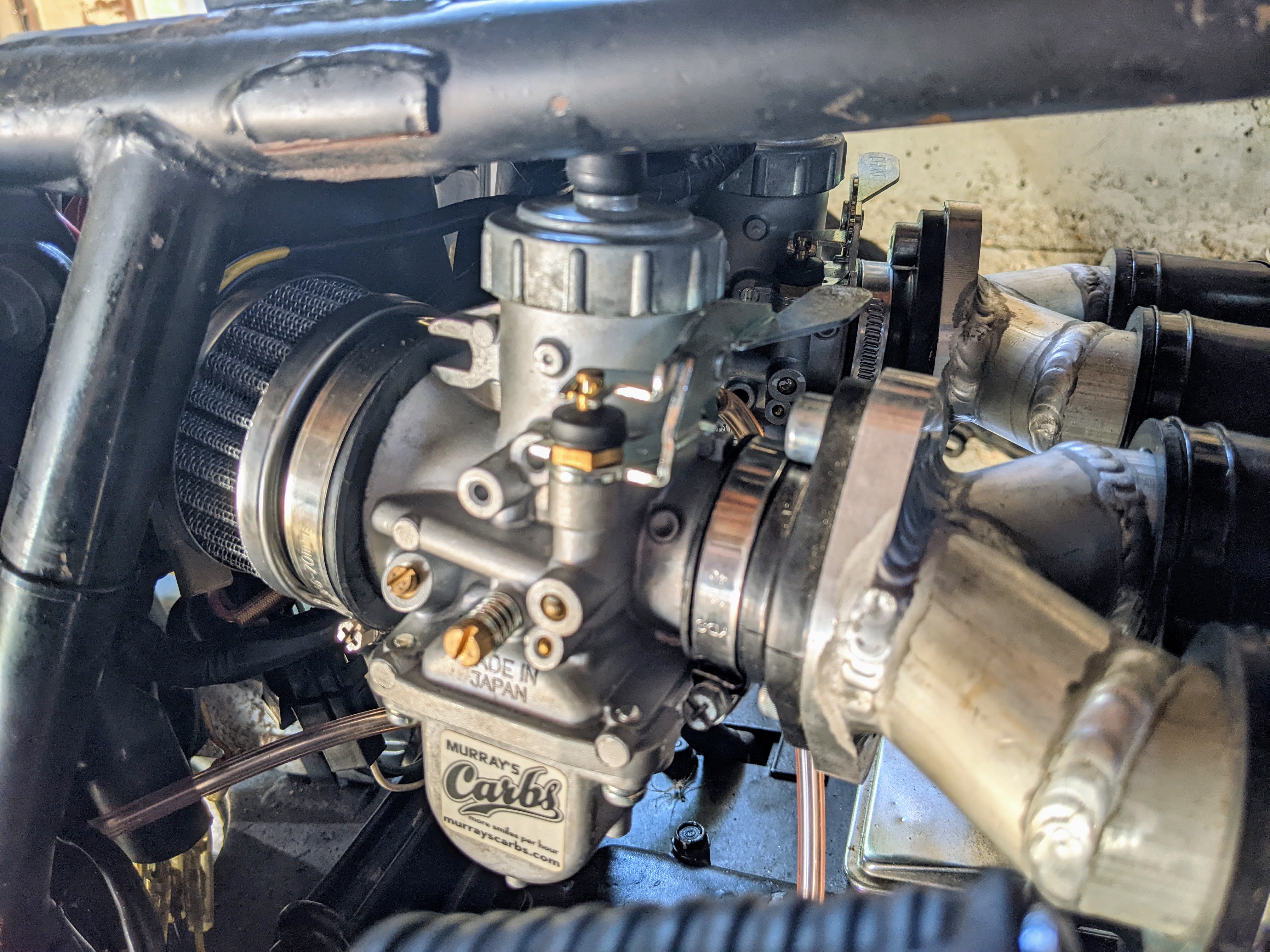
Finally, while the tank is off I took a picture of the carb setup from Murray's carbs. It was not long after I bought this set that they began to either improve the welds or clean them up afterwards, but they seem to get the job done and they fit the stock intake manifolds. I'm not super happy with the air filters, such as they are, but space is tight.

Xq5Gf3S.jpg
 
I seem to be having trouble with the replacement rear master cylinders. I've tried two different ones ($10 and $50) with the same result: brake fluid leaks from the bottom of the master cylinder before sufficient pressure builds up in the caliper. The most recent one is linked below.


Does anyone have a recommendation for a Honda rear master cylinder that might be made to work? I didn't even see any used ones at the moment that are a direct fit, but I'll be looking...
 
This morning I made a sanity check with the rear brake by connecting a spare CB360 front master cylinder to the caliper. I was able to bleed it and build up pressure to operate the brake as expected.

My attempts with two aftermarket rear master cylinders both ended with no pressure buildup and a puddle of brake fluid beneath the master cylinder. I hope this means the master cylinders were at fault.

I was able to order a used rear master cylinder from a 1975 CB750F. Hopefully it will fit and work, possibly after a rebuild.
 
I think your test is valid and both of those masters were apparently damaged enough that they leaked. Seems the rear masters are as hard or harder to successfully rebuild than the OEM front ones can be.
 
I think your test is valid and both of those masters were apparently damaged enough that they leaked. Seems the rear masters are as hard or harder to successfully rebuild than the OEM front ones can be.
I've read that the rear masters suffer from the fact that they are closer to the road and can more easily pick up dirt and moisture. Makes sense.

I tried to rebuild the original rear master on this bike several years ago, but it leaked afterwards. I used a cheap $15 part successfully for about three years, so it's been frustrating that I couldn't get either of these two to work at all.
 
Just a thought on the masters. Did you use a vacuum hand pump to bleed it, or were you just pumping the master? I know the master doesn't have much range and is more likely to leak the further out the master piston has to travel. If there is a way the lengthen the clevis rod or move the body mounting closer to the pedal arm to limit the master piston travel, perhaps it will help keep it from leaking.
 
Just a thought on the masters. Did you use a vacuum hand pump to bleed it, or were you just pumping the master? I know the master doesn't have much range and is more likely to leak the further out the master piston has to travel. If there is a way the lengthen the clevis rod or move the body mounting closer to the pedal arm to limit the master piston travel, perhaps it will help keep it from leaking.
Good thought. I've been contemplating the orientation of the pedal arm and the plunger bolt and clevis trying to find fault in what I did. I'll describe below.

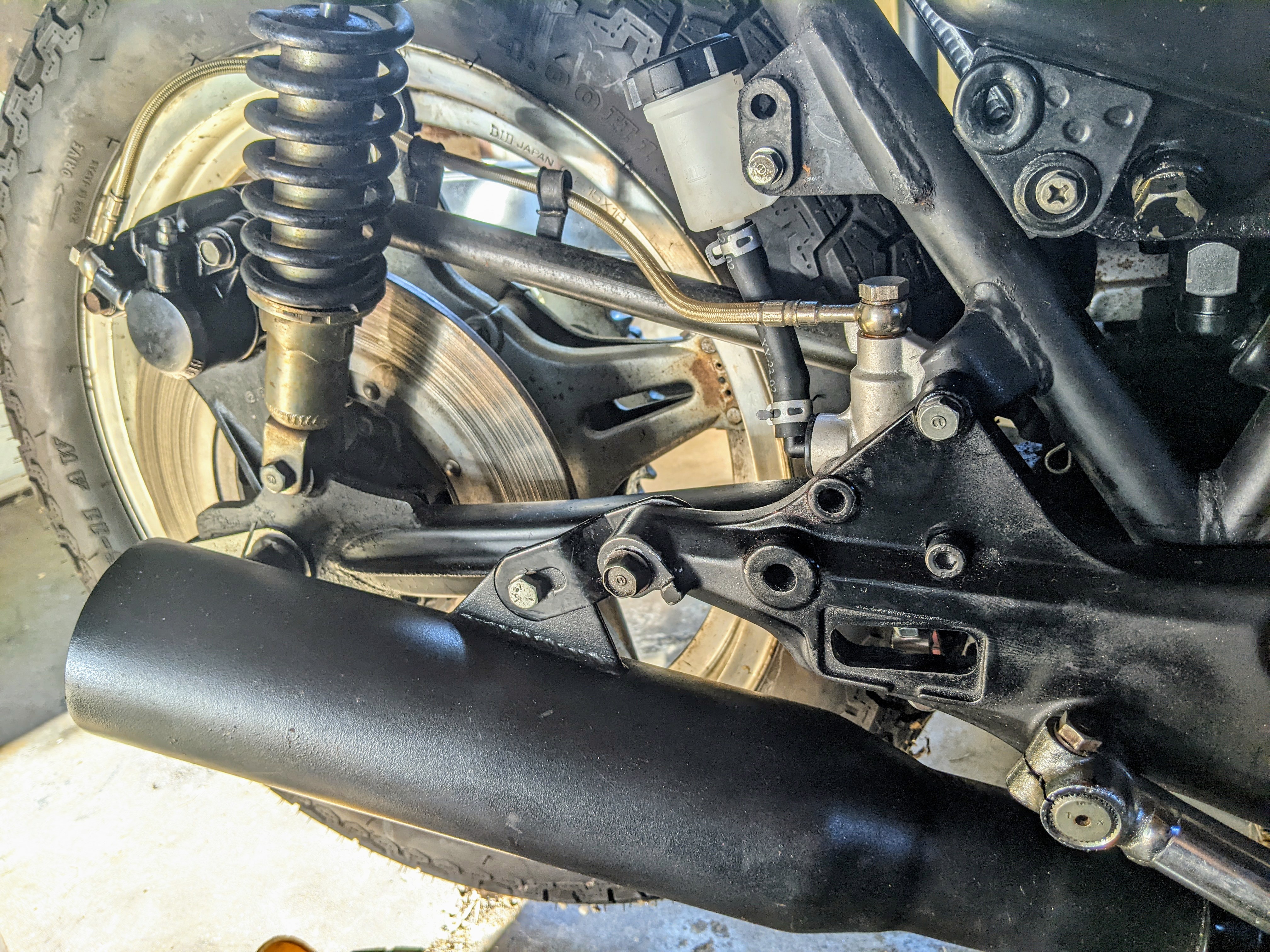
I am using one of the original mounting holes (top) and added a new hole (now slot) to accommodate the vertical bolt pattern of most aftermarket rear master cylinders. The lower bolt on the OEM master is set back roughly two inches — that hole is empty in the picture below.

ua8SNFs.jpg


In order to get the clevis and pedal arm close I have been doing a combination of lowering the clevis and pushing the pedal down. If the pedal height is incorrect (too low), I can remove it from the spline without disturbing anything else and realign it for appropriate height. It is worth noting that the plunger rod on the master can tilt and it typically is tilted forward when I connect it to the pedal arm. When the pedal is depressed I could see the plunger rising and I was getting fluid and bubbles to rise in the bleeder hose. What I couldn't do was build up sufficient pressure to push the piston against the rotor. Once I noticed the fluid dripping from the bottom of the master, I knew why.

I was bleeding the line by pumping the lever and I definitely used the full stroke at times not thinking that could be a problem. Maybe the fact that the rod was tilted was part of the problem. Or, maybe those aftermarket masters weren't made well.
 
I'd think lack of pressure would be air still present, especially in the caliper. Does it leak when at rest or when pressured by the pedal arm?
 
I'd think lack of pressure would be air still present, especially in the caliper. Does it leak when at rest or when pressured by the pedal arm?
Hard to say. Fluid was dripping from one place to another under the master, pooling on the floor below. It's hard to clean everything while trying to pump and still see what comes from where, when. I can't explain how any fluid would escape on the master side if it was working properly. It felt like the leak was the reason the caliper couldn't build up pressure.

When I switched to the spare front master, everything went as expected using the same brake line, with no fluid escaping the system other than what was bled intentionally.
 
One of the 'tricks' I used to do after servicing CB750's, while bike still on bench, kick-start' by hand.
Owners were generally freaked out how easy they should start, often they wanted to try as well.
If you have means to test, pretty sure capacitors are 22 micro-farad (I'll have to check to be certain but all Honda's are in the 20~26 range (+/- 10%)
Are there any recommendations to support rear of carbs?
That's an awful lot of leverage on the intake boots.
It can cause air leaks and changes in fuel level when they sag (which they will)
 
One of the 'tricks' I used to do after servicing CB750's, while bike still on bench, kick-start' by hand.
I've seen it done on another 750. Haven't done it on mine. We'll see if I can do it. I imagine it's one of those "it's all in the wrist" type of things.

If you have means to test, pretty sure capacitors are 22 micro-farad (I'll have to check to be certain but all Honda's are in the 20~26 range (+/- 10%)
My meter can give a rough capacitance measurement, so that's easy enough to check. I guess the fear with cheap copies is more about durability.

Are there any recommendations to support rear of carbs? That's an awful lot of leverage on the intake boots.
My experience buying specialty kits and parts is that they almost never send any useful information along. No different here. I agree it would be a good idea to support the carbs, but it honestly doesn't feel slumped to me at the moment. The boots are relatively new, but stouter than a fresh set of CB360/CB450 boots, plus there are four of them and only two carbs.

If I can decide on an elegant solution, I'd be up for implementing it.

Thanks, PJ. Hope you are on the other side of the storm damage.
 
Last edited:
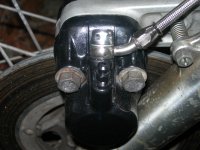
I was thinking about how to get a quality rear master cylinder and had the idea to search for Brembo units on eBay. Found a used one from an early 2000s Yamaha FZ1 for about $30. I wanted to see if it would use the same banjo bolts, but could only find the Yamaha part number the banjo bolt: 90401-10159-00. However, it seems that they are the same as those found on most old Hondas (10mm x 1.25?).

If the used master I'm waiting on doesn't work, I may go this route.
 
Brake banjo bolts on Japanese (and most others) only come in two thread types.
Almost everyone uses 10x1.25 but Suzuki used 10x1 until early 2000's.
I've been making my own from stainless steel Allen bolts for several years.
Won't be selling any though as I would need about $25~30.00 each for themCB378frontbrake.jpg
 
I have been working on cleaning up a used rear master cylinder from a 1975 CB750F over the last year. It was mostly full of crystalized brake fluid and I kept soaking it with cheap cola and eventually found that it got clean enough to at least attempt a rebuild. I tested it with fluid today and realized that the return hole is still plugged. It doesn't pump. Unfortunately, it's hard to get at that hole, so I ordered a Mikuni carb cleaning tool that will hopefully allow me to get in there.

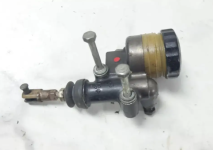
This is a photo of a similar master cylinder from an online search. The bolt head that is barely visible above the red dot must be removed and then the two holes in the cylinder bore are accessible through the bolt hole.


Screenshot_20250913-193115.png
 
Just did a quick scan of this thread and OMG after seeing your poor 750 in the first post makes me cringe. You are a brave man.
 
I can say the same for my 450, bought for $250 but now I don't even want to tally the investment to date. Money Pit might be a better name but with that said I am really glad I got it and I have gotten a ton of satisfaction out of the build so far and even more this incredible community where I get to hang out.
 
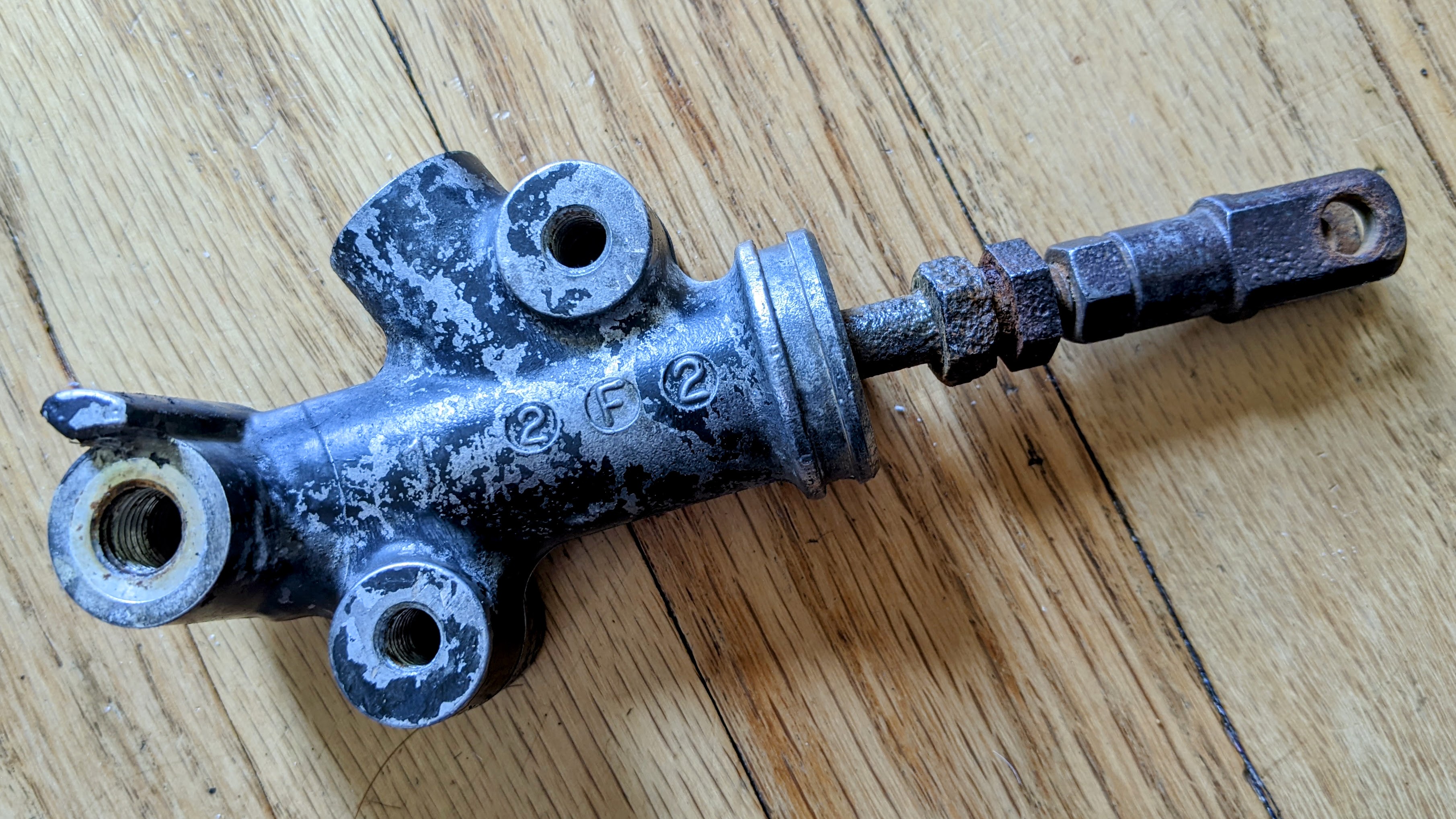
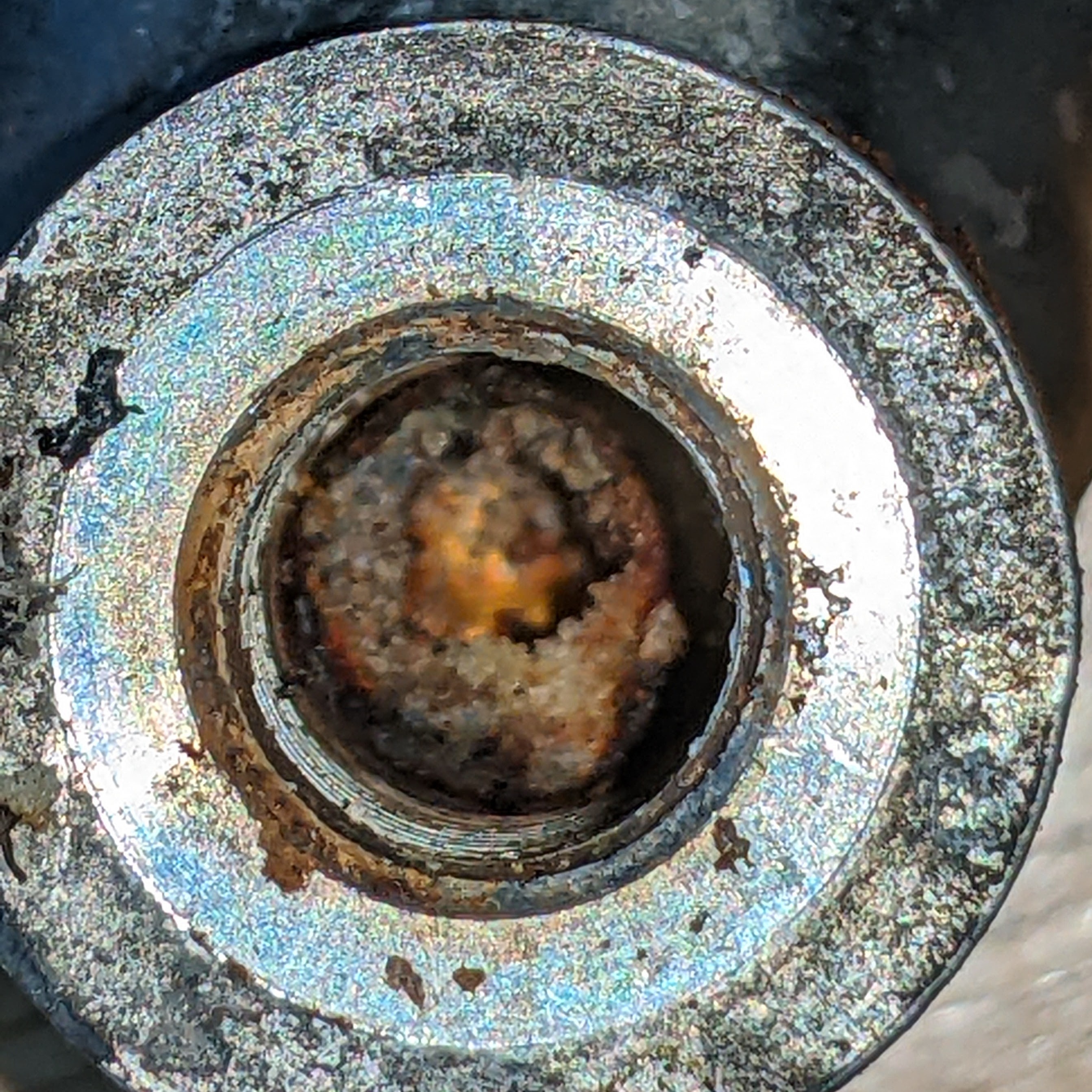
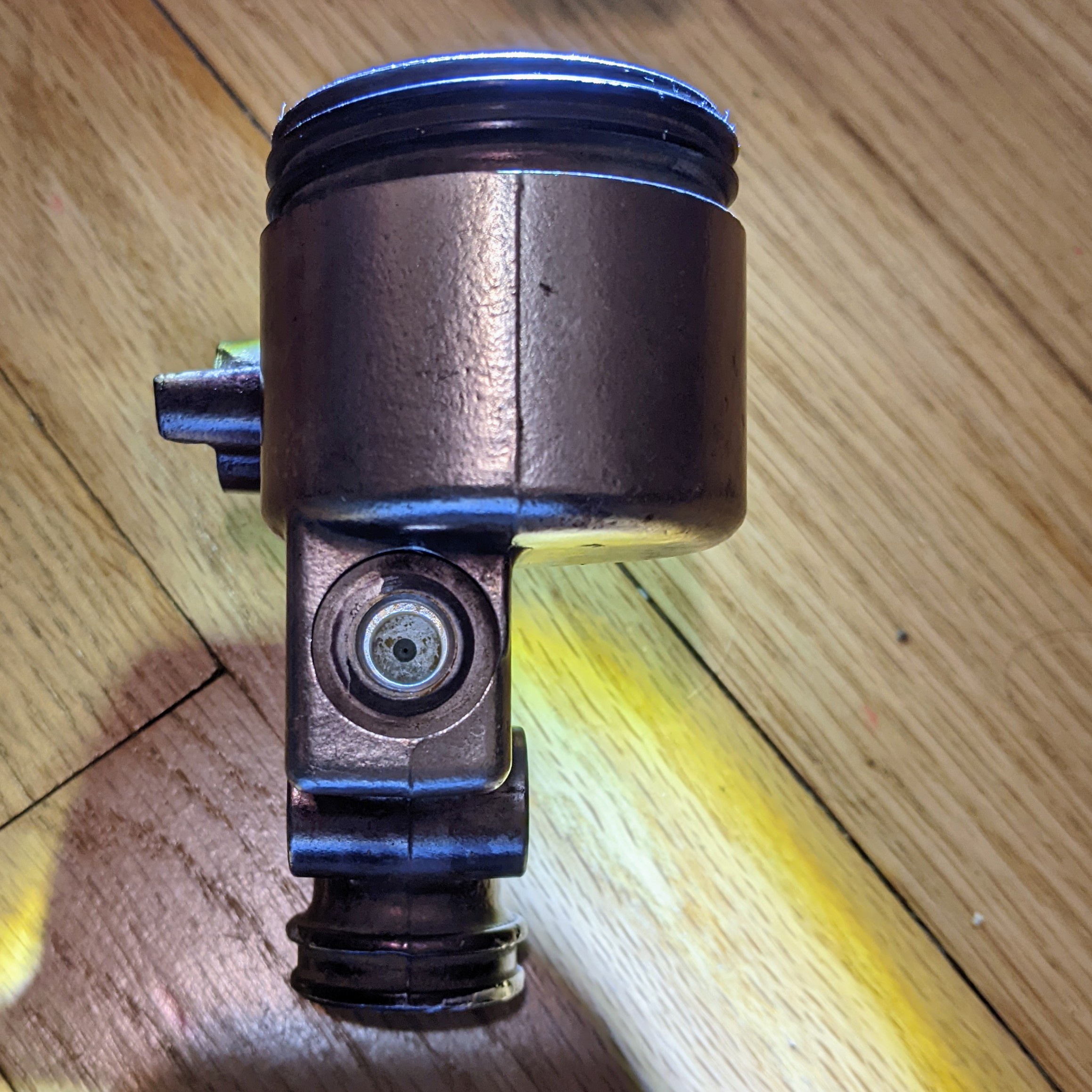
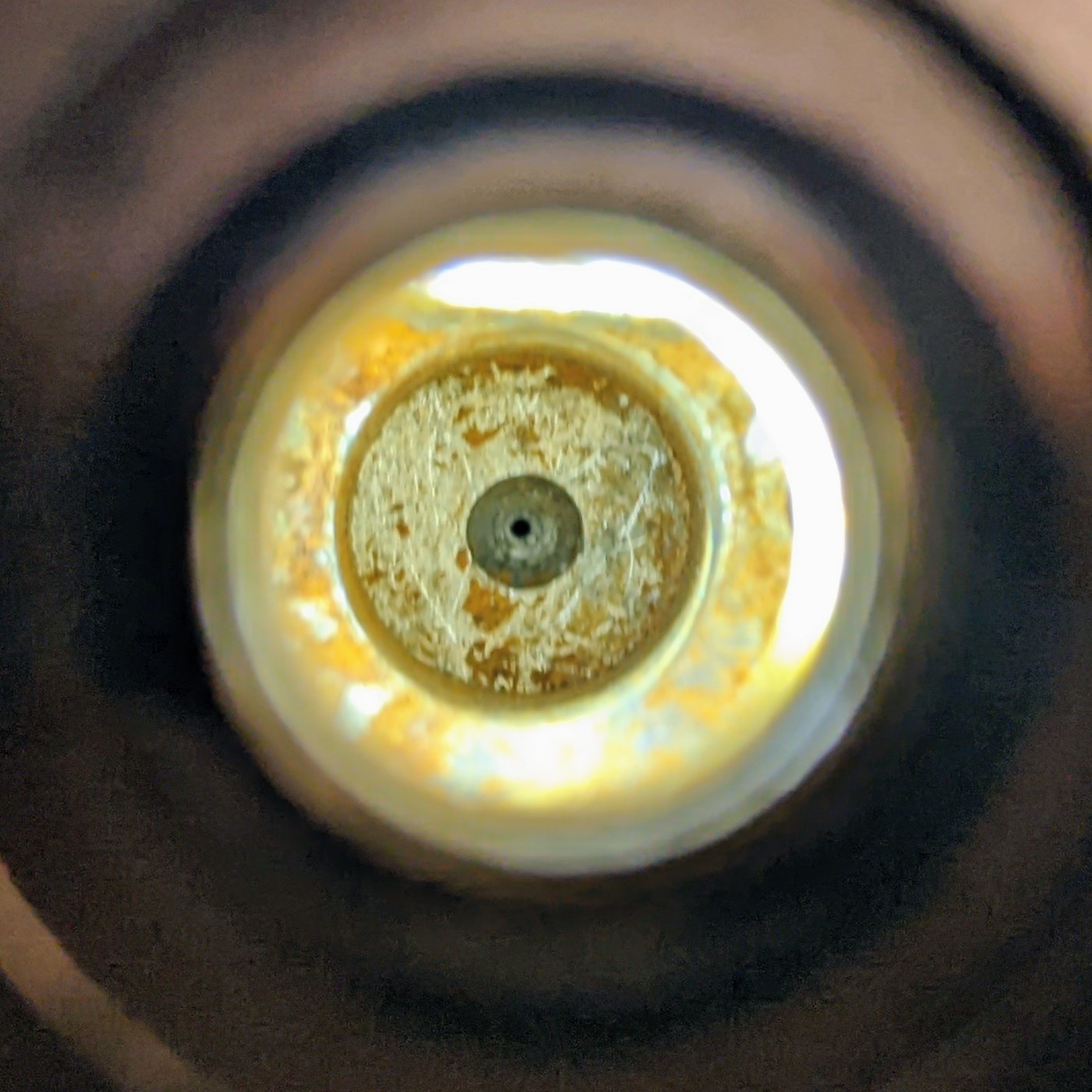
I just received a [another] used rear master cylinder — this one comes from a CB750F2, so it's a direct fit. Sellers rarely provide pictures of the internals, so I bought this assuming it would be crystal city inside and that turned out to be the case. I'd like to soak the whole thing in an appropriate solvent to deal with the crystallized brake fluid and then disassemble for the rebuild. What would be the best solvent to use?

hKYqrpG.jpg


kqLoavr.jpg


UIYE5Uv.jpg
 
Thanks, @Cycleranger. I'm going to start by soaking the bottom part in metal prep stuff. Hopefully that will allow me to remove the very rusty retaining ring. Once I get the piston out, I'll move on to soap/water, boiling water, and hopefully finish with brake cleaner.
 
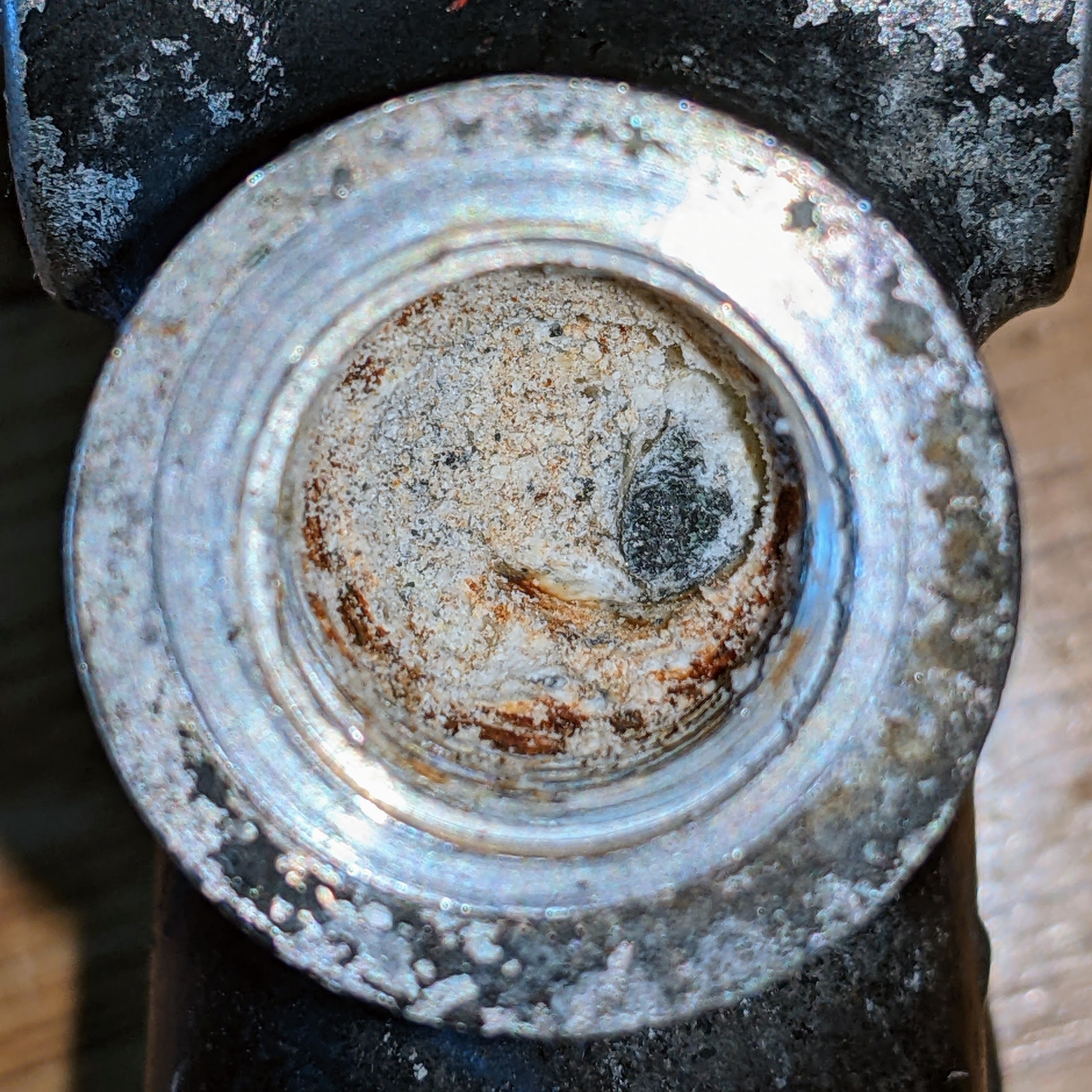
Yeah, so that rear master cylinder from a 1977 CB750F2 does not seem like it's going to work out. I eventually managed to remove the retaining ring, but then was unable to remove the internal parts. I drilled a bit with a fairly small bit to avoid damaging the sides and this allowed me to remove part of the plunger and the rubber seal, but I haven't been able to clear the whole bore. The end of the plunger, the cap, and the spring are all still buried in crystallized brake fluid. I'm throwing in the towel on that one.

My other possibility is a rear master cylinder from a 1975 CB750F. It was full of crystallized fluid when I received it, but the internal parts came out almost immediately after I managed to extract the retaining ring. It could still use some additional cleaning, but its main issue was that the return hole was blocked and I didn't have any tool that could reach it. I ordered a Mikuni jet cleaning multi-tool and the needles were too flexible to poke through, so I then moved on to a set of 0.5mm drill bits that are 80mm long and a pen-style mandrel. Those bits arrived today and the return hole was cleared within two minutes.

R34kl16.jpg


JS5u4TP.jpg


XqKont5.jpg


My free time for the garage is not abundant right now, but I'm excited to see if this will get the rear brake going.
 
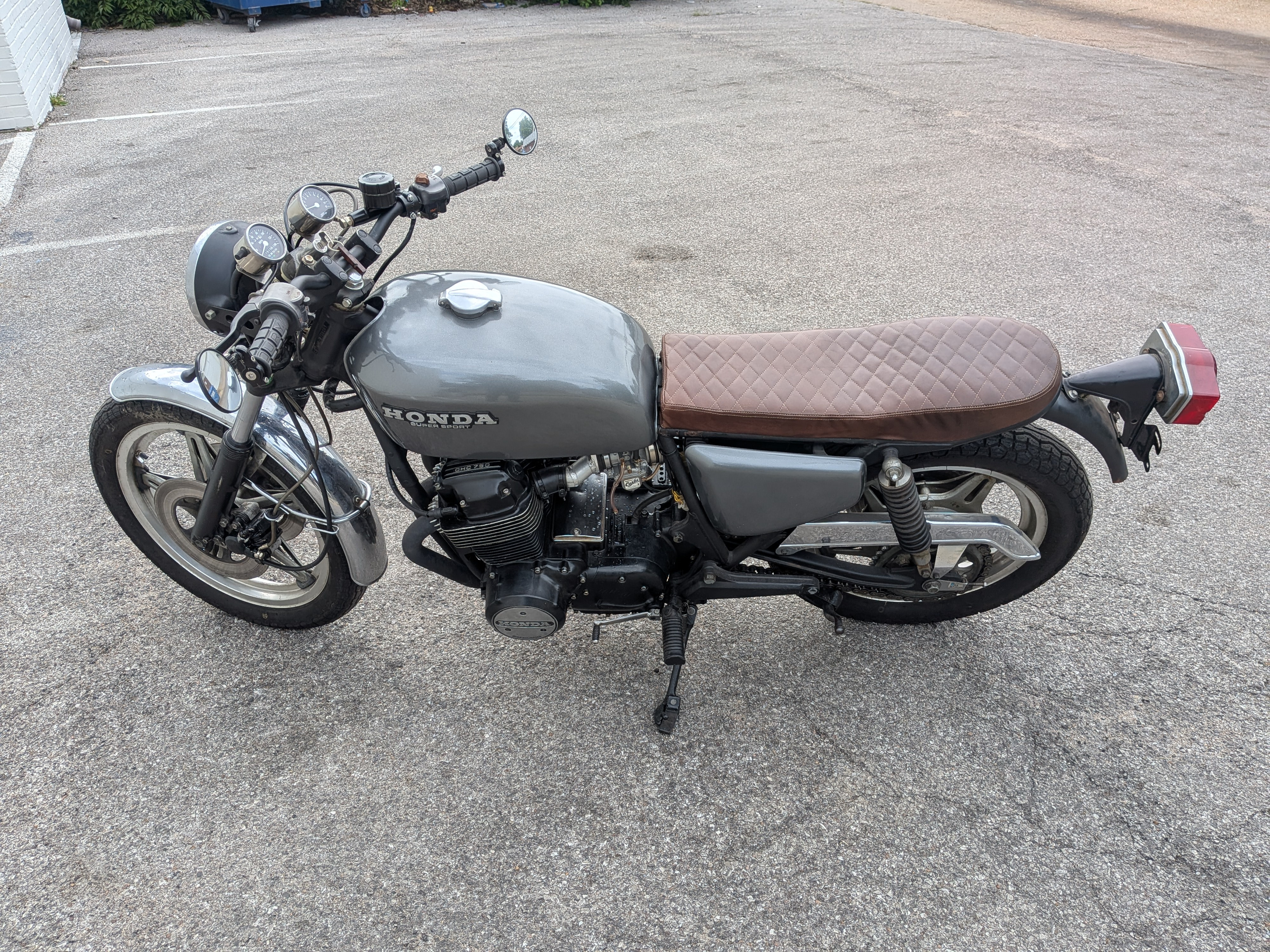
This CB750F2 has been my most neglected motorcycle project for several years now and I intend to let it go soon. My standard motorcycle insurance policy allows four bikes and those spots are occupied by my CB450K7, CB360G, XL350K2, and CB350K3. Those bikes better fit the type of rider and type of riding that I do and this project didn't really turn out how I had imagined it initially. Probably my initial ideas were too poorly thought-out and I lacked the skill to implement them.

I didn't want to let it go in a non-running state and last summer/fall I was having a hard time finding a rear master cylinder that would work. New aftermarket parts were failing on me and good used ones were not available. Over the last week I tried another rebuild on the 1975 CB750F master cylinder and finally got the back brake set up.

This afternoon I added some fresh gas to the empty tank and it fired up immediately on the starter circuit (VM34 dual-carb setup). I wanted to ride it up and down the block a couple of times before letting it go. There is no questioning the power of these machines. It feels monstrous to me in comparison to my stock CB450, but I'm more at home on the smaller, more forgiving bikes.


I rinsed off some of the dust and did a couple more laps up and down the block.

1F10RaP.jpg


VOBaaIW.jpg
 
Last edited:
Back
Top Bottom