

I need a replacement stator for the one on Chris's 1966 CL160 motor. If you have one for sale please PM me and I can give you a test to check the 3 output wire readings. In a perfect world it would be better if you had it on a running bike and can confirm it was working well. I can work with what you may have available though.

-
Don't overlook our Welcome Package, it contains many links to important and helpful information about functions at VHT like posting pictures and sending PMs (private messages), as well as finding the parts you need.
AD
You are using an out of date browser. It may not display this or other websites correctly.
You should upgrade or use an alternative browser.
You should upgrade or use an alternative browser.
Wanted Honda CB or CB160 stator windings.
- Thread starter Flyin900
- Start date

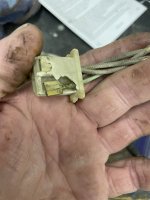
I’ve got one, but I’m not sure it’s up to your usual standards. I hadn’t pulled it off the parts engine yet because some of the cover screws were completely shredded and the head was quite far gone. This engine appears to have been worked over in a past life - let me crack those things off and see what kind of shape it’s in.
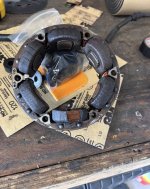

stl360+450
Veteran Member
I don't have stuff this old, but I'm curious if the CB175K0 stator is compatible. If so, it might attract attention from a wider group of members.
Good thought. I looked it up and the CB125/C93 that have a compatible stator.I don't have stuff this old, but I'm curious if the CB175K0 stator is compatible. If so, it might attract attention from a wider group of members.
Pete, I am willing to look at anything since everything on FleaBay is unknown and just as questionable in the appearance. The issue I have is the stator on the bike it has checked good as far as a static test with each leg of the windings showing 1.3 ohms 1.2 ohms and .8 ohms and no short to ground on any wires. The .8 ohms is low yet that isn't the winding showing the low AC output when I tested the stator with the bike running for the AC output. When I have the bike running the meter readings are all over the place. When I rev up the motor the readings at the battery are up and down the scale from 2 volts to 6 volts to 8 volts and nothing showing a charging output. It should show around 12.5V at idle and up the 13.5 - 14 VDC at the battery terminals.Ugh @Flyin900 it’s pretty ugly. I’ll clean it up a little, strip the ends of the cut off harness and test it but repairing the insulation on the windings might be more than it’s worth - it’s seen some better days.
View attachment 57725
I did the AC output test off the 3 stator winding wires and I get 1 VAC at idle to around 40 VAC at 4K RPM on two of the windings paired. The other set is only .6 VAC to 1 VAC output. Which leads me to believe there is an issue possibly in that stator winding on that low output wire set. I have a new modern Chinese rectifier and that needs some scrutiny too.
My friend Paul is much more knowledgeable on this, so I will ask for his input and assistance next week to verify.
I don't mind fixing the coils and I would place new male terminals on there anyway for the wiring harness. Could you please check the impedance across the 3 wires sets and also each wire to ground. If they show a reading to ground on any wire then the stator is shorted. It would be interesting to see if you get 1.2 -1.3 ohms across all three sets.
I checked my cross reference and it doesn't show a direct replacement to a CB/CL160 yet it could possible work. I would need one on hand though as shipping from the USA and buying one would be a gamble. The part numbers are totally different, yet that could be more of Honda changing it for a new model of bike.I don't have stuff this old, but I'm curious if the CB175K0 stator is compatible. If so, it might attract attention from a wider group of members.
CB/CL160 stator part # 31102-216-671 or 672
CL175KO stator part # 31102-235-005
CL175 K3 stator part # 31100-307-005


Grumpybugger
Veteran Member
This is from my spare CL 175 K7 motor. Yours if you feel like rolling the dice.
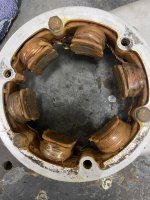
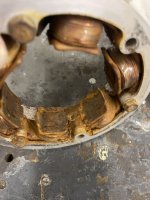

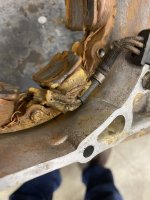
stl360+450
Veteran Member
Do you think the part number change could be based on something as simple as going from individual bullet connectors to a four-blade connector?The part numbers are totally different, yet that could be more of Honda changing it for a new model of bike.
If someone trustworthy could confirm that the 175k0 stator is compatible, you could get one from CMSNL.
Here is some old chatter about this on HT.
The offer is appreciated. I think there is a difference that may not allow this stator to fit or work correctly in my application though.This is from my spare CL 175 K7 motor. Yours if you feel like rolling the dice.
View attachment 57728View attachment 57729View attachment 57730View attachment 57731View attachment 57732
Some useful info in there especially with the AC voltages. I will do more testing to determine where the issue is presently. I am also chasing a carb leak from a Chinese fuel valve seeping and non ethanol compliant float bowl gaskets that were supplied and have swelled from the on and off of the float bowl.
The testing on the AC side if the regulator input shows 6-40 VAC which is good. The output in DC volts is erratic and way below the 12VDC I should be seeing there. I have an old selenium rectifier that I will substitute to test further.
It is looking like the Chinese voltage regulator is defective at first glance. If this is the fix I will leave the selenium rectifier in there as it is an OEM Honda part from my CL175K0 that I kept in my stock.
The leaky carb was finally fixed with a proper Honda OEM fuel seat and needle and some sealant on the swelled Chinese gasket. A win is a win!
It is looking like the Chinese voltage regulator is defective at first glance. If this is the fix I will leave the selenium rectifier in there as it is an OEM Honda part from my CL175K0 that I kept in my stock.
The leaky carb was finally fixed with a proper Honda OEM fuel seat and needle and some sealant on the swelled Chinese gasket. A win is a win!
That certainly sounds like a case of a defective rec/reg unit.The testing on the AC side if the regulator input shows 6-40 VAC which is good. The output in DC volts is erratic and way below the 12VDC I should be seeing there. I have an old selenium rectifier that I will substitute to test further.
It is looking like the Chinese voltage regulator is defective at first glance. If this is the fix I will leave the selenium rectifier in there as it is an OEM Honda part from my CL175K0 that I kept in my stock.
The leaky carb was finally fixed with a proper Honda OEM fuel seat and needle and some sealant on the swelled Chinese gasket. A win is a win!
So some further diagnosis is needed. I installed the used selenium rectifier with an improved result where the 12VDC is now stabilized at around battery voltage of 12.4 VDC. It doesn't change in any meaningful way when the motor is running and revved up. It reached around 12.6VDC which is still a no charge in my books. The selenium rectifier will not fit into the frame so I have ordered a replacement rectifier from Amazon.
As I noted above in post #6 I have about 6VAC to 40VAC at the wires going from the output from the stator off the yellow and brown pair, so there is decent AC voltage going into the regulator input of the system. The output from the regulator at only 12.5VDC is a mystery.
My question is on the one winding leg of the stator between the pink and yellow wires I am only getting .5 VAC to 1 VAC where the two other legs are 1VAC at idle and 40VAC at a good RPM . Which these two sets both pass the AC test. The pink wire from the stator goes straight to the ignition switch to the terminal labeled DY on the switch back on the schematic. The yellow wire from the stator is split partway in the harness with 1/2 going to the rectifier input and the other half to the ignition switch labeled SE on the wiring diagram.
If someone with one of these single phase AC stators could check their AC output from their stator on the pink and yellow wires, I would be very grateful for your readings. I think any bike from the 60's using this system is a candidate for the testing.
As I noted above in post #6 I have about 6VAC to 40VAC at the wires going from the output from the stator off the yellow and brown pair, so there is decent AC voltage going into the regulator input of the system. The output from the regulator at only 12.5VDC is a mystery.
My question is on the one winding leg of the stator between the pink and yellow wires I am only getting .5 VAC to 1 VAC where the two other legs are 1VAC at idle and 40VAC at a good RPM . Which these two sets both pass the AC test. The pink wire from the stator goes straight to the ignition switch to the terminal labeled DY on the switch back on the schematic. The yellow wire from the stator is split partway in the harness with 1/2 going to the rectifier input and the other half to the ignition switch labeled SE on the wiring diagram.
If someone with one of these single phase AC stators could check their AC output from their stator on the pink and yellow wires, I would be very grateful for your readings. I think any bike from the 60's using this system is a candidate for the testing.
Last edited:

mike in idaho
Veteran Member
You won't see any meaningful voltage numbers, between the yellow and pink wires. Voltage readings. need to be taken between the yellow/brown or pink/ brown connections. Full output would be measured( main switch to"lights", to combine pink and yellow) between the yellow and brown wires.
Mike, I have noted above the yellow to brown and pink to brown wires show about 1 VAC at idle and up to 40 VAC when the motor is revved up. There is virtually no AC voltage showing as you have noted between the pink and yellow wires and they are both connected into the main switch as shown in the drawing. The single headlight switch is supposed to have a middle off position based on the Honda CB160 service manual. This switch does not have this off position it only has high and low beam with no off.You won't see any meaningful voltage numbers, between the yellow and pink wires. Voltage readings. need to be taken between the yellow/brown or pink/ brown connections. Full output would be measured( main switch to"lights", to combine pink and yellow) between the yellow and brown wires.
As you know the main ignition switch is a 4 position switch with the first on position only offering brake lights and ignition run and horn. There is no rear running light or headlights until you select the next up position #3 on the switch which now gives you all electric and lighting functions. The #4 position is the taillight parking mode with the key removal from the ignition for a breakdown scenario I expect.
When the #2 position is selected and the bike is running there is a low voltage bleed through to the headlight where both low and high beams can be switched with the headlight switch and the bulb is just faintly lit. I suspect it is coming from the 60 year old ignition switch contacts???
My dilemma is I have roughly 6-40 VAC at the input of the rectifier which should be adequate for a charging I would suspect. When I have tried 2 cheap Chinese single phase rectifiers one was hinkey with the 12 VDC output fluctuating wildly from 2 VDC to 6VDC to 8 VDC etc. I then tried a CL175 used orange selenium rectifier which offered stable DC output but only the battery voltage of about 12.4 12.6 VDC and no more. This reading was with the headlight off. I then tried a new Chinese replacement modern rectifier and the same output outcome of around 12.4 VDC with no change when the motor was revved up.
It seems there is proper AC voltage on the two main stator output legs (pink to brown) and (yellow to brown) Why is there no improvement in the 12VDC rectifier output if it is getting close to 40VAC input when the motor is revved up?
So what is the purpose of the next to no voltage output from the pink and yellow wire combination which run directly to the ignition switch? Why is this circuit used in the stator windings? Which would appear to be an AC unrectified voltage output directly off the stator, unless it is only one side of the AC waveform. Wild guess here.
mike in idaho
Veteran Member
Early Hondas were built with a "dead" spot, in the center of the dimmer switch, to facilitate starting and running with a low battery. Our DOT concluded that was unsafe(lest some fool might put the switch in the center position, and crash in the dark). Honda removed the center-off feature, in the mid-sixties,as dictated by our government. a/c voltage in the headlight circuit, with the key switch in no.2 position, would seem to indicate a need to overhaul/replace the main switch. With your meter set to "a/c volts", can you read any a/c voltage at the battery treminals?
Amannl
Veteran Member
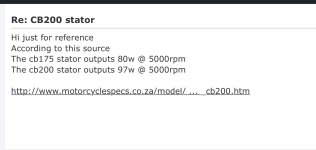
The CB175 stator will fit and I’m pretty certain that the CB 200 will fit as well; I installed a CB175 stator in my 160, but installed a combined reg/rectifier unit because of the slightly higher output, just to be safe. I can’t, at the moment, remember the output of the stock 160 stator.
Thanks for the clarification on the headlight switch, as I did notice on the electrical schematic there was no off position just a low and high beam option.Early Hondas were built with a "dead" spot, in the center of the dimmer switch, to facilitate starting and running with a low battery. Our DOT concluded that was unsafe(lest some fool might put the switch in the center position, and crash in the dark). Honda removed the center-off feature, in the mid-sixties,as dictated by our government. a/c voltage in the headlight circuit, with the key switch in no.2 position, would seem to indicate a need to overhaul/replace the main switch. With your meter set to "a/c volts", can you read any a/c voltage at the battery treminals?
I won't be testing anymore until tomorrow or Friday when I have fixed the one carb leaking issue that has resurfaced again through the fuel valve. Can you shed more light on what the pink and yellow wires going into the ignition switch circuit actually do please. I suspected the ignition switch was possibly the leaking issue causing the faint headlight glow in the #2 ignition switch position. I will pass this info along to the owner, as I have reached my tolerance on the work that has already been done and items still needing sorting out.
Any thoughts on why the output off the 2 different regulators isn't changing the 12VDC output given the 40VAC at RPM that the rectifier is receiving? There only appears to be the battery at rest voltage of 12.4 to 12.6 VDC when measured at the battery terminals when the bike is running. I will test for AC voltage at the battery once I have the carb issue sorted.
Can you confirm that I should be seeing 13.5 VDC or thereabouts when the system is working correctly and the rectifier is outputting correct DC voltage?
I appreciate the information supplied above. Being in Canada and this restoration has run the gamut of issues and costs. Those used CB160 stator units are very pricey and unknown as far as the ability to work correctly after 60 years. I see the CL175's stators are cheaper, so it is good to know and that the CB200 will also fit and work. Are you quoting a CB175 stator from a later version of the upright motor vs the early Sloper styles?The CB175 stator will fit and I’m pretty certain that the CB 200 will fit as well; I installed a CB175 stator in my 160, but installed a combined reg/rectifier unit because of the slightly higher output, just to be safe. I can’t, at the moment, remember the output of the stock 160 stator.
View attachment 57804
mike in idaho
Veteran Member
The pin and yellow wires are combined, inside the switch, to increase the lights-on charging rate.
The pin and yellow wires are combined, inside the switch, to increase the lights-on charging rate.
Mike,
I appreciate your feedback. I am not that good at troubleshooting these older electrical systems. A couple of more queries please.
What are your thoughts on the 40 VAC at the rectifier input from the stator and only seeing battery voltage of around 12.4 VDC when read by my meter at the battery off the rectifier output red and green wires? It leads me to speculate the rectifier is a dud, yet 2 different rectifiers show the same condition?
Any other thoughts on trouble shooting the system to determine if the stator or the regulator is at fault here?

GaryJames
Veteran Member
Flying900,
my thoughts on this are that the Selenium rectifiers even if unused NOS are mostly degraded selenium stacks Today. Additionally the leak through of the old regulator (if fitted, as some early 60’s. bikes did not have them ) will drain your newly charged battery. ( did we not have this conversation a month or two ago?)
Fix it once by buying a SparkMotor single phase regulator/rectifier. Go with the unit with the extra black 12v sensing wire.
my thoughts on this are that the Selenium rectifiers even if unused NOS are mostly degraded selenium stacks Today. Additionally the leak through of the old regulator (if fitted, as some early 60’s. bikes did not have them ) will drain your newly charged battery. ( did we not have this conversation a month or two ago?)
Fix it once by buying a SparkMotor single phase regulator/rectifier. Go with the unit with the extra black 12v sensing wire.
I bypassed the switch-based connection on mine and combined both straight from the alternator into the rec/reg. I’m wondering if somewhere in the factory circuit you’re not getting the second phase through to the rectifier.Mike,
I appreciate your feedback. I am not that good at troubleshooting these older electrical systems. A couple of more queries please.
What are your thoughts on the 40 VAC at the rectifier input from the stator and only seeing battery voltage of around 12.4 VDC when read by my meter at the battery off the rectifier output red and green wires? It leads me to speculate the rectifier is a dud, yet 2 different rectifiers show the same condition?
Any other thoughts on trouble shooting the system to determine if the stator or the regulator is at fault here?
The cleanest way to do it is take the yellow wire that branches to the ignition switch and replace the pink wire from the alternator connection with that one.
Gary,Flying900,
my thoughts on this are that the Selenium rectifiers even if unused NOS are mostly degraded selenium stacks Today. Additionally the leak through of the old regulator (if fitted, as some early 60’s. bikes did not have them ) will drain your newly charged battery. ( did we not have this conversation a month or two ago?)
Fix it once by buying a SparkMotor single phase regulator/rectifier. Go with the unit with the extra black 12v sensing wire.
I am not using a old style selenium rectifier on the bike. I tried a used one for a reference point since the first Chinese unit was a dud with erratic output DC voltages. I bought a second Chinese unit mainly for cost and convenience, as the Spark Moto one is weeks away and more costly.
This isn't my bike it is a build for a member of our vintage bike club. The costs are out of control in all aspects of the initial bike buy and all the parts and my work on the bike. So a cost effective solution is what I have been trying to achieve. The Spark Moto unit maybe a option when I sort out the no charge issue.
More importantly is finding out what is going on with the no charge situation from either the stator output or the regulator as an issue.
Thanks Pete,I bypassed the switch-based connection on mine and combined both straight from the alternator into the rec/reg. I’m wondering if somewhere in the factory circuit you’re not getting the second phase through to the rectifier.
The cleanest way to do it is take the yellow wire that branches to the ignition switch and replace the pink wire from the alternator connection with that one.
I have a new wiring harness so I don't wish to cut into it too much. Are you saying to join the pink and the yellow wires at the stator output together into one circuit that goes straight up into the regulator on the yellow input side. Then the brown stator wire is on the other regulators input side as it normally is located? I will still take your generous offer of the stator for the bike just in case I do need to get it replaced in there.
mike in idaho
Veteran Member
I would check out the main switch, it sounds like a/c current from the pink or yellow wire is leaking into one of the other connectins. A good cleaning of the internal switch contacts may be in order.Mike,
I appreciate your feedback. I am not that good at troubleshooting these older electrical systems. A couple of more queries please.
What are your thoughts on the 40 VAC at the rectifier input from the stator and only seeing battery voltage of around 12.4 VDC when read by my meter at the battery off the rectifier output red and green wires? It leads me to speculate the rectifier is a dud, yet 2 different rectifiers show the same condition?
Any other thoughts on trouble shooting the system to determine if the stator or the regulator is at fault here?
Pete,
I disconnected the pink and yellow at the ignition switch block and joined them together. I now have the headlight on in the #2 ignition switch position full time. It does get brighter when the bike is revved up. Yet now it has bypassed the #3 position for the full electrical where that position normally activates the lighting circuit.
Are you getting the same response with your headlight lighting in the #2 ignition position with the pink and yellow now joined together.
There is no improvement in the charging rate it seems to drop the DC voltage to just around 12 VDC now with the headlight engaged.
I disconnected the pink and yellow at the ignition switch block and joined them together. I now have the headlight on in the #2 ignition switch position full time. It does get brighter when the bike is revved up. Yet now it has bypassed the #3 position for the full electrical where that position normally activates the lighting circuit.
Are you getting the same response with your headlight lighting in the #2 ignition position with the pink and yellow now joined together.
There is no improvement in the charging rate it seems to drop the DC voltage to just around 12 VDC now with the headlight engaged.
Thanks Mike,I would check out the main switch, it sounds like a/c current from the pink or yellow wire is leaking into one of the other connectins. A good cleaning of the internal switch contacts may be in order.
I did test for AC on the battery side and I am unsure what to read there. It is a digital meter I am using and I get about 28 V showing on the 200 VDC setting. yet when I turn the bike off there is still 28 V showing on the scale when left in the 200 VAC setting. So hard to read what is happening there. When the bike is running with the meter set to the 200 VAC on the meter and revved up the reading stays at 28 V so I don't know what to make of the reading.
My wiring is a bit different in that I also don't have signals - just headlight/taillight/brake/horn, so I ran it all on one circuit. The third position is essentially unused. Seems odd that caused the lighting circuit in yours to activate - that switch is looking more and more like there could be something going on there.Pete,
I disconnected the pink and yellow at the ignition switch block and joined them together. I now have the headlight on in the #2 ignition switch position full time. It does get brighter when the bike is revved up. Yet now it has bypassed the #3 position for the full electrical where that position normally activates the lighting circuit.
Are you getting the same response with your headlight lighting in the #2 ignition position with the pink and yellow now joined together.
There is no improvement in the charging rate it seems to drop the DC voltage to just around 12 VDC now with the headlight engaged.
Stator is in the mail - USPS priority so it should be there Tuesday I'd imagine.
Pete,My wiring is a bit different in that I also don't have signals - just headlight/taillight/brake/horn, so I ran it all on one circuit. The third position is essentially unused. Seems odd that caused the lighting circuit in yours to activate - that switch is looking more and more like there could be something going on there.
Stator is in the mail - USPS priority so it should be there Tuesday I'd imagine.
I appreciate the stator and don't wish to have you pay the shipping too. I would like to at least send you the money for that portion of the ride.
I got the same response as you outlined with the headlight on in the #2 position and it does vary in brightness when the motor is revved up. I did the same join up at the ignition switch but just removed the spade connectors and I did put them back into the switch block later, as I was unsure what was happening with the lighting. I also was seeing around 12VDC with the headlight engaged on and the meter reading off the battery was around 12VDC.
What is the highest 12VDC reading you have achieved off your CB160 going into the battery. I suspect a high 12V to maybe 13 VDC is the top out area for the stator???
I think these Chinese regulators while this new one is working are choking or regulating the minimal voltage that they see off the stator. They likely are designed for a more robust output than the 150 watts the stator is putting out.
I have recommended that Chris buy the Spark Moto rectifier which he has agreed to do. I finally got the carbs sorted today it seems so far with some leak testing underway.
I agree there is something funky with the ignition switch. I am returning the bike by month end and will do the final assembly for Chris. The further electrical troubleshooting will be someone else's job.
mike in idaho
Veteran Member
It might be worth a try to unplug the tail light cord, and the bulb sockets in the speedometer, then start plugging things back in until you find the wire feeding current to the lights.
I did notice two LED bulbs used in the two headlight speedometer back lights on each side of the gauge. They do illuminate correctly and don't light up until the 3# full power position is selected on the ignition switch. I will start with those ones first. The neutral light and high beam light indicators are both normal filament bulbs.It might be worth a try to unplug the tail light cord, and the bulb sockets in the speedometer, then start plugging things back in until you find the wire feeding current to the lights.
I haven’t done anything about probably 6K rpm yet. Still only about 20 miles on the rebuild and it was a fresh bore/rings but when I was checking the system it was about 13.8 with no headlight. 13.4 with. I’d expect to see somewhere near 14 at max rpm.
If it dries out at all this weekend I’ll put the voltmeter I was using to troubleshoot the 450 on and see what I can get.
If it dries out at all this weekend I’ll put the voltmeter I was using to troubleshoot the 450 on and see what I can get.
What regulator or rectifier are you using then for those readings? I did just buy the Spark Moto unit. There is still an issue on mine then as the top voltage is around 12.6 VDC at probably 4K RPM. I also have a fresh build and the bike needs to be ridden, as the rings are not seating with just the static testing and no load on the motor.I haven’t done anything about probably 6K rpm yet. Still only about 20 miles on the rebuild and it was a fresh bore/rings but when I was checking the system it was about 13.8 with no headlight. 13.4 with. I’d expect to see somewhere near 14 at max rpm.
If it dries out at all this weekend I’ll put the voltmeter I was using to troubleshoot the 450 on and see what I can get.
The pin and yellow wires are combined, inside the switch, to increase the lights-on charging rate.
I’ve got the Sparck Moto unit, with the voltage seating wire looped into the black circuit, ground run directly to the negative terminal.What regulator or rectifier are you using then for those readings? I did just buy the Spark Moto unit. There is still an issue on mine then as the top voltage is around 12.6 VDC at probably 4K RPM. I also have a fresh build and the bike needs to be ridden, as the rings are not seating with just the static testing and no load on the motor.
I got it out today with a clip on digital voltmeter. I saw one 14 flash across the screen - probably around upper area of midrange? No tach so I was going by ear but it seems to be in line with what I get out of the 450.

jensen
Veteran Member
I have a nos CB200 stator and rotor, a nos CB/CL 250/350 stator as well, I can take pictures for comparison ?
Jensen,I have a nos CB200 stator and rotor, a nos CB/CL 250/350 stator as well, I can take pictures for comparison ?
Thank you for the offer, yet it is a moot point presently. I have spoken to Chris and my time with the bike is now done. I will finish the assembly next week and he will be talking the bike by month end. I have ordered the Spark-Moto regulator and Pete is sending a used CB160 stator. It is time for someone else to tackle the charging issue.
I have given Chris all the info regarding the ignition switch needing a look and more troubleshooting of the electrical bleed through of the 12VDC at the #2 ignition switch position into the headlight.
Thanks Pete, I have ordered that unit and with the stator your sending it will be someone else who will be troubleshooting the remaing issue. The bike runs and everything else appears good with the exception of the charging and 12VDC bleed through into the headlight in the #2 ignition position.I’ve got the Sparck Moto unit, with the voltage seating wire looped into the black circuit, ground run directly to the negative terminal.
I got it out today with a clip on digital voltmeter. I saw one 14 flash across the screen - probably around upper area of midrange? No tach so I was going by ear but it seems to be in line with what I get out of the 450.
jensen
Veteran Member
No problem, it's here for a while...Jensen,
Thank you for the offer, yet it is a moot point presently. I have spoken to Chris and my time with the bike is now done. I will finish the assembly next week and he will be talking the bike by month end. I have ordered the Spark-Moto regulator and Pete is sending a used CB160 stator. It is time for someone else to tackle the charging issue.
I have given Chris all the info regarding the ignition switch needing a look and more troubleshooting of the electrical bleed through of the 12VDC at the #2 ignition switch position into the headlight.