Jetting, a Qualitative then Quantitative Approach to a New Carburetor

Jays100

Veteran Member
Joined
May 29, 2020
Total Posts
1,493
Total likes
1,022
Location
Enfield, CT USA
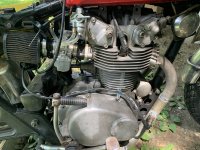
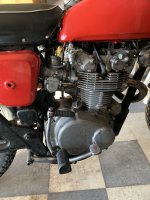
Some time ago, I was up against working with no carbs on a ‘68 CL450, a buried barn find and no kidding, this thing was bad. It had good tank and fenders but that’s about it. I bought it anyway, the price was right.

At the time, we had just relocated to CT via corporate move program, had few resources at hand and no garage, etc, you get the picture. I needed ready made solutions if I wanted to pursue this vintage bike, which I did. Carb options then (15 yrs ago), were expensive and unsatisfactory, ref 14H and VM32. Being an engineer, I got creative and ended up with 32mm venturi carbs from a Suzuki T500 with the goal to fit inside of the stock paper air filters and inlet manifolds. That worked, but I could never commercialize or fix the problems with either.

I ended up on a quest to find a modern perfect solution that would: be tuneable, fit the intake and air filter sizes, fit under the side covers without hacking, oh, and carburete smoothly.

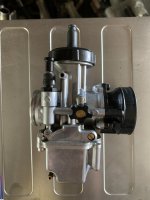
Found this, a KSR EVO32 that checked all the fit boxes. This is a Koso (Taiwan) design that was sold to a China manufacturer, I think I paid less than $45 for a pair. They advertised using Keihin jets, and with the wide range of jets available, what could go wrong, right?

Sorry about the title, all it means is I started to sort A new carb jetting by seat of the pants riding (Qualitative) with unsatisfactory results, then ended up acquiring some instruments to better measure each change (Quantitative).

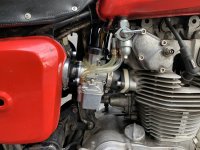
Here’s a pic of the Evo (Evolution) 32.
IMG_3210.jpeg
 
What I didn’t know was there was little application development done. This ended up limiting jetting for a custom application to only the Pilot, Main and Needle. I found out this wasn’t quite enough. When I queried the factory, I was told I needed an order of 1000+ pieces to get what I wanted.

Okay then, it was clear I was on my own. Because of the excellence of fit/interface, proceeded anyway. Hubris says I can do anything.

Getting the cable lengths and spacer thicknesses was the easy part and I ended up with a very clean installation, I was excited!

IMG_2315.jpeg
 
Everything affects everything.

The place to start rule of thumb (mine), is same size PJ and MJ as OEM - 38 and 140. Start the bike and right away the bike floods at idle. PJ’s smaller than 38 were custom, more research, procured down to a #30 which was barely enough but it worked. The bike would roughly run to the needle or 1/4 throttle setting, good enough to start sorting out the needle.

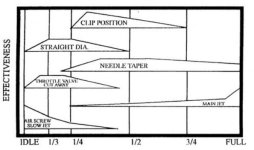
Note the 1/8-3/4 throttle opening is where we predominantly run in everyday use. Getting a series of needles was easier than I thought, seems others in Asia have this same carb and Needle sets were readily available from Nibbi. Bought 2 sets.

Rideability was improved by alleviating these symptoms:
If backfire through the carb, too rich. Fuel pools in the intake port then ignites in the intake.
If pops in the exhaust, too lean. Incomplete combustion is afterburner in the pipe.
Fouled spark plugs? Too rich…or weak spark…
 
Once the basic runability issues were under control, some basic questions of throttle opening v. response needed to be answered to target progress.

Does it start? Yes
Idle? Yes, mostly
Off idle transition to 1/8 opening? No
1/8 - 1/4? Somewhat
1/4-3/4? Clean, found a good needle
3/4 - WFO? Yes

I needed to identify exactly which Jet, or adjustment, possible in order to tune on purpose.

IMG_0888.jpeg

Notice the overlapping effectivity of the various circuits.
 
That issue of 1/8 throttle richness, it was popping back through the carburetor, was the problem area seemingly unsolvable. No help from the factory with a tuning manual, or anything. The koso literature hinted at different slide cutaways but the factory had none.

So I studied any and every piece of published information I could find from Mikuni to DellOrto to Keihin, factory pubs, performance tuners, my head was spinning.

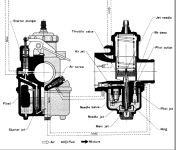
Here’s a layout of a Mikuni VM showing the circuits. I knew there were differences but this served to get my focus on how air and fuel were mixed, and where.

IMG_0889.png
 
Quantitative approach to the rescue!

At this point I was pretty frustrated with my progress. Lack of progress is more accurate.

Enter a wideband O2 sensor. I bought this when working on a (as yet unfinished) turbo project. Eventually I’ll get back to it…. For now, I had unanswered questions on just what the engine liked to run well. This would in its turn guide me to a consistent standard of tuning

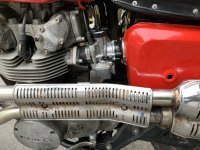
New exhaust, some wiring and presto, a tuning aid that’s repeatable and much, much more accurate that my butt, cute as it is, isn’t a greatly precise tuning feedback. Yeah, and plug chops with unleaded fuels are useless I found.

IMG_2796.jpeg
 
Last edited:
The sensor has an on-board heater which maxed out my charging system. Then, had to get a new battery plus, my stator overheated and had to replace that too.

All of a sudden I could start logging and graphing my data so my year long effort to make that particular carb work got condensed into a couple of short weeks.

The 450 runs best at 12:1 afr (air/fuel ratio) at 10:1 it will run but blubber or 6-stroke if that makes sense.

Float level had the most profound effect on the whole of cold start to 1/4 throttle. In practical application everywhere, this is the fine tuning between jet sizes. For me, it improved but didn’t solve my too rich transition at 1/8 open.

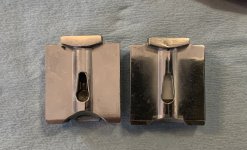
Then, slide cutaway was experimented - from the chart note more air being leans out at exactly 1/8.

IMG_3064.jpeg

On left is modified. The larger cutaway allows more are into the pilot circuit.
 
I wasn’t satisfied with having to use the smallest PJ at sea level elevation. If this carb were applied at 5000ft, they wouldn’t work. I needed to figure out how to add ever more air into the PJ mixing chamber. This was a drastic step for a permanent change.

IMG_3069.jpeg

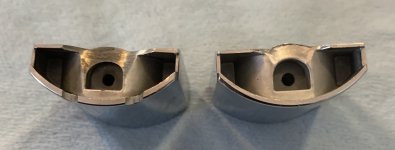
This carb design has a removeable jet holder which made opening up the circled hole (the one just downstream of the jet needle) from .5mm to 1.0mm.

Now, my PJ is at #38. It didn’t seem to effect that 1/8 position richness, perhaps it was slightly narrowed, but moved my adjustability into a more globally useable range.
 
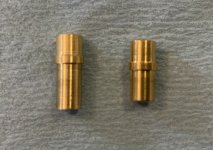
My next thought was if the needle was contributing fuel, too early. I made up some new jet needle orifices with a much taller shroud.


IMG_3063.jpeg
At left, what I was able to cobble together.
 
My results were now afr in the neighborhood of 16-18. I felt this too lean for long term use. In retrospect I wish I had done an interstate run to ensure the intake was clearing, other than blasting up and down my street, isolated as it is. I don’t think full temp was reached.

Still did not correct rich @ 1/8 - would just never go away.

In desperation, I tried notching the slide trailing edge.

IMG_3066.jpeg
 
At this point I had developed the carburetor for use. I detailed my information and connected with the factory, “can you make these changes?”

Crickets.

There is enough information here to make the KSR EVO32 work on your own 450, I don’t recommend in anything but this installation.

More importantly, the process of finding exact cause and effect per circuit, accurately logging your results and being diligent to only one change at a time is translateable to any carb we have. For this one, some one-off pieces were made, hand grinding and shaping as well as applying the accumulated knowledge, I was able to make it work and work well.

Without factory support, this will never be mass applied as I don’t want to mod every carb imported.

Especially since the replacement design carb was able to be made to work perfectly within a weeks work, start to finish. And, is AHMRA legal.
 
Last edited:
Your adventures immediately reminded me of the two weeks I spent immersed in making a multi piece attachment weighing 60 grams for an oscillating tool stay together at 12000 opm's.

Very satisfying when it all comes together.

Well done sir, well done.
 
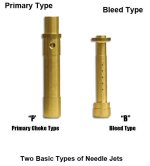
Mikuni uses two types of emulsion tubes, see below and names them Jet Needle (as opposed to the Needle Jet)

IMG_0890.jpeg

The types have been developed for both 2-stroke and 4-stroke applications. The Primary type is predominately used for 2-strokes. The simple answer as to why, is 2-strokes have twice the intake signals so more fuel is delivered.

The Bleed type emulsifies fuel in a lower cavity and is arguably a more homogeneous mix into the engine.

For what it’s worth, Keihin uses the bleed type exclusively, irregardless of engine type.

Remember, everything affects everything.
 
Yes, a single sensor.
Two reasons for that decision. The first is these engines in their mild state of tune, are relatively insensitive to small differences or mismatches between the two. Could that be improved and would it help? Of course! Later designs did just that.

The second is the sensor itself. I only had one but what I found with that one was the charging system could barely keep with the one heater.

Modern ECU’s control all that better.
 
Today, there are some lessons learned on using an automotive sensor on a motorcycle. Autos collect multiple cylinders before the sensor so there is a high gas flow at low speeds.

What I found was an artificial rich reading when it was in fact very lean. So lean there was no combustion inside resulting in the misfire reading as rich. Supporting that was a carb backfire which was a classic rich indicator. When I went (out of desperation) to a huge pilot jet just to bound the problem, it started to run properly. That’s where I am now.

I also found a kinked fuel line was starving supply (ya think?) on one side.

Test rides are starting to be fun!
 
There is classic thought that a rich carburetor condition backfires through the intake. Conversely, a lean condition explodes through the exhaust.

What I found was that when starting from totally unknown jetting from a new carb system - unknown how it will react with the engine - the engine feedback does not necessarily follow the classic rules stated above. I found that the low speed circuit was lean but still backfired through the carb. Fuel pooling in the intake port igniting at cam overlap? I dunno.

I’m also finding (with these particular carbs) that the mixture screw more profoundly tunes the fixed calibrations of slide cutaway and pilot jet interaction.

Exhaust note at a lean condition is quieter whereas a correct/rich condition is much bolder in line with basso profundo!
 
Interesting thread, Jay! Somehow I missed it last spring/summer.

You mention that there was little application development for these carburetors. Are you aware of any particular platform in which they are considered an off the shelf replacement? If they purchased the design I wonder if they lack an R&D wing and thus do not want to consider modifications.
 
I think the primary market is scooters in Asia.

In years past I found that carbs that worked for another application could cross over just fine, I.e. 4-stroke - 4-stroke, and that the jetting wouldn’t be far off. I once adapted a set of GS750 Suzuki/mikuni (26mm?) to my XJ550 Yamaha with no additional jetting needed. My theory was that the pressure impulses/flow were proportional such that a smaller flow would result in a proportionally smaller fuel flow.

So I “thought” these would work. And I did eventually get them there but it was not a bolt on endeavor.
 
Back
Top Bottom