Electronic ignition on CD 200

Alan G

Well-known Member
Joined
Aug 13, 2023
Total Posts
52
Total likes
19
Location
Norfolk, UK
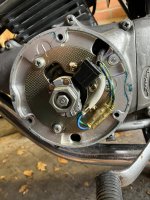
Just bought a 1982 CD200 12 volt and went to oil felt pad for points only to find some sort of electronic ignition & no points. Picture hopefully attached. Internet search has failed to find anything similar. Any ideas welcome.
IMG_0396.JPG
 
That's the factory CDI, the 185 had points and the 200 went to CDI. Just check the timing and you're good.

1784204094376.png
 
Last edited:
Very many thanks for your reply, very helpful. I've never come across a CDI unit before. Very best regards Alan
 
Hi Alan, I have this geeky interest in ignition systems. I have to say this is an odd one, nice pic of that pickup. I spent a little time trying to hunt down this CD200, schematics, CMSNL parts list, parts on ebay. Could not find much, and what I did find was inconsistent or subject to confusing changes(going from 6v to 12v, points to electronic). So this appears to be arranged directly on crankshaft, as apposed to the cam shaft. That is like my 1981 CM400 with it's 360 degree 'wasted spark' CDI system. On my bike, that includes a CDI box. I read yours has a mechanical advance. Mine has a complex electronic advance that includes added stator windings and involves the CDI box operation.

I'm wondering if this is a CDI system, or if it is perhaps a electronic points system. Can you tell if those two wires coming from this 'pickup' go directly to the coil and not to a CDI electronic box? Is your battery 12v or 6V? I'd be curious if this 'pickup' can be ordered or found anywhere and what the description is. I assume it is magnetic, so probably the rotor there has a magnet built in one side.
 
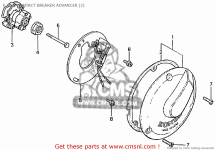
So CMSNL part 5 like AD shows some info. Calls it a 'Gen.ASSY,Pulse'. 30300465671 $78. Whatever schematic I came across perhaps just shows it as a general box, maybe points, and going straight to coils, like points do.
 
I share kbongos 'geeky interest'. So, the CD200 appears to have a crankshaft mounted advance retard mechanism, with a ( ? Hall effect ) ignition trigger. Looking at the battery box schematic, it does have a CDI unit. Presumably this CDI just provides a spark, doesn't have a built in advance map like later CDI ignitions do.

 
I share kbongos 'geeky interest'. So, the CD200 appears to have a crankshaft mounted advance retard mechanism, with a ( ? Hall effect ) ignition trigger. Looking at the battery box schematic, it does have a CDI unit. Presumably this CDI just provides a spark, doesn't have a built in advance map like later CDI ignitions do.
That's my assumption Richard, inexpensive version for the smaller model.
 
It is definitely a CDI system , see post from Administrator yesterday. Evidently from 1981 CD185's continued to be fitted with normal points whereas CD200's were fitted with CDI ignition. Have to say with choke, very cold weather, it start immediately.
CDI systems are said to give much better starting.
 
I share kbongos 'geeky interest'. So, the CD200 appears to have a crankshaft mounted advance retard mechanism, with a ( ? Hall effect ) ignition trigger. Looking at the battery box schematic, it does have a CDI unit. Presumably this CDI just provides a spark, doesn't have a built in advance map like later CDI ignitions do.

Good find Richard. Hall sensor maybe, I'd guess pulse coil. I'd guess it is a DC-CDI(versus AC-CDI) assuming it does not have high voltage stator windings, a proper schematic would show that.
 
Without taking the ignition base plate off, and disturbing the timing setting, I have no idea if there is a crankshaft advance retard mechanism. The Haynes workshop manual isn't a lot of help. However, I also have a 1968 BSA D14/4 Bantam 2 stroke that has ignition points on the crankshaft and NO advance/retard mechanism, it is fixed. It ticks over and runs a high speed perfectly ok. Of course two stroke engines are a lot different to 4 strokes but would the CD200 run ok on a fixed ignition. When I raced my BSA Rocket 3 in the 1970's I removed the points and advance/retard system and fitted a fixed ignition system with NO advance/retard. The 3 contact breakers were forever going out of adjustment. It always started, bump start and achieved a max speed of of 135 mph at Snetterton race circuit. Happy days.

 
Without taking the ignition base plate off, and disturbing the timing setting, I have no idea if there is a crankshaft advance retard mechanism. The Haynes workshop manual isn't a lot of help. However, I also have a 1968 BSA D14/4 Bantam 2 stroke that has ignition points on the crankshaft and NO advance/retard mechanism, it is fixed. It ticks over and runs a high speed perfectly ok. Of course two stroke engines are a lot different to 4 strokes but would the CD200 run ok on a fixed ignition. When I raced my BSA Rocket 3 in the 1970's I removed the points and advance/retard system and fitted a fixed ignition system with NO advance/retard. The 3 contact breakers were forever going out of adjustment. It always started, bump start and achieved a max speed of of 135 mph at Snetterton race circuit. Happy days.
If you look at the parts fiche above, the picture of #3 shows a mechanical advancer with weights, and the visual of your ignition matches up with that picture.
 
Many thanks for your reply, picture wasn't very clear but all solved now. You've been a great help
 
The CDI footprint at least looks common, newer NAVI shows same pattern, tough to say if any of these are compatible, it's all generally proprietary/unknown and buried in epoxy. I do play around with running my CM400 with no-name cheapo CDI's. One such arrangement with switch to just toggle between 15 and 43 degrees(least and most advanced, start/fast). It does run bogged down at just 15 at higher RPM. Google/AI says 2-stroke does generally use some advance adjustment. My CM400 complains bitterly if I accidentally try and start it at high advanced 43 position. I do have half a mind to make a manual control on the advance just to play around with it, like a throttle cable.
 
I do have half a mind to make a manual control on the advance just to play around with it, like a throttle cable.
I briefly had a BSA Goldstar 500cc single with a manual advance like that. Didn't want to advance too much with that big single as it could hurt if it kicked back!
 
I briefly had a BSA Goldstar 500cc single with a manual advance like that. Didn't want to advance too much with that big single as it could hurt if it kicked back!
Wow a 500cc single, I bet that could kick like a mule! And a manual advance, I have heard there were such things.
 
Does anyone have a wiring diagram for the CD200 CDI ignition circuit. The wiring diagram in the Haynes manual for CDI is in black & white, difficult to read and almost impossible to follow! Also Chapter 3 Ignition System only covers points (contact breakers) and no mention of CDI unit or how to set timing etc. The diagram on page 150 mentions "17" Pulser Coil but no pic or mention of "Contact breaker" or how to set CDI timing & of course no wiring.
 
Does anyone have a wiring diagram for the CD200 CDI ignition circuit. The wiring diagram in the Haynes manual for CDI is in black & white, difficult to read and almost impossible to follow! Also Chapter 3 Ignition System only covers points (contact breakers) and no mention of CDI unit or how to set timing etc. The diagram on page 150 mentions "17" Pulser Coil but no pic or mention of "Contact breaker" or how to set CDI timing & of course no wiring.
Check your PMs
 
Many thanks for helpful info. Never come across CDI ignition before and much appreciate help.
 
Have now replaced Coil and HT leads as well as spark plugs & spark plug caps on my 1982 CD 200 with CDI ignition. After re-searching the internet I have fitted compatible Non "R" spark plugs & Spark plug caps with only 1 Ohm resistor instead of the usual 5 or 10 Ohms. Evidently older CDI systems with age produce a much weaker spark with resistor spark plus & spark plug caps. The bike now has a regular tick over and revs easily but yet to test ride it although I don't envisage any problems. By the way the single carburettor was clean and all jets clear when I dismantled it.
 
Back
Top Bottom