CB 450 K5 Starter Ohms to Ground Reading

Greybeard70

Member
Joined
Mar 8, 2026
Total Posts
32
Total likes
32
Location
Texas City TX
Starter was working fine and then after a ride it doesn't do anything. The solenoid clicks and the battery voltage goes down to about 9 volts. I figured the battery gave up so ordered a new one and installed it, still the same, but holding voltage much higher. I measured the connector at the starter and it shows 0.1 ohms to ground. Does anyone know a typical ohm reading for a good starter? I will wait till the end of this HOT weather and rebuild the starter and starter clutch. Maybe sooner as this 70 year old doesn't care to have to use the kick start every time.
 
If you’re talking about the connector lug on the starter, that shouldn’t have connection to ground. That should be isolated from the starter casing with insulated washers.

Have you checked voltage at the solenoid switch? Sometimes the contacts internally get crusty and stop passing enough to kick the starter.
 
If you’re talking about the connector lug on the starter, that shouldn’t have connection to ground. That should be isolated from the starter casing with insulated washers.

Have you checked voltage at the solenoid switch? Sometimes the contacts internally get crusty and stop passing enough to kick the starter.
That's the problem, it is shorted to ground, I will have to pull the starter to find out why. I really wondered what a typical ohm meter reading from the terminal to ground is. It has to go through the brushes and armature and eventually complete the circuit to ground. The connection all looks good externally it is an internal short. Solenoid checks out good.
 
Just for grins I went out to the garage (still too darn hot) and checked my starter from the hot post to the engine case with 2 different digital meters set at 200 ohms. Both meters read 00.3 ohms when the test lead ends are touched together to check the meter and the starter motor read 01.0 ohm, the actual resistance would be 00.7 ohm I suppose taking the test lead resistance into account. My starter was rebuilt recently and has been working fine.
 
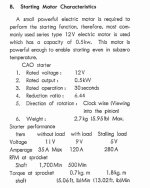
The FSM lists the motor at 500 Watts, so a back of the envelope calculation says
P = I*V = V^2/R​
or
R = V^2/P = 144/500 ≈ 0.288 Ω.​

You can get another estimate from the performance data given in the manual, as shown below, i.e., 35A at 11V would be 0.31 Ω. So hopefully less than half an Ohm, but Rob's seems fine at a slightly higher resistance. The behavior changes drastically under load.
1635.jpg
 
Last edited:
That 0.3 Ohms would be the equivalent resistance with the motor running; what it reads when the motor is not running depends on the connections of the brushes through the windings, which then go to the case. It could, however, read from 1 to 0 on an ordinary DVM; you need lab quality meters to read anything that low with accuracy.
Bottom line: you have to gain access to the brushes to really know what went wrong. I suggest you try to find a replacement set, because it will likely be needed.
 
That's the problem, it is shorted to ground, I will have to pull the starter to find out why. I really wondered what a typical ohm meter reading from the terminal to ground is. It has to go through the brushes and armature and eventually complete the circuit to ground. The connection all looks good externally it is an internal short. Solenoid checks out good.
For some reason I was thinking you had tested with the starter cable disconnected. I’d expect something near what you’ve got if it’s the resistance from the windings, brush and battery.

Checking voltage thru the switch is the least invasive for possible causes.
 
For some reason I was thinking you had tested with the starter cable disconnected. I’d expect something near what you’ve got if it’s the resistance from the windings, brush and battery.

Checking voltage thru the switch is the least invasive for possible causes.
That test was done with the cable disconnected from the starter. I knew it would be a low range just not sure how low. I am using a FLUKE 189 meter and I rechecked with the leads shorted together it reads 0.11 ohms, and the starter reads 0.19 ohms with the cable disconnected. That makes the starter actually showing to be 0.08 ohms to ground. (0.19 - 0.11 = 0.08). I guess I will just have to take it apart. Plans are to rebuild the starter and the starter clutch while it is apart. Since it starts easily with the kick, I may wait until the weather gets cooler average highs right now are around 93-94 Fahrenheit.
 
Was the battery measurement done across both the battery terminals, or was the negative lead at the engine case? Reading at the engine case will cause a lower reading, especially if the battery ground cable at the back of the transmission hasn't been polished in a while.
 
Was the battery measurement done across both the battery terminals, or was the negative lead at the engine case? Reading at the engine case will cause a lower reading, especially if the battery ground cable at the back of the transmission hasn't been polished in a while.
First time I read across the battery, second time to the engine for the negative lead. If anyone has a meter handy just check from starter terminal to the engine and see what yours reads for comparison. I will also check the ground lead, although I am pretty sure that it's not bad, The headlight and horn work good.
 
Starters go bad but I have seen a lot more bad batteries, solenoids, cables and connections being the cause of a starting problem so definitely eliminate other possibilities.
 
Starters go bad but I have seen a lot more bad batteries, solenoids, cables and connections being the cause of a starting problem so definitely eliminate other possibilities.
Absolutely true, Honda starter motors are pretty damn durable. I've never had to replace one I've owned.
 
  • Like
Reactions: J-T
Low starter resistance is normal in my experience.

 
I did have to repair a starter once - the wire that connects one of the brushes to the brush holder broke. While I had it apart, I refreshed the grease in the gear train.

If the motor doesn't run when you press the start button, connect the Voltmeter to the starter motor terminal, and press the start switch. You should see (nearly) full battery Voltage there when the solenoid closes. If not, go back to the solenoid and check it out.

Some solenoids can be opened up, and the contacts cleaned up.
 
I appreciate all the input and things to check. I will get back at it after I take care of a few medical issues. I should be able to make a confident diagnosis, I have worked in electronics since 1975 including low voltage circuits to 480 and 3200VAC subsea motor circuits. I am retired now and am enjoying not having to live on someone else's schedule. I'll let you know what I find.
 
Back
Top Bottom