1982 Honda CM250C Mod

ProducerBill

Member
Joined
Jun 26, 2023
Total Posts
28
Total likes
0
Location
Saranace, Mi, USA
I would like to introduce you all to my horrifying masterpiece of my 1982 Honda CM250C carbonator modification. My CM250C had almost no power and would bog down leading to almost no power in 3rd, 4th, and 5th.

20230806_124304.jpg

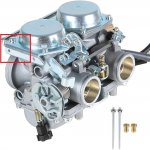
Out of frustration I said frack it and removed the carb, intake manifold, air box, battery box, and crammed an after market dual carb for a Rebel 250 in there. Did it fit? No. Did it require me to grind the sides of the new carb down? Yes. Did it require me to use a rubber mallet to "negotiate" the carb into place.... well Yes. Did it also leave me no options but to tie wrap the battery, starter cap, and turn signal interrupter into any place it would fit.... Yes it did.

But did it work? Hell ya! For the first time since I bought the bike it acts like a motorcycle should. Power in every gear. No worries that the power is going to randomly cut out in a curve. It's fun to ride and blast to do slow speed maneuvers in.

Now that I know it works I would really like to clean it up, but believe it or not the hardest part is finding air filters that fit. Finding them in the correct diameter (48 mm) isn't hard but the carbs are so close together that no two filters seem to fit next to each other. I tried these DKMotoRK 48mm and Stainless Steel ones but the gab from one carb to another just leaves no room. I can't help but think that my cobbled fever dream idea is missing something. If you have any ideas I would love to hear them.

Once I solve that issue I believe I can move on to fitting the battery and other electrical thing-a-bobs.
 
Looks like the fuel line is pinched a bit coming out of the in-line filter.
Why the filter? Is there crap in the tank?
 
I definitely appreciate the inventiveness. Are the carbs supported by anything other than the intake boots (not counting the throttle cable)? If not, you may want to think about a way to provide additional support. How are your fabricating skills? Can you make a custom battery tray? Maybe the flasher relay and starter relay could be mounted on that. You could try to provide extra support for the carbs, too.

Was the grinding required because the spacing of the dual Rebel carbs did not match the intakes on your CM250C? It might be helpful for future readers to hear more about the specifics, e.g., the different spacing measurements. Were you able to use the same throttle cable?

I guess if a carb swap can make such a difference, it begs the question: what was wrong with the original carbs? Maybe it's correctable.
 
I definitely appreciate the inventiveness. Are the carbs supported by anything other than the intake boots (not counting the throttle cable)? If not, you may want to think about a way to provide additional support. How are your fabricating skills? Can you make a custom battery tray? Maybe the flasher relay and starter relay could be mounted on that. You could try to provide extra support for the carbs, too.

Was the grinding required because the spacing of the dual Rebel carbs did not match the intakes on your CM250C? It might be helpful for future readers to hear more about the specifics, e.g., the different spacing measurements. Were you able to use the same throttle cable?

I guess if a carb swap can make such a difference, it begs the question: what was wrong with the original carbs? Maybe it's correctable.

Th carbs are not supported by anything other then the intake boots. I was thinking that it should have more, but looking at other Honda bikes of the era they didn't seem to have anything supporting them so.... I made the intuitive leap that it would be ok. If you have any example/idea you can point me to that would help me better understand what I should look at doing.

The grinding that I did was on the outer housing of the top vacuum ,,,, area. The intake boots and the cab output fit 100%. I was pretty sure it was going to work as the 1985 Honda Rebel 250 uses the same engine... so again another intuitive leap here.
71g-GKBwgVS._AC_SX679_.jpg
Removing part of the cable mount and grinding down that area under it on both sides allowed it to "fit" inside the frame.

Throttle cables was... well a mess. The original acceleration cable works... it is loose a bit but fits. I tried adjusting it, but I have tightened to as must as I can. As for the deceleration cable the original was too short. I replaced it with a 1985 Honda Rebel cable. However it seems too long as well, butttt well it kinda works. The overall effect is that it seems to only spring back 98% when you release the throttle. There might be a way to build a more custom cable,,,, but at this moment I have never done that.

As for what is wrong with the original... frankly I have no idea. I tried cleaning it, new jets, ultrasonic cleaning, replaced everything I could and it just refused to work correctly. What seems to be happening was there was too much vacuum lifting the needle up too much combined with the vacuum piston getting stuck from time to time. This however is just a guess.
 
Th carbs are not supported by anything other then the intake boots. I was thinking that it should have more, but looking at other Honda bikes of the era they didn't seem to have anything supporting them so....

Actually, all other Hondas of the era have support at the back of the carbs in a couple different ways, both resulting in the same type of support. The twins with separate air cleaners bolted to the frame have rubber outlet tubes that are clamped to the back of the carbs, and the other later twins have the same type of outlet tubes clamped to the carbs from a single common airbox. And the 4 cylinders have a common airbox with 4 outlet tubes that are clamped and provide support.

Knowing the weight of a pair of carbs, whether tied together or separate, I created a support bracket that bolts to the middle frame tube to make sure my Mikunis are properly supported on my 450.

https://www.vintagehondatwins.com/forums/attachment.php?attachmentid=1082&d=1591804739

Your carbs will be fine like that for a while, but eventually the weight of the carbs will cause the intake boots to sag and potentially get cracks in the top areas.
 
ProducerBill said:
As for what is wrong with the original... frankly I have no idea. I tried cleaning it, new jets, ultrasonic cleaning, replaced everything I could and it just refused to work correctly. What seems to be happening was there was too much vacuum lifting the needle up too much combined with the vacuum piston getting stuck from time to time. This however is just a guess.

Given all the secondary effects of the carb swap, it might be worth giving the original carbs another try at some point. It's possible there were some differences between the components in the carb kit and your original parts. Did you save the original components? It's also possible that some passages in the carbs are still blocked or some part of reassembly was not done properly. Did the bike run for you with the original carbs at some point? I'm sure members here would follow a carb rebuild to help isolate any problems that exist.

It is satisfying to get the bike running again, so if you choose to focus on fixing the secondary issues and keep the Rebel carbs on the bike, there's nothing wrong with that. I've dealt with throttle cable issues before and that can be a pain, but hopefully you can find something that works.
 
Actually, all other Hondas of the era have support at the back of the carbs in a couple different ways, both resulting in the same type of support. The twins with separate air cleaners bolted to the frame have rubber outlet tubes that are clamped to the back of the carbs, and the other later twins have the same type of outlet tubes clamped to the carbs from a single common airbox. And the 4 cylinders have a common airbox with 4 outlet tubes that are clamped and provide support.

Knowing the weight of a pair of carbs, whether tied together or separate, I created a support bracket that bolts to the middle frame tube to make sure my Mikunis are properly supported on my 450.

https://www.vintagehondatwins.com/forums/attachment.php?attachmentid=1082&d=1591804739

Your carbs will be fine like that for a while, but eventually the weight of the carbs will cause the intake boots to sag and potentially get cracks in the top areas.

Thank you for sharing the photo. It looks like the carbs are kind of clamped to a horizonal bar that then uses a vertical support/element to mount to the frame. Do I have that right?

Running the carbs back to a common air box seems to be the approach I have seen on normal/restored Hondas. However I seem to be really off script here. I wish I could find a site that would help me find a more elegant air filter solution for bolt on air filters. That said I fear I am kind of on my own here and might need to get off of lazy butt and fire up Fusion 360 and start designing my way out of the situation. Maybe a offside Y back to the OEM air box... just an idea.
 
Given all the secondary effects of the carb swap, it might be worth giving the original carbs another try at some point. It's possible there were some differences between the components in the carb kit and your original parts. Did you save the original components? It's also possible that some passages in the carbs are still blocked out some part of reassembly was not done properly. Did the bike run for you with the original carbs at some point? I'm sure members here would follow a carb rebuild to help isolate any problems that exist.

It is satisfying to get the bike running again, so if you choose to focus on fixing the secondary issues and keep the Rebel carbs on the bike, there's nothing wrong with that. I've dealt with throttle cable issues before and that can be a pain, but hopefully you can find something that works.

It would be nice to get the original carb working, but the carb and part for it are hard to come by. I blamed it on the CM250C not being a big seller for Honda. I don't know if that is true, but the more I make it like a Honda Rebel the more I can find parts for it. That said... maybe I should just get a Honda Rebel :)
 
I'm sorry I can't be of more help with respect to the airbox. I don't have any experience with the CM250C. It's not a crazy idea to think about making your own airbox and that could solve the support issue for the carbs at the same time. Lots of members make modifications in order to accomplish what they want, so you will fit in well around here.
 
Thank you for sharing the photo. It looks like the carbs are kind of clamped to a horizonal bar that then uses a vertical support/element to mount to the frame. Do I have that right?

Not exactly. The black flat metal bar sits against the back of the carb bodies just under the cap where the cable goes through to the slide, no clamps involved. It's just a brace attached to the center downtube of the frame behind the engine (between the carbs) with a single bolt welded to the frame tube, and it keeps the carbs from 'drooping' or leaning backwards in the rubber boots due to their weight.
 
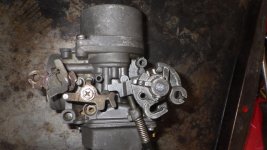
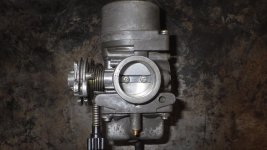
Carb is finished and on the way home.
The VB15 carb is pretty much identical to a VB21 with no accel pump and no air cut valve. The cover used is just a shaped steel plate for appearances only.
RIMG0300.jpg RIMG0302.jpg RIMG0303.jpg
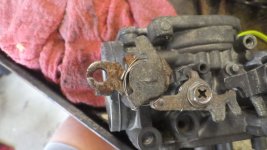
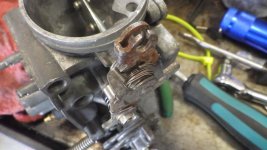
The choke plate set spring was bent and non functional so getting full choke wasn't possible but that was the only obvious problem.
RIMG0301.jpg
A number of things needing correction internally but nothing terrible. Main jets were switched, mot of the emulsion tubes air holes had some degree of blockage, slow/idle jet and primary emulsion tubes weren't fully seated, float level was 16.5mm.
Ran the stripped carb thru 1 hour of 26hz and another at 40hz. Cleaned all the jets and checked all the passages for flow. Trimmed the spring loaded float needle pintle to get the float level back to 15.5mm.
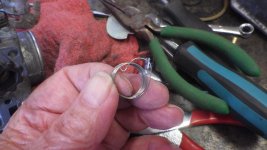
Had to remove the choke plate and shaft to get the spring out so I could reshape it to somewhat close to original
RIMG0304.jpg
And now the choke will work as it should
RIMG0305.jpg RIMG0307.jpg
I don't remember what was used for the initial cleaning that discolored the carb BUT I can say to never ever use it for carb cleaning.
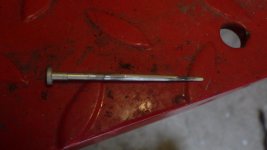
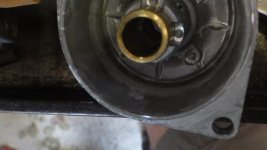
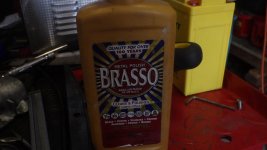
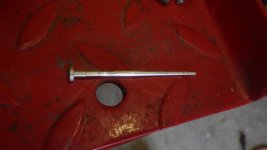
The mixture needle was corroded as well as the piston and cap. I had to sand and polish all three to get rid of the corrosion and have the piston move freely in the cap. Brasso work wonders for polishing
RIMG0308.jpg RIMG0312.jpg

RIMG0309.jpg RIMG0311.jpg
 
Jim thank you taking a look and repairing my carb. I apricate your break down of the issues. I had no idea the choke was not working correctly. It did function as far as I could tell, but am excited to see the difference.

As for the discoloration. This was caused when I ultrasonically cleaned the carb in a heated bath mixture of water and Super Clean. This was a 1 cup Super Clean to 6 cups water. I think it stripped the carb and it rusted almost instantly after I removed it from the cleaner. You have confirmed for me that was a real bad idea. Seems everything on the internet is not true. Could you recommend a proper/preferred cleaning solution?

As for mixing up the jets can you tell me how you determined what one goes where? Are there some kind of marking, aura, taste that I should look for in the future.

Thank you again Jim. After I get the family through the MSF driving class and testing I will get the carb back in and see how it all goes.
 
Jim thank you taking a look and repairing my carb. I apricate your break down of the issues. I had no idea the choke was not working correctly. It did function as far as I could tell, but am excited to see the difference.

As for the discoloration. This was caused when I ultrasonically cleaned the carb in a heated bath mixture of water and Super Clean. This was a 1 cup Super Clean to 6 cups water. I think it stripped the carb and it rusted almost instantly after I removed it from the cleaner. You have confirmed for me that was a real bad idea. Seems everything on the internet is not true. Could you recommend a proper/preferred cleaning solution?

As for mixing up the jets can you tell me how you determined what one goes where? Are there some kind of marking, aura, taste that I should look for in the future.

Thank you again Jim. After I get the family through the MSF driving class and testing I will get the carb back in and see how it all goes.

For someone who also reads this thread. The poster used way too much cleaner in just 6 cups of water. I suggest a few oz maximum of any cleaner, as most non specific cleaners used in the UltraSonic such as Simple Green, PineSol etc have the wrong PH. They will turn the carb black which is almost impossible to remove, especially with the heated water in the Sonic cleaner.

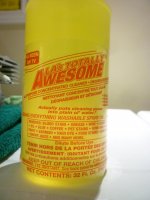
I use 2oz only of "Awesome" in a 6L (192 oz) UltraSonic cleaner and have to watch the time and heat settings, as it can still develop the white fuzz on the metal material which is likely a combination of metals, not just aluminum only.

P1060982.jpg
 
Jim thank you taking a look and repairing my carb. I apricate your break down of the issues. I had no idea the choke was not working correctly. It did function as far as I could tell, but am excited to see the difference.

As for the discoloration. This was caused when I ultrasonically cleaned the carb in a heated bath mixture of water and Super Clean. This was a 1 cup Super Clean to 6 cups water. I think it stripped the carb and it rusted almost instantly after I removed it from the cleaner. You have confirmed for me that was a real bad idea. Seems everything on the internet is not true. Could you recommend a proper/preferred cleaning solution?

As for mixing up the jets can you tell me how you determined what one goes where? Are there some kind of marking, aura, taste that I should look for in the future.

Thank you again Jim. After I get the family through the MSF driving class and testing I will get the carb back in and see how it all goes.

The larger jet always goes in the jet holder which feeds the piston needle. Smaller jet always goes nearest the mixture screw and feeds the idle/slow jet.
I looked at Super Clean and the MDS sheet, nothing written about not using it on aluminum so no fault there. I use LPS Precision Clean concentrate for carb cleaning now https://www.itwprobrands.com/product/precision-clean In fact I need to buy some more, running low again.
The spring that was messed up actually moves the choke plate when the linkage is pulled, spring loaded in case of backfire so the choke plate can blow open relieving pressure. The way it was the choke plate would only close 1/2 way by itself.
 
For someone who also reads this thread. The poster used way too much cleaner in just 6 cups of water. I suggest a few oz maximum of any cleaner, as most non specific cleaners used in the UltraSonic such as Simple Green, PineSol etc have the wrong PH. They will turn the carb black which is almost impossible to remove, especially with the heated water in the Sonic cleaner.

I use 2oz only of "Awesome" in a 6L (192 oz) UltraSonic cleaner and have to watch the time and heat settings, as it can still develop the white fuzz on the metal material which is likely a combination of metals, not just aluminum only.
The white fuzz is a chemical reaction to one of the metals in the aluminum composite material. Essentially it's corroding that particular metal
LA's Totally Awesome looks like it can do the job other than that chemical reaction and it's not biodegradable. Toxic to fish and wildlife per the SDS sheet and disposal is regulated.
 
Thank you for sharing the photo. It looks like the carbs are kind of clamped to a horizonal bar that then uses a vertical support/element to mount to the frame. Do I have that right?

Running the carbs back to a common air box seems to be the approach I have seen on normal/restored Hondas. However I seem to be really off script here. I wish I could find a site that would help me find a more elegant air filter solution for bolt on air filters. That said I fear I am kind of on my own here and might need to get off of lazy butt and fire up Fusion 360 and start designing my way out of the situation. Maybe a offside Y back to the OEM air box... just an idea.
How is the higher RPM power? Usually that takes a hit when running direct pods, but going to smaller dual carbs should mitigate that some.

There's a no-airbox hack that will solve your brace issues, and can help your high RPM response and power. Get some thick PVC plumbing, cut it off at about 3 inch section, and use the 2 pieces as a velocity stack on the back of each carb. Once assembled you can make a simple bracket to hold them together, and hold the assembly to the frame.

The homemade velocity stacks should be tapered on the inside, and can run in a bit of a "V" shape to get the pod filters away from each other. Be prepared to experiment with stack length for best high RPM power.

I hear you on fitting the pod filters. I have struggled with them on pit bikes and mini-atv's, often they would come with a 1/2 or 1/4 inch gap and no apology for just how badly they fit. Many seemed to be provided just for show, or to make the "kit" look complete, with no functional filtering possible until the gaps were addressed.
 
Back
Top Bottom