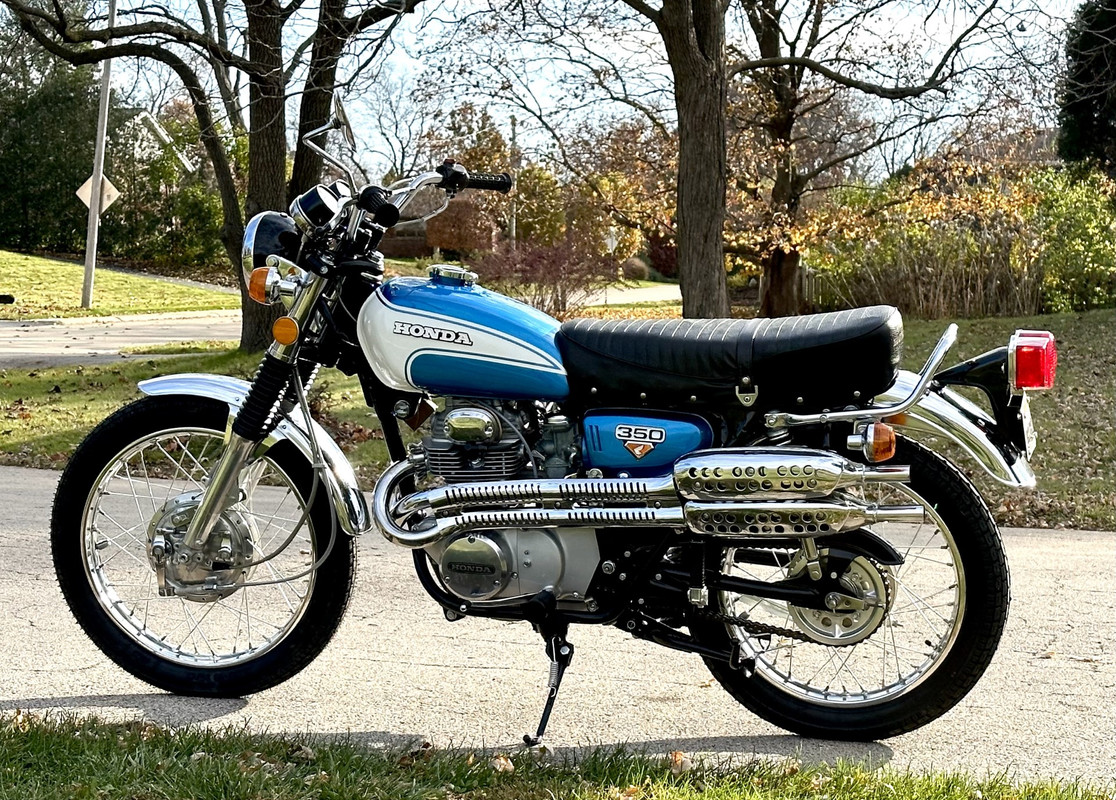
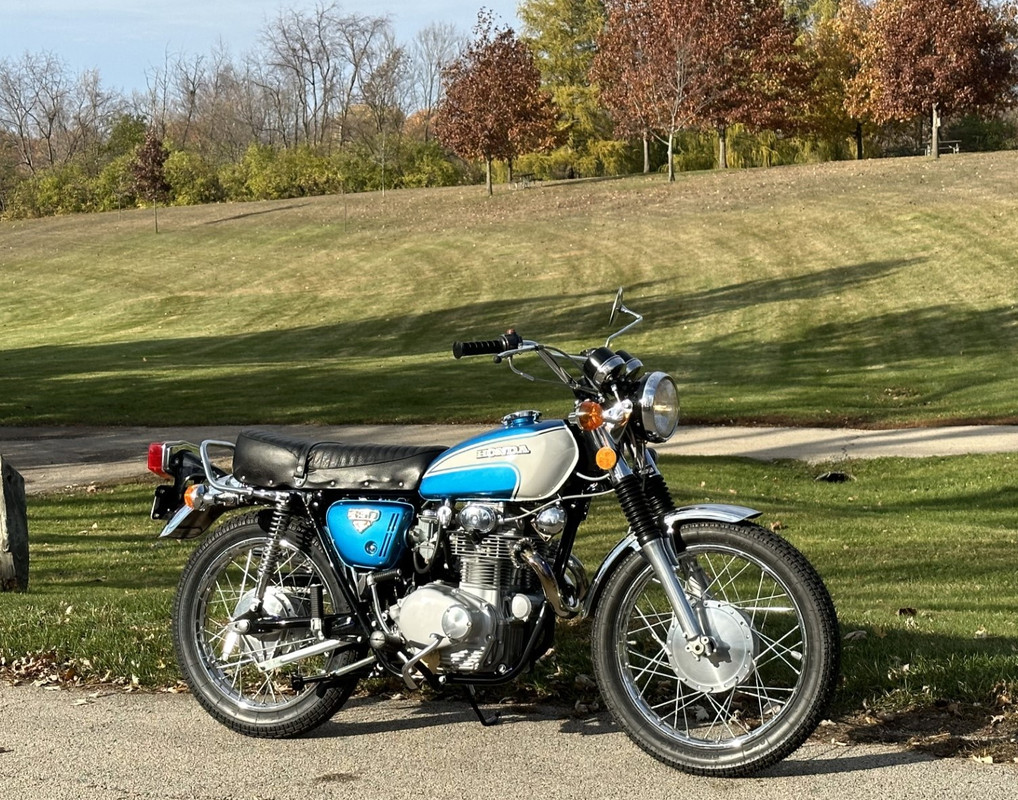
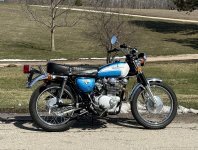
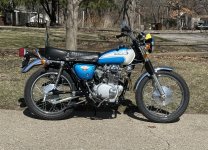
1973 CL350 Restore

IIRC, the dot on the top edge of the cam lobe aligns with the notch in the back of the advancer body where the locating pin goes.
 
I'd just do it. I had a bike I bought real cheap because it wouldn't start after a lot of work, and after turning that cam 180 degrees it started immediately.
 
I'd just do it. I had a bike I bought real cheap because it wouldn't start after a lot of work, and after turning that cam 180 degrees it started immediately.
I will turn the cam 180 tomorrow and give it a whirl.

But! If the cam is installed 180 off, how would it be possible to static time it properly?
 
I gassed it up and was expecting a drama free start. Didn't work out that way. All I have been able to get out of it is a few farts and an occasional backfire.

I have double checked timing - spot on.
Plugs are throwing nice spark
Valve clearances checked
Plenty of compression.

Scratching my head at the moment.
This happened to me and turns out I had the points wires swapped
 
I turned the points cam 180 and it started right up! Thanks guys. BTW the mark on the cam is 180 opposite of the slot on my bike.

I do have issues with bogging going uphill. I noticed that the advance springs were sloppy last night. I will start with replacing them and see if the bog improves.
 
I turned the points cam 180 and it started right up! Thanks guys. BTW the mark on the cam is 180 opposite of the slot on my bike.

I do have issues with bogging going uphill. I noticed that the advance springs were sloppy last night. I will start with replacing them and see if the bog improves.
Where do you get new springs for the advance? Either way, I would suggest checking advanced timing with a light
 
A few adjustments that led to incremental improvement, but not total success.

Changed to B7ES from B8ES. Seems happier with the hotter plug.

Timed the bike with the strobe. It required a small tweak.
_________

The bog is still there but not as severe as before. It seems to run quite well up to about 1/3 throttle and then the bog sets in.

The left plug has a perfect color, but the right plug is very sooty after 2 miles.

The left carb pilot screw adjusts per the book at 3/4 turn out. The RIGHT pilot screw wants to be screwed all the way in.

It appears to me that there is an obstruction or a mis-assembly in the right carb that is causing my problems.

 
Well, at least it LOOKS fantastic. Meanwhile, it's a break to have a problem with the right carburetor, as opposed to the left on a CL...
I must admit it does look great. :giggle: Honda hit it out of the park with this series. I guess that's why they sold like hotcakes.

Now to get it running as good as it looks.

 
Similar carb issue with my CL. Finally I removed the spring, washer and O-ring to run the screw all the way in to a light stop. Measured the screw depth, reassembled correctly and measured again. The screw wasn't bottoming out. Removed the washer and now it bottoms out so I have an adjustable mixture like I should.
 
On my 450, obviously a different carb but maybe it's relevant, I finally cleared up an issue like this one but poking clear the tiny air jet that lies hidden inside the small tube opening at the lowest part of the air intake of the carb. That's where air comes in to feed the pilot jet system that ends with the holes at the base of the throttle plate. Without a clear jet the vacuum at the plate sucks too much fuel up through the holes and can create the rich problem. I used an acupuncture needle, but a fine guitar string should work.
 
I drained the gas and parked the CL and worked through a few long term restorations. Time gets away, and now I am determined to get my CL running like it should.

The last time I was plagued by the right plug fowling, so I just started with the basics.

I checked the valve lash clearance and they were fine, EXCEPT I found the index mark on the end of the right exhaust rocker arm shaft to be pointing INWARD instead of outward like it should. I don't understand all the implications of this error, but I assume it wont provide the proper valve lash with corresponding running problems.

I checked compression and it is 165 - 170 lbs per cylinder.

I had replaced the carb rubber diaphragms earlier.

I re-synchronized the carb cable pull and set about running it on a fuel bottle for carb tuning. Both carbs are responding correctly to adjustments and this little video shows what I have so far. The acid test will be a road test when it warms up around here.

 
I checked the valve lash clearance and they were fine, EXCEPT I found the index mark on the end of the right exhaust rocker arm shaft to be pointing INWARD instead of outward like it should. I don't understand all the implications of this error, but I assume it wont provide the proper valve lash with corresponding running problems.
The orientation of the eccentric shaft affects the geometry between the cam and follower. The desired tappet clearance can be achieved at two different points, but only one puts the follower in the correct position relative to the cam to follow the lobe smoothly. My understanding is that running in the wrong position could lead to faster wear and maybe alter valve timing slightly.

Fantastic job on the restoration. Glad to see you return to the thread.
 
I checked the valve lash clearance and they were fine, EXCEPT I found the index mark on the end of the right exhaust rocker arm shaft to be pointing INWARD instead of outward like it should. I don't understand all the implications of this error, but I assume it wont provide the proper valve lash with corresponding running problems.
As @stl360+450 said, the geometry of the incorrect position can cause issues because the design adjustment method is intended to be properly positioned over both the cam lobe and the valve stem only in the adjustment range available when the index mark is pointing away from the spark plug. This picture shows a DOHC 450 version which uses followers instead of rocker arms, but the principle and parameters are the same. If the index mark is incorrectly positioned, the tip of the rocker arm/follower will not be centered over the valve stem tip, and of course it also changes the positioning of the rocker arm/follower pad where the cam lobe rides.

350-450 index orientation implications.jpg
 
I drained the gas and parked the CL and worked through a few long term restorations. Time gets away, and now I am determined to get my CL running like it should.

The last time I was plagued by the right plug fowling, so I just started with the basics.

I checked the valve lash clearance and they were fine, EXCEPT I found the index mark on the end of the right exhaust rocker arm shaft to be pointing INWARD instead of outward like it should. I don't understand all the implications of this error, but I assume it wont provide the proper valve lash with corresponding running problems.

I checked compression and it is 165 - 170 lbs per cylinder.

I had replaced the carb rubber diaphragms earlier.

I re-synchronized the carb cable pull and set about running it on a fuel bottle for carb tuning. Both carbs are responding correctly to adjustments and this little video shows what I have so far. The acid test will be a road test when it warms up around here.
Still looks and sounds great, but take the time to re-adjust that valve so you can rotate the adjuster shaft to the proper index position before putting any miles on it.
 
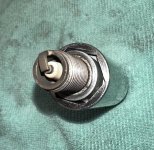
The road test was a fail. The bike was missing and losing power even under full throttle. When I pulled the plugs the left one is dark and looked wet.

LEFT PLUG
plugL.jpg
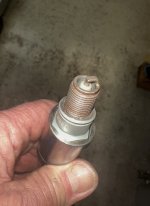
RIGHT PLUG
plugR.jpg
 
I'm sure you already have suspects in mind, but I imagine spark on the left (cap/coil/points connections) and the float/needle would be on the list.

Did you go through the carbs recently? And are you able to get non-ethanol fuel thereabouts?
 
I'm sure you already have suspects in mind, but I imagine spark on the left (cap/coil/points connections) and the float/needle would be on the list.

Did you go through the carbs recently? And are you able to get non-ethanol fuel thereabouts?
I was going to pull the carbs first, but I like your suggestion of going through the ignition circuit. If it is ignition related it will save me the work of pulling the exhaust and carbs.

The compression on the left is 170 which is a bit higher than the right at 160-165, but when I put my hand over the left exhaust outlet it feels less forceful than the right.
 
If I block the LEFT muffler outlet the engine barely reacts and the puffs are not forceful at all. If I block the RIGHT muffler outlet it bogs down and stops the engine after a few seconds.

If I pull the LEFT sparkplug cap the engine idle slows but in a minor way. If I pull the RIGHT cap it dies immediately.

I wonder if the left muffler could be plugged. I will check that out tomorrow.
 
Never fun with the high pipes, but sometimes it cannot be avoided.

I don't think you ever said explicitly, but I guess this means you had strong spark on the left?
I should have taken all the steps to eliminate the weak left spark possibility before pulling the exhaust, BUT I fell hard into expectation bias that there was going to be a mouse house in the muffler.

Now that the exhaust is off the bike it seems most prudent to go over the carbs with great care, especially the left.
 
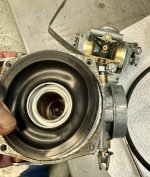
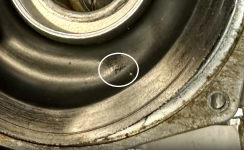
The diaphragm looks to be in good shape — it was just not seated properly when the carb top was secured? Hopefully this makes a big difference.
 
The diaphragm looks to be in good shape — it was just not seated properly when the carb top was secured? Hopefully this makes a big difference.
Right, not seated in the groove all around. The effect on carb performance could not be good. Air leaking in that area, and as a result the main needle would not be rising correctly are what I assume would happen.
 
Right, not seated in the groove all around. The effect on carb performance could not be good. Air leaking in that area, and as a result the main needle would not be rising correctly are what I assume would happen.
In hindsight, that is another check that might've proven fruitful here, namely, to remove the air boxes and see what the vacuum pistons are doing on each side. I guess that's still a pain because of the high pipes.

Better would be to manually open the throttle on each carb independently to see if the motor picks up or not. My guess is it would be sluggish on the left side. This is one reason I dislike the linked carbs on the CB360 and most of the fours.

Good that you found it and better if all is well after it's corrected. Does it seem like it will sit in there well or is it going to be tricky getting it to stay seated while you button up the carb top?
 
Right, not seated in the groove all around. The effect on carb performance could not be good. Air leaking in that area, and as a result the main needle would not be rising correctly are what I assume would happen.
When I first saw it, this is what stood out to me but I suppose it just could be the how the picture displays it.

1773576960414.png
 
Since the diaphragm spent time in a distorted shape it was quite difficult to keep it in the groove. After many failed attempts I put a small amount of rubber cement in the groove to help keep it in place and that was successful.

After leaving it assembled overnight I removed the cover to make sure all was well. You can see the slightly distorted area of the diaphragm were it spent time dislocated.

I don't believe the distortion will cause any performance issues.

carb1.jpg
 
Last edited:
That seems like a good solution with a small amount of rubber cement. I wonder if a little heat might've helped the diaphragm to forget it's distorted shape, but onward and upward. I hope it'll get warm up there later this week for a test ride, like it will here. Heading into a cold couple of days in the Midwest.
 
Although I am feeling a bit sheepish that I could have found this just by popping off the left carb cover, I am also feeling psyched that this thing just might run like it should - finally!

Some valuable lessons learned were acquired which makes all this fooling around with bikes worthwhile. If I had the right thinking cap on I would have questioned the last parts I installed (carb diagphragms) FIRST in my quest to cure the plug fouling. It seems very elementary in retrospect that my plug fouling problem switched sides after. I fixed one side and created a problem on the other. HA.

One of my favorite Robert Pirsig quotes which has been on the wall in my shop for many years. It is always a good idea to do your best to keep this in mind while wrenching.

pirsig.jpg
 
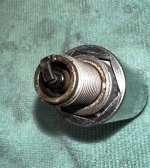
It is too lousy outside for the critical road test but the static run was very encouraging! The engine revs freer and after a few static runs I pulled the left plug. Before after static running it would darken quite a bit.

Here is a short run up video.

sparkplug.jpg
 
Back
Top Bottom