My CB350K4 and its problems

bladen

Member
Joined
Nov 29, 2025
Total Posts
47
Total likes
20
Location
Northern California
Hi all! This is a thread dedicated to my new to me CB350K4. I am not mechanically trained or experienced - but my dad is and I grew up helping him wrench on cars - so my knowledge is limited, and my budget is also quite limited. But, I have done much research and studying the FSM and feel I can do anything on this bike adequately given enough research and willpower.

The bike is cosmetically pristine, however there are some minor issues. Bike started first kick and revved cleanly when I bought it but died consistently at idle. PO did not have airboxes but still rode it around fine for a few miles. I took it home and wanted to hear her run but starting required covering carburetor intakes with a towel, but after starting it idled fine but adding throttle meant it’d reach 2.2k rpm and then die quietly.

So, airboxes were purchased and attached, bike started after a few kicks and died at 2.2k rpm, concluded that the carburetors need to be cleaned. I had never done this and just followed some basic videos on this - removed and disassembled carburetors and soaked jets and emulsion tubes (one of which was completely clogged) in carb cleaner for about 45 minutes. noticed left side diaphragm has some small holes near lip. The holes are minor and seem to not drastically cause issues but replacements were ordered (4into1) and are being shipped. Set float height to 23mm when resting (will re set to 26mm following FSM soon, followed misinformation from those guys in Houston). Shot compressed air through the jets and emulsion tubes, and reassembled the carbs with new orings.

Carbs reattached, realized I did not clean the internal passages of the carb nor did I clean the pilot jet. Alas, determined to get it running well enough to ride it for the first time I tried to start her up after adjusting the throttle cable slack and pilot screw to factory spec.

Bike starts, idles a bit rough and low so I adjust the idle butterfly screws. then it idles around 1.2k and revs cleanly through the entire range. Satisfied, I take it for its first drive (with airboxes attached) and it drives nicely and reaches speeds smoothly with power through the entire range! I had a great time until it died at a stop sign a mile away and wouldn’t start unless choked. I get it running enough to get back home and as soon as it reaches idle it quietly dies. Will start briefly with choke but then eventually die without throttle. Turns out, battery has died.

Concluded that the regulator is likely bad, causing weak spark at idle speeds and dying at low rpm. I also believe the idle circuit is clogged and is deserving of a thorough cleaning. Currently the battery is on a trickle charger and replacement parts are on order for the diaphragms. The graphite gasket on the right side muffler to header connection is also missing, causing and exhaust leak at the muffler - the gasket I ordered did not fit - so I’ll be expanding the right side muffler a tiny bit to get it to fit properly and ensure lack of exhaust leak (if the new gasket coming does also not fit).

When I get home today I will reset idle screws to factory spec and see if it starts up with a fully charged battery. Next week when my parts and tools arrive i’ll be doing a valve clearance check and adjustment, go through the points gap and timing adjustments per the FSM, replace spark plugs, replace regulator, replace the diaphragms and fully clean the carbs. Any suggestions as to what I should cover as I get the bike up and running would be appreciated and I will keep this thread updated with new developments.

Thanks,
Bladen
 
Two initial thoughts:
  • How is the tank? If it's not clean, the carbs can get clogged up quickly. I recommend pure gas also, without ethanol, if you can get it.
  • Have you verified that the charging system works? If you can check the voltage while it's running and see numbers in the thirteens when revving it up a bit, you're probably okay. If not, you'll need to diagnose.
 
Last edited:
Nice update and sounds like you're doing a fine job working out the bugs.

Only few things to add

Check the oil religiously (for overall oil level and viscosity in case your fuel valve/petcock is leaking), until you get familiar w your bikes oil consumption and have confidence your fuel valve isn't leaking.

Never leave the petcock on when parked, I usually shut it off a couple blocks before I park it

Don't let the bike idle on the side stand if at all possible

Didn't see it mentioned but worth checking the oil slinger before you put a whole lot of miles on it.

Check your chain tension has appropriate amount of slack and keep it lubed as needed. I've seen a lot of owners over tighten the chain.

Enjoy the bike!

Edit, sorry forgot to mention, the header muffler leak, if expanding doesn't work or is too much effort, maybe a thin soda can shim or sheet metal shim will help seal it up.
 
Two initial thoughts:
  • How is the tank? If it's not clean, the carbs can get clogged up quickly. I recommend pure gas also, without ethanol, if you can get it.
  • Have you verified that the charging system works? If you can check the voltage while it's running and see numbers in the thirteens when revving it up a bit, you're probably okay. If not, you'll need to diagnose.
The tank is clean, no visible rust. Gas was old when I bought it so I switched it for some fresh 91 before anything. I’ll hunt down non ethanol gas nearby for future running.

The charging system doesn’t appear to work judging by the battery dying after my trip, but I haven’t properly tested it as the bike does not start at the moment. I charged the battery today with a battery tender and it is healthy and full, starter runs strong but the bike did not fire up! I’m looking at replacing the regulator anyways cause it’s the original one and PO stated it would die if not for the battery tender.

Thanks for your reply!
 
I’m looking at replacing the regulator anyways cause it’s the original one and PO stated it would die if not for the battery tender.
Rather than replace the regulator, have a look at the rectifier/regulator from Sparck Moto. It takes the place of both of the original units and is a good upgrade if you currently have OEM parts.

Did the previous owner say that they had narrowed it down to the regulator? Once you have a new rec/reg and can start the bike, you should diagnose. We can help with that.

Add on: Have you looked at the plugs after the bike died and was hard to start? I'm wondering if they are fouled in one way or another. Watch out for the possibility of resistor plugs combined with resistor plug caps. Check to see what you've got.
 
Last edited:
Nice update and sounds like you're doing a fine job working out the bugs.

Only few things to add

Check the oil religiously (for overall oil level and viscosity in case your fuel valve/petcock is leaking), until you get familiar w your bikes oil consumption and have confidence your fuel valve isn't leaking.

Never leave the petcock on when parked, I usually shut it off a couple blocks before I park it

Don't let the bike idle on the side stand if at all possible

Didn't see it mentioned but worth checking the oil slinger before you put a whole lot of miles on it.

Check your chain tension has appropriate amount of slack and keep it lubed as needed. I've seen a lot of owners over tighten the chain.

Enjoy the bike!

Edit, sorry forgot to mention, the header muffler leak, if expanding doesn't work or is too much effort, maybe a thin soda can shim or sheet metal shim will help seal it up.
Thank you for the advice, I appreciate it. I was thinking of improvising some sort of aluminum gasket!
 
Rather than replace the regulator, have a look at the rectifier/regulator from Sparck Moto. It takes the place of both of the original units and is a good upgrade if you currently have OEM parts.

Did the previous owner say that they had narrowed it down to the regulator? Once you have a new rec/reg and can start the bike, you should diagnose. We can help with that.

Add on: Have you looked at the plugs after the bike died and was hard to start? I'm wondering if they are fouled in one way or another. Watch out for the possibility of resistor plugs combined with resistor plug caps. Check to see what you've got.
Yes! That was the part I had in mind to replace the r/r. The previous owner bought it and barely touched it as he had lots of bikes and bought it because it was pristine and did no maintenance to it - in fact he never even changed the oil or gas! I did look at the spark plugs before and they are very dark and didn’t look healthy, I have new ones ready to go in - I will recheck them before as I know how useful the can be for diagnostics. Thanks for your reply!
 
She lives! I took apart the carbs this morning and cleaned the pilot jets, both sides were clogged - who could’ve guessed! Did a spray out of all the parts and internal passages with compressed air and carb cleaner, set float heights to 26mm (they were actually set already), and reassembled. Bike didn’t start, checked drain plugs in bowls - only right side had fuel in the bowl. Check gas lines from petcock, only right side has fuel flow when on, both sides have fuel when on reserve - so i put it on reserve and she started right up! Idled a bit high so I adjusted the screws and brought it down to 1.2k - sounded pretty good!

IMG_4645.jpeg

However, as soon as I blip the throttle even a little bit the rpm’s start to run away and it will just rev and rev until i hit the kill switch. I checked the throttle cables, they reset nicely and are synchronized, I attached the air filters which didn’t affect it at all, I sprayed carb cleaner at the boot of the intake and the insulator with no change to idle, I adjusted the idle mixture screw it had no effect. I verified slides drop with instantly throttle and they do. So, something is happening with air obviously, there must be a leak somewhere to cause this runaway lean condition. Any thoughts?
 
Did you go through the whole tune-up? Check the advancer for loose/sloppy return springs on the weights, adjust cam chain and valves, set points, timing and check advancer for p[roper operation with strobe timing light. Loose advancer springs allow the timing to remain slightly advanced which causes slow return to idle. Or, an air leak somewhere. Did you have the throttle plates out of the carbs during cleaning? If so, you might have put them in backwards so the beveled edge is facing the wrong way.
 
Also, Keep the Revs up. CB350 and CB360 don't charge at idle. They generally don't get charging till about 5000 RPM. These engines are happy revving all day. Minimize idling. I worked with Matt on the Sparck Moto Regualtor/Rectifier. It is what I have on my CB360 (Same Charging system as CB350). It has lower internal resistance so you get charging at a little lower RPM. But still, best oil pressure and flow, power, and charging is 5000 RPM and higher. Your motorcycle will thank you.
 
Did you go through the whole tune-up? Check the advancer for loose/sloppy return springs on the weights, adjust cam chain and valves, set points, timing and check advancer for p[roper operation with strobe timing light. Loose advancer springs allow the timing to remain slightly advanced which causes slow return to idle. Or, an air leak somewhere. Did you have the throttle plates out of the carbs during cleaning? If so, you might have put them in backwards so the beveled edge is facing the wrong way.
Thank you for your reply! No, I have not done the full tune up yet, but it did run normally before I got into the carbs. I did not take out throttle plates so they should be alright. It actually doesn’t return to idle at all, it only rises after blipping throttle, like a runaway engine. A full tune up is necessary of course, but it didn’t progressively happen, and this condition was only present after I cleaned the carbs. Waiting on some tools for a full tune up that come next week!

Here’s a video, keep in mind I barely hit the throttle for less than a half second, and used the kill switch to lower the rpm’s so that it didn’t get out of hand:

 
Keep in mind that since you cleaned the carbs better this time through, things will react differently than they did previously. You might have turned the idle speed screws in more to compensate for the incorrect idle mixture previously with clogged jets, so you'll have to go through the idle adjustments again. Since these older bikes have all completely separate components for fuel and spark, there is nothing to help correlate any changes between timing, spark advance and carburetion like a modern computer-controlled engine would have, so they all need to be adjusted individually so they properly interact with each other. My guess at this point would be advancer and timing, and you don't need any really special tools to check it - a test light, a set of feeler gauges, a #2 and #3 JIS screwdriver and wrenches/sockets to check the spark advance unit and static timing, and until you do that then you're still only guessing.
 
Your bike is idling pretty fast, you want it closer to 1,200 rpm at idle

Curious how you set the idle speed and if you need to better sync your carbs

Does it do this when cold or only when warm?

When cold and idling, do both headers warm up the same after a few seconds of idling, or is one colder than the other? Idling only, not hi revs
 
Alright! I found the culprit. I set the static timing on the bike today and it idled a lot smoother, and it was behaving nicely with revs too, was almost ready to take it out for a spin and I noticed when giving full throttle it just bogs and the right cylinder doesn’t fire, probably leaning out. So, I learned today that another source of air leaks could be the throttle plates, and sure enough when I sprayed carb cleaner around the throttle body (right by the idle butterfly adjustment screw) the idle dropped.

So I found the intake leak, but how do I fix the throttle plate leaking?

Video:

Pictures of throttle plate L and R:
IMG_4656.jpegIMG_4658.jpeg
 
Last edited:
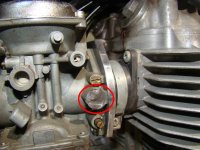
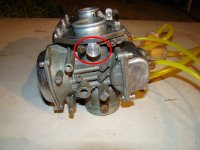
One side is blank, there should be a small round plate blocking any air. If missing, I used some silver RTV, the PJ made machined aluminum covers that I replaced it with. Also, the linkage side of the throttle shaft has a donut shaped piece of felt to seal. If the sela is there and in good shape, a little oil will help. I found some felt in my Wifes sewing basket, and made a denser donut then what was there. Oiled it and the seal is great.

Right Carburetor Shaft Seal Circled.jpg

Right Carb throttle shaft cover new Circled.jpg
 
One side is blank, there should be a small round plate blocking any air. If missing, I used some silver RTV, the PJ made machined aluminum covers that I replaced it with. Also, the linkage side of the throttle shaft has a donut shaped piece of felt to seal. If the sela is there and in good shape, a little oil will help. I found some felt in my Wifes sewing basket, and made a denser donut then what was there. Oiled it and the seal is great.

View attachment 53227

View attachment 53229
The 350’s 722A carburetor does not have this, the throttle shaft goes through each and out the other side and is sealed by felt as far as I can tell. I used 3in1 oil and some white lithium grease to seal it up and now it is a lot better - but still lean. Idle screw has to be turned way in to even start the bike. I’m beginning to suspect that the tank has sediment in it that keeps reclogging my idle circuit (main petcock is clogged and i’ve been running on reserve). Bike runs great if started with throttle, but it will not idle without the butterfly opened too far.
 
Two things which may help.
1. the felt "seals" are just to keep dust and dirt out. they fit quite loosely. They do not seal anything. I actually replaced mine with some soft rubber O rings of appropriate size with some white grease.
2. Closely inspect your Idle jet tubes. Spray on carb cleaner and even ultra sonic may not clear them. I had to clean mine ( both carbs ) with E guitar wire.
3. as a bonus... Clean the tank!!!
 
The 350’s 722A carburetor does not have this, the throttle shaft goes through each and out the other side and is sealed by felt as far as I can tell. I used 3in1 oil and some white lithium grease to seal it up and now it is a lot better - but still lean. Idle screw has to be turned way in to even start the bike. I’m beginning to suspect that the tank has sediment in it that keeps reclogging my idle circuit (main petcock is clogged and i’ve been running on reserve). Bike runs great if started with throttle, but it will not idle without the butterfly opened too far.
Either way, fresh felt or not too tight fitting oring will help. Felt need to be oiled. When people dip their carbs in carb cleaner, it removes the oil from the felt and then it dries out. Also dries out with age. 50 year is a long time.
 
Either way, fresh felt or not too tight fitting oring will help. Felt need to be oiled. When people dip their carbs in carb cleaner, it removes the oil from the felt and then it dries out. Also dries out with age. 50 year is a long time.
I put a bit of oil and lithium grease into the shaft and it no longer dies given throttle - but i am back to it just running very lean.
 
Here’s where I am at. The bike will start and rev given throttle but refuses to idle unless the butterfly is opened too high for it to run correctly (will not start about a half turn in, needs to be almost 3 full turns in to idle at 1.2k at factory pilot screw setting).

Today I have
- Cleaned the carburetors idle jet and circuit
- Cleaned petcock
- Set static timing
- Greased throttle shaft felt
- Checked for air leaks

The intake manifolds look new, but I will replace them tonight - just in case.
 
Just to check, in your picture of the general jet area with fuel bowl removed above, the idle jet it the top one in the triangular cluster to the left in the pic.
the jet needs to be removed and held up to a strong light. It is a very small diameter hole and if you can see a tiny dot of light through it then it is not blocked.
I had idle problems and dead right cylinder at idle and no adjustment worked, was until I removed the idle jet again and checked with a light I discovered the issue.
I posted my findings in the CB350 section.
 
When you start and idle are both headers temperature approx the same or one colder than the other?
 
Just to check, in your picture of the general jet area with fuel bowl removed above, the idle jet it the top one in the triangular cluster to the left in the pic.
the jet needs to be removed and held up to a strong light. It is a very small diameter hole and if you can see a tiny dot of light through it then it is not blocked.
I had idle problems and dead right cylinder at idle and no adjustment worked, was until I removed the idle jet again and checked with a light I discovered the issue.
I posted my findings in the CB350 section.
Yeah every time I had an idle issue I tore apart the carbs and it was clogged. That’s why today I cleaned the petcock out (it was nasty), and I cleaned the idle jets again.

I also replaced the intake manifolds, and in the process I reset the idle adjustments hoping for an improvement - and it was sounding about the same after starting it up, so I played with idle settings again, this time I screwed the pilot screw all the way in on both carbs and set the idle adjustment screw to a 1 turn out. The bike then was idling about 1.2k and revving nicely, I took it for a test ride and it feels great! The spark plugs I removed were dark and sooty. The bike seems to be running rich - I think i’ll adjust the float levels and see if I can get the bike idling at factory spec for the pilot screw.
 
That sounds like progress. (y)

Did you get the engine speed up much on the test ride? Hopefully through the mixture screw and/or a small float height increase, you will see cleaner plugs.
 
That sounds like progress. (y)

Did you get the engine speed up much on the test ride? Hopefully through the mixture screw and/or a small float height increase, you will see cleaner plugs.
Yes, I was definitely riding it a bit spirited for a test ride, got engine speed up hoping for a better color on the plugs. Unbelievably fun stuff, this is my first motorcycle so I’m very excited to have it running at all.

I think adjusting the float should help, it’s set at 26mm (checked while holding carb at an angle). I’ll adjust the height next time I get to work on it.
 
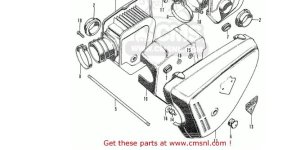
Bad news, on my drive the airbox connecting rod fell out! I will retrace my path but I fear it is gone for good. Anyone know how I could get a replacement?
 
Bad news, on my drive the airbox connecting rod fell out! I will retrace my path but I fear it is gone for good. Anyone know how I could get a replacement?
Cmsnl has one is stock currently if its part #5 your speaking of. airbox.JPG
 
What a day. I rode the bike 105 miles around my little town and up into the hills. Wonderful, absolutely in love with the bike. Gonna get it fully dialed in by spring but it’s running really solid already.
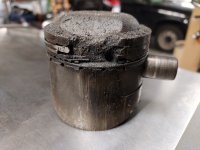
Good to hear it's running well and you can fully enjoy it now. At this point, since you're new to these vintage air-cooled engines, I think it's important to point out that on days when you get in a lot of riding miles like yesterday, you should remember to check the oil at your fuel stop. These air-cooled engines burn a little bit of oil as a way of life and a spirited day of riding can lower the oil level enough that a long run at speed on the road could lead to disaster without you realizing it. We've seen more than a few engine meltdowns after a day of riding and a long run at 70 mph, and it can often result in something like this:

450 burned piston.jpg

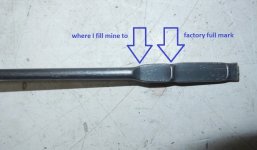
You can run the oil level slightly above the full mark to help with that. I'm not as familiar with the 350 on a daily basis anymore as it's been decades since I rode one regularly, but I run my 450 oil level at the top of the pressed area of the dipstick and I'm sure you could run yours about a half pint over without any issues.

dipstick full level.jpg
 
Good to hear it's running well and you can fully enjoy it now. At this point, since you're new to these vintage air-cooled engines, I think it's important to point out that on days when you get in a lot of riding miles like yesterday, you should remember to check the oil at your fuel stop. These air-cooled engines burn a little bit of oil as a way of life and a spirited day of riding can lower the oil level enough that a long run at speed on the road could lead to disaster without you realizing it. We've seen more than a few engine meltdowns after a day of riding and a long run at 70 mph, and it can often result in something like this:

View attachment 53266

You can run the oil level slightly above the full mark to help with that. I'm not as familiar with the 350 on a daily basis anymore as it's been decades since I rode one regularly, but I run my 450 oil level at the top of the pressed area of the dipstick and I'm sure you could run yours about a half pint over without any issues.

View attachment 53267
Thanks a lot for the information. I checked the oil before I took it out today and it was a bit low so I topped it off. I also noticed it is leaking a bit from the head gasket. is this something that is pretty regular after 200 miles of riding or something I need to address immediately?

View attachment IMG_4697.jpegView attachment IMG_4698.jpeg
View attachment IMG_4699.jpeg
The bike does not create a puddle after sitting, seems to only happen when the oil is warm and thinner.
 
Thanks a lot for the information. I checked the oil before I took it out today and it was a bit low so I topped it off. I also noticed it is leaking a bit from the head gasket. is this something that is pretty regular after 200 miles of riding or something I need to address immediately?
Never going to be a problem that HAS to be repaired, no damage will come from it, just the mess Engine has to come out of the frame to do the top end and there will be maintenance items in the top end that will likely need to be replaced when you do (cam chain tensioner rollers, etc), so plan it for a winter when you won't be riding the bike.
 
Never going to be a problem that HAS to be repaired, no damage will come from it, just the mess. Engine has to come out of the frame to do the top end and there will be maintenance items in the top end that will likely need to be replaced when you do (cam chain tensioner rollers, etc), so plan it for a winter when you won't be riding the bike.
Sounds good. Thanks a lot for all of your help that you do for this community. Appreciate it!
 
Alright a little update; I’ve put about 500 miles on the bike at this point and a winter storm just hit so I’m doing some more work on it. Since I got it running I have changed the oil, got new tires, replaced right side graphite exhaust gasket, replaced intake boots, and lubricated the chain. Today the rain started here in Humboldt so I’ve taken the gas tank and carburetors off to access the slightly torn diaphragm and replace it. A screw from the diaphragm cover has vibrated out and been lost to the world.
IMG_4769.jpeg
IMG_4771.jpeg
Here you can see the little tear - it didn’t cause issues but I figured it was time to replace it. I drew a little mark on the slide to note the spot of the tab and then pryed the plastic piece down a tiny bit with a feeler gauge before pulling the whole diaphragm off. I then slipped the new one on and tucked it into the plastic with my finger nail and then with the feeler gauge. Was very easy and the replacements from 4into1 fit nicely.
View attachment IMG_4777.jpeg
Reinstalled the parts and looked at my floats to see if they are actually set to 26mm and they are, so I figured I’d let them be and assume my idle issue (pilot screw must be all the way turned in to idle correctly) must be due to some other culprit.
I took a look into my intake and the gross brown sludge and goo that concerned me when I picked up the bike has gone away which tells me I’m doing something right.
Before:
IMG_4469.jpeg
After:
IMG_4780.jpeg
I’m picking up some better feeler gauges this afternoon so I may do the valve tappet clearance adjustment tomorrow along with resetting timing, adjusting a point that appears worn, and adjusting cam chain tension per the order and instruction of the FSM.
 

Attachments

  • IMG_4777.jpeg
    3.1 MB · Views: 4
The new issue with the bike has a flat spot in the powerband around 6.5-7k. Feels like a clogged carburetor again, unsure how that could’ve happened - maybe it’s something else? I can accelerate smoothly through it in neutral but in third gear it’s really noticeably bogging at 6.5k before picking up again at 7k. Otherwise the bikes running better than ever, guess I’ll be cleaning the carbs again!
 
Google search for stainless carburetor screws. I replaced all those philips (Excuse me, JIS Head) head screws with hex heads. Looks nicer, doesn't strip out. Something like this: StainlessCycle.com
 
Looks like the bike might be done..

I did valve clearance, cam chain tension, and timing, plus an oil change a few days ago. bike was running better than ever! Finally the bike was feeling great up above 7k rpm and pulled stronger than ever. Today I got on and rode about 10 miles, crested a hill and started to hear pinging or spark rattle. it was a quiet but noticeable rattle sound so I pulled in the clutch to pull over and the engine just stalled. On the shoulder I looked down and saw the bike was spewing oil from the crank case, flowing out of the case cover and the sprocket / clutch cover. No visible holes, no rod knock. I suspect the piston rings somehow got damaged. Oil was in the bike when I left and was not after it broke down.

Heartbroken, it’s been a very sad day. Going to tear it apart in a few days and see what happened.

View attachment IMG_5266.jpeg
 
Looks like the bike might be done..

I did valve clearance, cam chain tension, and timing, plus an oil change a few days ago. bike was running better than ever! Finally the bike was feeling great up above 7k rpm and pulled stronger than ever. Today I got on and rode about 10 miles, crested a hill and started to hear pinging or spark rattle. it was a quiet but noticeable rattle sound so I pulled in the clutch to pull over and the engine just stalled. On the shoulder I looked down and saw the bike was spewing oil from the crank case, flowing out of the case cover and the sprocket / clutch cover. No visible holes, no rod knock. I suspect the piston rings somehow got damaged. Oil was in the bike when I left and was not after it broke down.

Heartbroken, it’s been a very sad day. Going to tear it apart in a few days and see what happened.
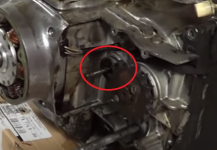
Sorry to hear of this, most likely the clutch rod seal blew out of the crankcase. Depending on how far you rode it afterward, pistons and bottom end would survive this better than the cam bearing covers generally do, hopefully you'll get lucky after you replace the clutch rod seal and refill it with oil. This is what happened

1770239059768.png
 
Sorry to hear of this, most likely the clutch rod seal blew out of the crankcase. Depending on how far you rode it afterward, pistons and bottom end would survive this better than the cam bearing covers generally do, hopefully you'll get lucky after you replace the clutch rod seal and refill it with oil. This is what happened

View attachment 54809
Well would you look at that, that would make a lot of sense. I have not been able to remove this cover yet because of a stripped screw. I’ll be investigating everything come tuesday and will keep the thread updated. So far it seems the bike is okayish, it makes compression still at the very least.
 
Well would you look at that, that would make a lot of sense.
It doesn't happen all that often, but the 350 has been known to do it now and then as well as the 450 occasionally. I made a retainer to cover the seal on my 450 to prevent it from happening, VHT member @Boomer343 might have one for sale ready to go here:

So far it seems the bike is okayish, it makes compression still at the very least.
The larger concern will be the integrity of the cam bearing covers, particularly the left side where the points plate and advancer are located. Excess wear on that bushing surface can allow erratic timing and could cause the seal behind the advancer to leak, among other things if worse.
 
Well would you look at that, that would make a lot of sense. I have not been able to remove this cover yet because of a stripped screw. I’ll be investigating everything come tuesday and will keep the thread updated. So far it seems the bike is okayish, it makes compression still at the very least.
If you’ve got compression that’s a huge win. If it is indeed the clutch seal, that’s not the lowest part of the sump so there’s still some oil left in there.

With a stripped screw, the easiet solution is a LH extractor bit. Harbor Freight sells a cheap set that has managed dozens of those for me without breaking (yet).

The seal can also be replaced without pulling the engine, just make sure you don’t lose the steel ball in the clutch lifter when pulling that cover off (#21)

IMG_2237.jpeg
 
View attachment IMG_5299.jpeg
Compression test at cold yielded 150 psi at both cylinders using kickstarter. Hopeful that is good enough. Leak down test was inconclusive but not horrible. Seal is completely popped out and will be cleaned and replaced with a 4into1 seal.
 
View attachment 54924
Compression test at cold yielded 150 psi at both cylinders using kickstarter. Hopeful that is good enough. Leak down test was inconclusive but not horrible. Seal is completely popped out and will be cleaned and replaced with a 4into1 seal.
Put a little Hondabond around the outside of the seal before pushing it into the crankcase to help keep that from happening again, though a seal retainer like I showed you above is also a good idea.

Before starting it, I'd still suggest removing the alternator rotor cover and the points cover, turn the engine over with a socket or wrench and watch the advancer on the camshaft. If it moves side to side at all, you probably suffered some cam bearing cover damage from loss of oil flow.
 
Put a little Hondabond around the outside of the seal before pushing it into the crankcase to help keep that from happening again, though a seal retainer like I showed you above is also a good idea.

Before starting it, I'd still suggest removing the alternator rotor cover and the points cover, turn the engine over with a socket or wrench and watch the advancer on the camshaft. If it moves side to side at all, you probably suffered some cam bearing cover damage from loss of oil flow.
The advancer moves smoothly as it should and has no play or wobble in it if that’s what you mean. We got the bike started, which was actually pretty easy just two kicks, so that’s nice. But what isn’t nice is a new clacking sound coming from what I believe to be the advancer. it seems to throttle nicely and start easy though. Soundest loudest at very small amounts of throttle and goes away with more higher rpm. Otherwise runs and sounds about the same.

 
The dimple in the advancer bolt head seems to be running true as it idles, the noise is very possibly a dished rocker arm from lack of oil, possibly some cam lobe surface wear/galling too. The oil pump feeds several orifices right out of the oil filter, one of which goes to the transmission and the oil loss was from there when the seal blew out. But, that free oil loss also detracted from the flow going to the feeds for the top end and crankshaft. The crankshaft is all ball and roller/needle bearings so it can stand it more than the bushed-surface cam bearing covers where the steel camshaft rides on aluminum with oil flow to keep it from damage. So it's my guess the top end was a bit starved and it resulted in at least one dished rocker arm. This is from a DOHC 450 and is also pretty extreme, but it shows what happens to cam lobes and followers when oil flow is intermittent.

450 ruined follower.png
 
I should add that you should try adjusting the valves again to see if any have excess clearance. That will tell you if any excess wear happened, and hopefully you can adjust most of the noise out of it but it remains to be seen.
 
Back
Top Bottom