

Maraakate
Veteran Member
I'll just give you the incandescent man. Just pay the shipping cost. I have extras.


If you insist then sure, I just don’t like taking stuff from people is all. Hopefully shipping isn’t outrageous hahaI'll just give you the incandescent man. Just pay the shipping cost. I have extras.

It says DOT SAE on the glass, maybe it’ll be fine as is?I should be able to put it in one of those larger priority boxes for $20 but I'll double check.

You do realize you can PM him, right? You're well past 10 total posts.Go ahead and shoot me a PM if you can, I’ll chat with you about possibly buying yours.
My apologies, should’ve read up on thatYou do realize you can PM him, right? You're well past 10 total posts.
No need to apologize, but all you have to do is try to see if the option show up for you to use. Like this - if you can see the option, it means you can use it.My apologies, should’ve read up on that
Awesome, thank youNo need to apologize, but all you have to do is try to see if the option show up for you to use. Like this - if you can see the option, it means you can use it.
View attachment 51936
I thought turning the screw out (lefty loosey) introduced more air thus leaning it more? Maybe I’m wrong on this.Those sync gauges are not known for being very accurate. You need a real one like the Motion Pro or the Morgan Carbtune.
Popping on decel is a lean mixture. Rotate the mixture screw on the offending cylinder OUT about 1/2 a turn or so and see if things improve.
I posted a video here in this thread previously about setting the idle.
When the mixture screw is on the engine side of the carb it's generally a fuel screw, on the air cleaner side it's generally an air screw.I thought turning the screw out (lefty loosey) introduced more air thus leaning it more? Maybe I’m wrong on this.

These slip-ons seem to work very well. I haven't had to do any further carb work, other than following the advice of LDR and installing larger jets. The bike performs very well through the rpm range and is very comfortable at highway speeds. This bike impresses me every time I ride it. Yes, I'd rather have a DOHC 450, but that's another story...............Do the mufflers also aid in back pressure or is the power chamber sufficient for the carbs? I’d rather not have to do more carb work so I’m curious what room I have to work with.
Sorry, I should have added..............These slip-ons seem to work very well. I haven't had to do any further carb work, other than following the advice of LDR and installing larger jets. The bike performs very well through the rpm range and is very comfortable at highway speeds. This bike impresses me every time I ride it. Yes, I'd rather have a DOHC 450, but that's another story...............
I was thinking about this the other day, the slip-ons came off of an 883 Harley, which has 2 cylinders but runs at half the RPM, if not less. That would mean to me that there is a similar volume of exhaust going through the pipes, which may be why they work so well. So my bike is half the size, roughly, but puts out at least twice the exhaust do to the RPM difference. Only guessing though...............
bob
I’m a Mechanical Engineering student here at the University of Arkansas and we actually discuss problems like you mention (only more simplified) in fluids. Theres a lot of factors at play there but from my understanding it would mostly pertain to mass flow rate of the air at the cross section of the most restrictive point on the muffler. “Volume” is more so just a measure of 3 dimensional space, but since air is compressible its mass at any given volume can change. The compressed air leaving the cylinder chamber into the muffler may be similar on each bike. I’d definitely be curious as to why the same way you are and I think “half the size double the rpm” may have something to do with it. It’s all neat but very complex stuff.These slip-ons seem to work very well. I haven't had to do any further carb work, other than following the advice of LDR and installing larger jets. The bike performs very well through the rpm range and is very comfortable at highway speeds. This bike impresses me every time I ride it. Yes, I'd rather have a DOHC 450, but that's another story...............
I was thinking about this the other day, the slip-ons came off of an 883 Harley, which has 2 cylinders but runs at half the RPM, if not less. That would mean to me that there is a similar volume of exhaust going through the pipes, which may be why they work so well. So my bike is half the size, roughly, but puts out at least twice the exhaust do to the RPM difference. Only guessing though...............
bob
Hey, thanks for you much better explanation!I’m a Mechanical Engineering student here at the University of Arkansas and we actually discuss problems like you mention (only more simplified) in fluids. Theres a lot of factors at play there but from my understanding it would mostly pertain to mass flow rate of the air at the cross section of the most restrictive point on the muffler. “Volume” is more so just a measure of 3 dimensional space, but since air is compressible its mass at any given volume can change. The compressed air leaving the cylinder chamber into the muffler may be similar on each bike. I’d definitely be curious as to why the same way you are and I think “half the size double the rpm” may have something to do with it. It’s all neat but very complex stuff.
Sorry to nerd out, but this stuff gets me going haha. Similar concepts are used for airflow through rocket nozzles and afterburners.
You as well!Hey, thanks for you much better explanation!
have a great day!
bob
You should pick up "Scientific Design of Intake and Exhaust Systems" for some fun reading and research.I’m a Mechanical Engineering student here at the University of Arkansas and we actually discuss problems like you mention (only more simplified) in fluids. Theres a lot of factors at play there but from my understanding it would mostly pertain to mass flow rate of the air at the cross section of the most restrictive point on the muffler. “Volume” is more so just a measure of 3 dimensional space, but since air is compressible its mass at any given volume can change. The compressed air leaving the cylinder chamber into the muffler may be similar on each bike. I’d definitely be curious as to why the same way you are and I think “half the size double the rpm” may have something to do with it. It’s all neat but very complex stuff.
Sorry to nerd out, but this stuff gets me going haha. Similar concepts are used for airflow through rocket nozzles and afterburners.
I look into it, thanks!You should pick up "Scientific Design of Intake and Exhaust Systems" for some fun reading and research.
I failed to mention I’m running the stock jets that have been throughly cleaned.Ok fellas, this thing is giving me hell idle wise, I’m guessing that’s somewhat normal for these things. I’ve got the sync back to somewhat decent by ear (obv not perfect but it should be okay). Slow return to idle, I think I’m about 3 turns out now on the fuel mixture screws. It also will occasionally die on idle. I have the idle screw pretty far in to try to compensate for this. It also makes kinda an odd knock sound off throttle. I’m desperately trying not to blow this thing up hahah…
What would be the harm in permanently idling above the idle circuit (1,400-1,500) aside from gas millage? Tempted to do this.
Gotcha, I’m checking compression Thursday once my buddies tool comes in the mail, gonna check the spark plugs when I do. As long as my idle is fine and my plugs don’t indicate lean I should be okay then correct? I assume these things are a lot heartier / durable than I’m thinking.Correct mixture setting:
Engine fully hot after riding a couple miles. Parked on center stand.
Idle speed no more than 1300
Pick a carb and adjust the mixture for the highest rpm. Might have to readjust the idle speed, if so then readjust the mixture again.
Go to 2nd carb and repeat.
Ride 5 miles or so and recheck.
Ignore any decel popping from the exhaust. That could be from air cut valves not working right or exhaust leaks.
At any idle speed over 1300 the mixture screw adjustment is void.
The original jetting is on the lean side, I suggest to everyone to go up 1 size. Max is a 75. There's a sticky in the SOHC Fuel section that will tell you the original jetting by carb number.Gotcha, I’m checking compression Thursday once my buddies tool comes in the mail, gonna check the spark plugs when I do. As long as my idle is fine and my plugs don’t indicate lean I should be okay then correct? I assume these things are a lot heartier / durable than I’m thinking.
I’m gonna go grab some thin rubber matting or something and seeCould be the metal to metal contact.
A little over 2 hours to find it, others have taken days.I found it, it was the tin gas cap cover that was rattling at that rpm range haha

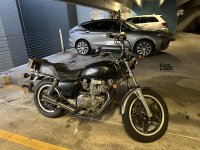
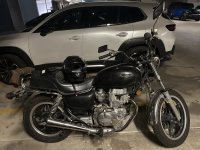
Honda typically overgeared their bikes to never actually reach redline in high gear, whether 5th or 6th which was always an "overdrive" of sorts on any bike that came with 6 speeds. My SOHC 750s all benefited from a 1 tooth drop on the front sprocket and would get a lot closer to redline in 5th afterward. With stock gearing on my first CBX, I put it on speedometer calibration rollers at the City garage where I worked during the late '70s and through the '80s, and the 9500 rpm redline with stock gearing represented 150 actual mph.5th gear is pretty funny tho, super long with virtually 0 torque.
Good to know, the gearing doesn’t bother me at all honestly. I’m not planning on interstating the bike much, only for short distances if I need to. It’s a lot of fun around town and some curves.Honda typically overgeared their bikes to never actually reach redline in high gear, whether 5th or 6th which was always an "overdrive" of sorts on any bike that came with 6 speeds. My SOHC 750s all benefited from a 1 tooth drop on the front sprocket and would get a lot closer to redline in 5th afterward. With stock gearing on my first CBX, I put it on speedometer calibration rollers at the City garage where I worked during the late '70s and through the '80s, and the 9500 rpm redline with stock gearing represented 150 actual mph.

Compression test with throttle held wide open?
Plug color should end up just a bit darker than the left plug, right side is definitely too lean.
Compression test with throttle held wide open?
Plug color should end up just a bit darker than the left plug, right side is definitely too lean.

Most likely a tune problem although increasing the mains 1 size will also helpAlso, is this a carb tuning issue or jet issue?
Sounds good, thank youMost likely a tune problem although increasing the mains 1 size will also help
No power in 5th tends to be a classic CDI issue on the manual bikes. There's no known good test that I know of besides replacing with a known good unit. Have you verified the advance is actually working with a timing light?
You buy a timing light, I recommend the Innova 3551 - https://www.amazon.com/INNOVA-3551-Inductive-Timing-Light/dp/B000EVYH72/ and remove the left cover. Attach the leads to the battery and the inductive clamp to one of the spark plug wires. Start the bike and the light should be flashing. If it isn't then change the direction of the clamp. Aim the light at the stator. It should be showing the F mark being static/non-moving with the mark on the crankcase. Now rev the engine to 4500-5300 RPM. It should move in between the two lines on the stator as this is the window for full advance. If it stays near the F mark or barely moves then the advancer coil or CDI is at fault.No I have not. I’m not even sure how to do that. The bike is going back to my dads shop Sunday for the winter, I’m gonna work on it middle of December - middle of January and hopefully have it all ready and waiting or spring.